Ch Ing Yu An Thomas Cleary
The 'monkey mind' concept, originating in Chinese Buddhism, describes a restless and uncontrolled state of thought.
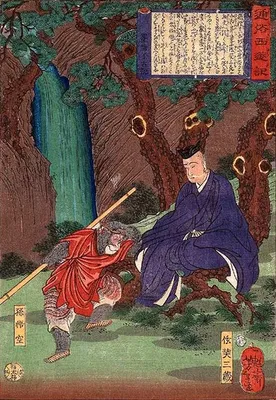
The term 'monkey mind,' or 'mind monkey,' originates from the Chinese term 'xinyuan' and is a Buddhist concept describing a restless, capricious, and uncontrolled state of thoughts. This metaphor is prevalent not only in various Buddhist traditions like Chan, Consciousness-only, Pure Land, and Shingon, but has also been incorporated into Taoism, Neo-Confucianism, and Chinese literature and theater. It is often paired with the 'idea horse' (yima) in idioms like 'xinyuanyima' (心猿意馬), signifying the interplay between a restless mind and wandering thoughts. The iconic Monkey King, Sun Wukong, from 'Journey to the West,' serves as a famous personification of this unsettled state.
The concept draws on the Chinese characters 'xin' (心) for heart/mind and 'yi' (意) for thought, which are linked to Sanskrit terms like 'citta' and 'manas' in Buddhist philosophy. The 'monkey' (yuan/en) and 'horse' (ma/ba) components represent the agile and uncontrolled nature of the mind and thoughts, respectively. In Chinese mythology and Daoist practices, monkeys and horses hold symbolic significance, with the 'monkey mind' and 'idea horse' being associated with breath meditation techniques aimed at controlling mental wandering. The metaphor's literary history traces back to early Chinese translations of Buddhist sutras and philosophical poems.
The 'Monkey Mind' Metaphor and its Origins
The 'monkey mind' (xinyuan) is a Buddhist concept that vividly portrays the human mind's tendency towards restlessness, capriciousness, and a lack of control over thoughts. This metaphor, originating in Chinese Buddhism, has found its way into various East Asian spiritual and cultural traditions, including Taoism and Neo-Confucianism, as well as poetry and theater. It is frequently paired with the 'idea horse' (yima) in idioms such as 'xinyuanyima' (心猿意馬), illustrating the inseparable connection between a restless mind and wandering thoughts. A prominent cultural embodiment of this concept is the character Sun Wukong, the Monkey King from the classic novel 'Journey to the West,' who exemplifies indecisiveness and a perpetually unsettled nature.
Linguistic and Cultural Symbolism
The 'mind-monkey' metaphor is linguistically grounded in the Chinese characters 'xin' (心), meaning heart or mind, and 'yuan' (猿), meaning monkey. These are often combined with 'yi' (意), meaning thought or intention, and 'ma' (馬), meaning horse, to form phrases like 'xinyuanyima.' In Buddhist philosophy, 'xin' and 'yi' correspond to Sanskrit terms like 'citta' and 'manas,' representing different aspects of consciousness and cognition. The 'monkey' symbolizes the agile, unpredictable, and easily distracted nature of the mind, while the 'horse' represents the swift and often unruly movement of thoughts and desires. This symbolic pairing is deeply embedded in East Asian cultural understanding of mental states.
Esoteric and Philosophical Applications
Within esoteric and philosophical traditions, the 'mind-monkey' and 'idea-horse' metaphor is utilized in practices aimed at mental discipline and spiritual cultivation. For instance, Daoist breath meditation techniques, like 'xinyuanyima,' involve synchronizing breath with mental focus to 'lock up the monkey heart and tie up the running horse of intellect.' This process aims to achieve a state of concentration and inner stillness by guiding the generative life force through a microcosmic orbit. The association of monkeys with longevity and the absorption of 'qi' in Chinese mythology, alongside the sacred status of horses in both Chinese and Japanese traditions, further enriches the symbolic depth of this metaphor in spiritual contexts.
Key Ideas
- Monkey Mind (Xinyuan): A Buddhist concept describing a restless, uncontrolled, and capricious state of thoughts.
- Idea Horse (Yima): Represents wandering thoughts and desires, often paired with the 'monkey mind' metaphor.
- Xinyuanyima (心猿意馬): A four-character idiom symbolizing the interconnectedness of a restless mind and wandering thoughts.
- Daoist Breath Meditation: Techniques using the 'monkey mind' and 'idea horse' metaphor for mental control and concentration.
Books by Ch Ing Yu An Thomas Cleary
0 free public domain books · Read online or download
