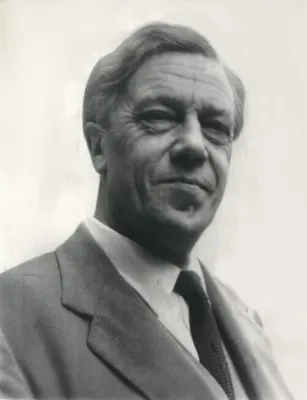
Cecil Day Lewis
Cecil Day-Lewis was an Anglo-Irish poet, Poet Laureate, and mystery novelist known as Nicholas Blake.
Cecil Day-Lewis (1904–1972) was an Anglo-Irish poet who achieved prominence as the Poet Laureate of the United Kingdom from 1968 until his death. Born in Ireland, he was educated in England and at Oxford, where he was associated with W. H. Auden. Day-Lewis also penned numerous mystery novels under the pseudonym Nicholas Blake, featuring the detective Nigel Strangeways, which provided him with a significant income. His early life was marked by the death of his mother at a young age and his upbringing by his father. He pursued a career in education before dedicating himself to writing. During World War II, he served in the Ministry of Information. His personal life involved complex relationships, including simultaneous affairs and marriages. He was the father of actor Daniel Day-Lewis and chef Tamasin Day-Lewis. Day-Lewis's literary output spanned poetry, essays, and translations, reflecting evolving stylistic and thematic concerns throughout his career. He also engaged with political ideas in his youth, briefly aligning with communist views before becoming disillusioned.
Poetic Career and Laureateship
Cecil Day-Lewis established himself as a significant voice in 20th-century poetry, initially influenced by figures like W. H. Auden. His early collections, such as 'Beechen Vigil and other Poems' (1925) and 'From Feathers to Iron' (1931), marked his emergence. Throughout his career, his style evolved, moving towards a more traditional lyricism, particularly evident in works like 'Word Over All' (1943). He held academic positions, lecturing on poetry at Cambridge and serving as Professor of Poetry at Oxford. His contributions were recognized with a CBE and culminated in his appointment as Poet Laureate of the United Kingdom in 1968, a role he held until his passing. Despite some critical assessments suggesting his poetry was 'run of the mill', his laureateship solidified his national standing.
The Persona of Nicholas Blake
To supplement his income from poetry, Day-Lewis adopted the pen name Nicholas Blake, under which he authored nineteen detective novels. His most famous creation within this genre was the amateur detective Nigel Strangeways, who, through his connections to Scotland Yard, became involved in various criminal investigations. These novels, beginning with 'A Question of Proof' (1935), provided a popular outlet for his narrative skills and allowed him to explore different thematic elements, sometimes drawing on his wartime experiences at the Ministry of Information. While many Blake novels featured Strangeways, some, like 'The Beast Must Die,' explored different characters and scenarios, demonstrating the versatility of his crime fiction writing.
Early Life and Political Evolution
Born in Ireland in 1904, Cecil Day-Lewis's early life was shaped by the loss of his mother at the age of two and his subsequent upbringing in London by his father, a Church of Ireland rector. His family had English roots, with his father combining paternal and adoptive surnames. He received his education at Sherborne School and Wadham College, Oxford. In his youth, influenced by the economic hardships of the Great Depression, Day-Lewis embraced communist ideals, joining the Communist Party of Great Britain from 1935 to 1938 and editing 'The Mind in Chains' (1937). However, the Stalinist purges and repression led to his disillusionment with communism, a renunciation he detailed in his autobiography, 'The Buried Day' (1960). This shift was later reflected in his fiction, such as 'The Sad Variety' (1964), which critiqued doctrinaire communism.
Notable Quotes
“As a writer I do not use the hyphen in my surname – a piece of inverted snobbery which has produced rather mixed results.”
Books by Cecil Day Lewis
0 free public domain books · Read online or download
