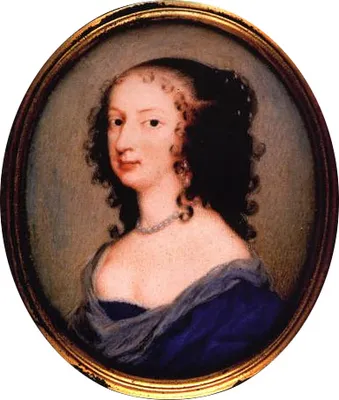
Cavendish Pierre Louis
Margaret Cavendish was a pioneering English philosopher, poet, and writer, recognized as an early science fiction author and a vitalist thinker.
Margaret Cavendish, Duchess of Newcastle-upon-Tyne, was a prolific English writer of the 17th century, known for her philosophical treatises, poetry, scientific writings, and fiction. She distinguished herself by publishing over a dozen original works under her own name at a time when female authors were largely excluded from the public sphere. Cavendish engaged with prominent thinkers of her era and is considered an essential pioneer of science fiction for her work "The Blazing World."
Born Margaret Lucas, she was the youngest of eight children and, despite lacking formal education, had access to tutors and libraries. She served as a lady-in-waiting to Queen Henrietta Maria, accompanying her into exile in France. After marrying William Cavendish, she continued to write extensively on topics including gender, power, scientific method, and philosophy. Cavendish rejected prevailing Aristotelian and mechanical philosophies, advocating instead for a vitalist model. She was the first woman to attend a meeting at the Royal Society of London, where she engaged with its members. Her writings aimed to challenge the contemporary belief in women's intellectual inferiority and advocate for their education.
Philosophical and Scientific Contributions
Margaret Cavendish was a notable figure in 17th-century natural philosophy, distinguishing herself by publishing extensively in this field when it was uncommon for women. She rejected the dominant Aristotelianism and mechanical philosophy of her time, proposing a vitalist model instead. Cavendish actively engaged with leading intellectuals of her era, including René Descartes and Thomas Hobbes. Her participation in a meeting of the Royal Society of London in 1667 marked her as the first woman to attend such an event, where she critically engaged with the assembled philosophers. She is also recognized for her early opposition to animal testing. Cavendish's philosophical inquiries often explored the nature of matter, the existence of God, and the relationship between the material and immaterial worlds, proposing that even inanimate matter possesses an innate knowledge of the divine.
Literary Innovation and Gender Advocacy
Cavendish's literary output was extensive, encompassing poetry, prose romances, essays, and plays, published under her own name, which was unusual for women of her period. Her utopian romance, "The Blazing World," is recognized as one of the earliest works in the science fiction genre, predating widely acknowledged pioneers. She consciously used her publications to advocate for women's education, asserting that women were intellectually capable and would achieve even greater things with access to schooling, similar to her brothers. Cavendish also sought to control her public image by often having her portrait included on her works, ensuring her authorship was known. Her writings frequently touched upon themes of gender, power, and societal manners, reflecting her unique position and perspective as a woman engaged in intellectual pursuits.
Personal Life and Public Persona
Margaret Cavendish's personal life was marked by a notable bashfulness, which she described as 'melancholia,' and which influenced her reluctance to discuss her work publicly. She married William Cavendish, 1st Duke of Newcastle-upon-Tyne, in 1645. Though she had no children of her own, her husband had surviving children from a previous marriage. Cavendish was conscious of her public image and actively cultivated uniqueness in her dress, thoughts, and behavior, expressing a desire for lasting fame. She wrote her memoir, "A True Relation of My Birth, Breeding, and Life," to provide a factual account of her life for future generations, drawing parallels with figures like Caesar and Ovid. Despite facing financial difficulties due to her husband's political affiliations, she maintained a distinct public presence, challenging contemporary beliefs about female inferiority through her intellectual and creative endeavors.
Key Ideas
- Vitalism: A philosophical stance that life is a fundamental characteristic that cannot be explained by non-living components alone.
- Early Science Fiction: Pioneering exploration of speculative fiction with scientific or technological elements.
- Advocacy for Women's Education: Championing the intellectual capabilities of women and their right to education.
- Rejection of Mechanical Philosophy: Opposition to the view that the universe operates like a machine, favoring a more dynamic, life-infused model.
Notable Quotes
“Pray account me not an Atheist, but believe as I do in God Almighty”
“that natural reason cannot perceive or have an idea of an immaterial being”
“when we name God, we name an Inexpressible, and Incomprehensible Being”
“also have an interior, fixt and innate knowledge of the existency of God, as, that he is to be adored and worshipped. And thus the inanimate part may, after its own manner, worship and adore God.”
Books by Cavendish Pierre Louis
0 free public domain books · Read online or download
