Catalina Vel Zquez
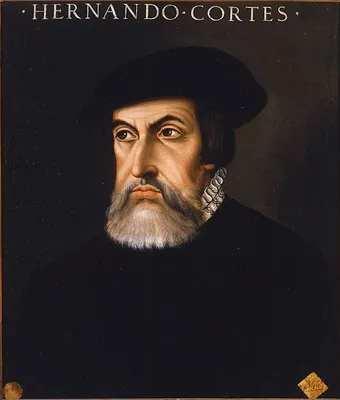
Spanish conquistador Hernán Cortés led the conquest of the Aztec Empire, significantly impacting colonial Mexico.
Hernán Cortés was a Spanish explorer and military leader instrumental in the fall of the Aztec Empire and the establishment of Spanish rule in much of present-day Mexico during the early 16th century. Born into minor nobility in Spain, Cortés sought fortune in the New World, first establishing himself in Hispaniola and then Cuba, where he held administrative positions and received land grants with indigenous labor. His ambition led him to lead an expedition to the mainland, defying orders from the governor of Cuba. Cortés skillfully formed alliances with indigenous groups who were rivals of the Aztecs, utilizing a native woman, Doña Marina, as an interpreter. He faced and overcame challenges from Spanish rivals sent to arrest him, ultimately communicating his successes directly to the King of Castile. Following the conquest, he was granted the title Marquis of the Valley of Oaxaca. Cortés returned to Spain later in his life and died there in 1547.
Early Life and New World Ventures
Born around 1485 in Medellín, Spain, Hernán Cortés hailed from a family of modest nobility. He was sent to study Latin, which, along with his later experience as a notary, provided him with legal knowledge he would later apply to justify his actions in the Americas. Described as somewhat sickly in childhood and later as ruthless and haughty, Cortés was drawn to the opportunities presented by the New World following Columbus's discoveries. He eventually sailed to Hispaniola in 1504, where he became a colonist, receiving an encomienda and land. His early years in the Caribbean included participation in the conquest of Hispaniola and Cuba, where he gained administrative experience and further land and slave grants.
Conquest of the Aztec Empire
In 1511, Cortés accompanied Diego Velázquez in the conquest of Cuba, where he rose to prominence, serving as secretary to the governor and twice as municipal magistrate. He also became a man of influence with his own encomienda. Relations with Governor Velázquez eventually soured, partly due to Cortés's involvement with the governor's sister-in-law, Catalina Xuárez, whom he eventually married. By 1518, Cortés was appointed captain-general of an expedition to Mexico, a move he pursued rapidly to preempt Velázquez's potential change of heart. Despite Velázquez revoking his charter, Cortés proceeded with the expedition in February 1519, an act of open mutiny. He landed on the Yucatán Peninsula with a small force, where he secured the services of Geronimo de Aguilar as a translator. Cortés demonstrated effective leadership, securing early victories and claiming territory for the Spanish Crown.
Strategy and Aftermath
Cortés's strategy for conquering the Aztec Empire relied heavily on forming alliances with indigenous peoples who opposed Aztec rule, a tactic that proved crucial to his success. He also employed Doña Marina, a native woman who served as his interpreter and bore him a son. When emissaries were sent by the governor of Cuba to arrest him, Cortés fought and defeated them, incorporating their troops into his own. He maintained direct communication with the King of Castile, seeking recognition for his achievements rather than punishment for insubordination. After the downfall of the Aztec Empire, Cortés was granted the title marqués del Valle de Oaxaca. He returned to Spain in 1541 and died six years later from natural causes.
Books by Catalina Vel Zquez
0 free public domain books · Read online or download
