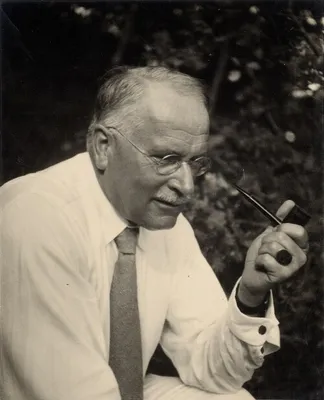
Carl Gustav Jung Robert Segal
Carl Jung was a Swiss psychiatrist who founded analytical psychology, known for concepts like archetypes and the collective unconscious.
Carl Gustav Jung was a Swiss psychiatrist and psychologist who established the school of analytical psychology. He authored over twenty books and is renowned for his concept of archetypes, significantly influencing fields ranging from psychiatry to religious studies. Jung's early career involved work at a psychiatric hospital in Zurich, where he developed a close relationship with Sigmund Freud. Initially seen as Freud's successor, their differing visions for understanding the human psyche led to a separation, prompting Jung to develop his distinct approach. His theories, such as individuation, the collective unconscious, and synchronicity, explore the depths of the human mind and its connection to broader spiritual and symbolic phenomena. Jung's personal experiences and observations, including early childhood incidents and his interest in spirituality, informed his groundbreaking psychological theories.
Early Life and Influences
Born in Switzerland in 1875, Carl Gustav Jung was the first surviving son of a pastor. His maternal grandfather was a distinguished churchman and scholar of Hebrew with an interest in the occult, while his paternal grandfather was a physician and university professor, rumored to be an illegitimate son of Goethe. Jung's early life was marked by a complex relationship with his parents; he perceived his mother as unreliable and mysterious, experiencing vivid visions, and his father as weak. These early impressions, particularly concerning his mother's perceived eccentricity and spiritual inclinations, would later be revisited and revised in his understanding of the psyche. His childhood also included solitary introspection, the development of a dual personality concept, and formative experiences like a childhood illness and a head injury that led to fainting spells, which he later identified as an early understanding of neurosis.
Academic Path and Psychological Development
Jung initially considered a career in ministry due to his family's religious background and moral upbringing, but ultimately chose psychiatry and medicine. He was drawn to these fields for their integration of biological and spiritual aspects. After his father's death during his studies at the University of Basel, Jung's education was supported by relatives. He developed a strong interest in philosophy, exploring thinkers like Pythagoras, Heraclitus, Plato, and Kant, as well as mystics like Meister Eckhart. His early career included research at the Burghölzli psychiatric hospital, where he established himself as a significant intellectual figure. This period also saw the beginning of his influential association with Sigmund Freud, which profoundly shaped his early psychological work before their eventual divergence.
Founding Analytical Psychology
Jung's professional relationship with Freud, initially one of collaboration and mentorship with Freud viewing Jung as his successor, eventually fractured due to their differing theoretical perspectives. This separation led Jung to establish his own school of thought, analytical psychology. Central to his work is the concept of individuation, a lifelong process of psychological development where an individual integrates conscious and unconscious elements to achieve a differentiated self. He also introduced seminal ideas such as archetypes, the collective unconscious, synchronicity, and psychological complexes, as well as the concepts of extraversion and introversion. Jung's explorations extended to the symbolic significance of religion and spirituality, viewing them as vital expressions of the human psyche and its quest for meaning, a perspective that distinguished him from Freud's more secular approach.
Key Ideas
- Archetypes: Universal, archaic patterns and images that derive from the collective unconscious and are the psychic counterpart of the instinct.
- The Collective Unconscious: A part of the unconscious mind derived from ancestral experience and the evolution of the human species, as distinct from the personal unconscious.
- Individuation: The psychological process of integrating the conscious and unconscious aspects of the personality to form a unified whole.
- Synchronicity: The acausal connecting principle that refers to meaningful coincidences.
- Extraversion and Introversion: Concepts describing the direction of an individual's energy, either outward towards the external world or inward towards the internal world.
Books by Carl Gustav Jung Robert Segal
0 free public domain books · Read online or download
