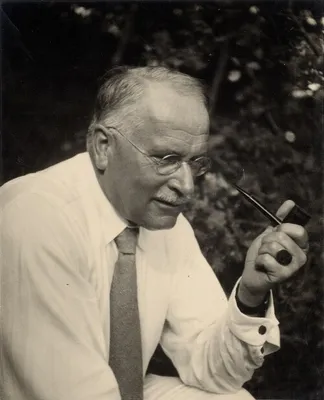
Carl Gustav Jung Gerhard Adler R F C Hull
Carl Jung was a Swiss psychiatrist who founded analytical psychology, known for concepts like the collective unconscious and archetypes.
Carl Gustav Jung was a Swiss psychiatrist and psychologist who established the field of analytical psychology. He was a highly influential figure, contributing significantly to various disciplines including psychiatry, anthropology, literature, and religious studies. Jung's early career involved working at a psychiatric hospital in Zurich, where he befriended Sigmund Freud. Initially collaborating and sharing a vision for understanding human psychology, their relationship eventually fractured due to differing perspectives. This separation led Jung to develop his own comprehensive psychological system, distinct from psychoanalysis.
Jung's work introduced several foundational concepts, most notably individuation, which he described as the central task of human development involving the integration of conscious and unconscious elements of the self. He also coined terms such as the collective unconscious, archetypes, synchronicity, and psychological complexes. Beyond his academic contributions, Jung's insights into spiritual experiences influenced the formation of Alcoholics Anonymous. He was also a prolific artist and writer, with many of his works published posthumously.
Early Life and Influences
Born in Switzerland in 1875, Carl Gustav Jung was the first surviving son of a pastor. His maternal lineage traced back through centuries of Swiss heritage, including a distinguished churchman and academic who was interested in the occult and an early advocate of Zionism. Jung's father, a pastor, was perceived by young Carl as reliable but weak, while his mother was seen as inconsistent and eccentric, experiencing periods of depression and reporting visions of spirits. These early impressions of his parents influenced his later views on gender roles, although he would later revise these perceptions. The family moved several times, and Jung experienced periods of illness and emotional distress during his childhood, including eczema and fainting spells, which he later recognized as manifestations of neurosis. His education included a challenging time at the Basel Gymnasium, where he developed a strong interest in philosophy and thinkers like Pythagoras, Heraclitus, and Plato.
Development of Analytical Psychology
Jung's intellectual journey led him from initial aspirations of becoming a minister to pursuing medicine and psychiatry, drawn by the intersection of biological and spiritual aspects of human experience. After his father's death during his university studies, financial support from relatives and a grant enabled him to continue. His early academic career involved research at the Burghölzli psychiatric hospital. A pivotal relationship was his friendship with Sigmund Freud, the founder of psychoanalysis. They shared a vision for understanding the human psyche, and Freud saw Jung as a successor and a means to legitimize psychoanalysis, especially given the rising antisemitism faced by Jewish analysts. Freud even supported Jung's presidency of the International Psychoanalytical Association. However, Jung's independent research and personal vision eventually led to a painful parting of ways with Freud, prompting Jung to establish his own distinct school of thought: analytical psychology.
Key Concepts and Later Life
Central to Jung's analytical psychology is the concept of individuation, a lifelong process of psychological differentiation where the self emerges from conscious and unconscious elements, considered the primary goal of human development. He introduced influential ideas such as the collective unconscious, a shared reservoir of ancestral experiences and images; archetypes, universal patterns of thought and behavior; synchronicity, meaningful coincidences; and psychological complexes. Jung's clinical work also had broader societal impacts; his conviction that alcoholics could recover through a 'vital spiritual experience' was instrumental in the founding of Alcoholics Anonymous. A prolific writer and artist, Jung continued his work throughout his life, with many of his writings being published after his death.
Key Ideas
- Individuation: The process of psychological development and integration of the self.
- Archetypes: Universal, inherited patterns of thought and behavior.
- Collective Unconscious: A shared layer of the unconscious mind containing ancestral memories and archetypes.
- Synchronicity: Meaningful coincidences that appear to be related but lack a direct causal connection.
- Psychological Complex: A core pattern of emotions, memories, perceptions, and wishes in the personal unconscious organized around a common theme.
Notable Quotes
“I have trusted men friends and been disappointed by them, and I have mistrusted women and was not disappointed.”
“Now you won't have to go to school anymore”
“was when I learned what a neurosis is”
Books by Carl Gustav Jung Gerhard Adler R F C Hull
0 free public domain books · Read online or download
