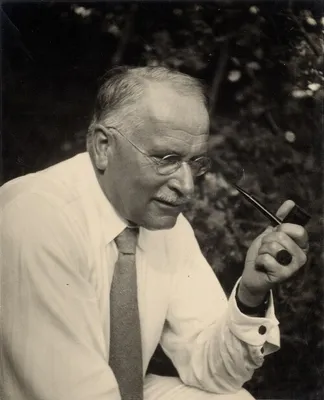
Carl Gustav Jung Gerhard Adler
Carl Jung, founder of analytical psychology, explored archetypes, the collective unconscious, and individuation, profoundly influencing psychology and beyond.
Carl Gustav Jung (1875-1961) was a Swiss psychiatrist and psychologist who established analytical psychology. He initially worked with Sigmund Freud, but their differing visions led Jung to develop his own distinct school of thought. Jung's prolific writings explored concepts such as archetypes, the collective unconscious, synchronicity, and individuation, which he considered the primary goal of human development. His work has had a significant impact not only on psychology but also on fields like anthropology, philosophy, and religious studies.
Jung's early life was marked by a complex family dynamic, including a mother he perceived as unreliable and a father he found weak. These early experiences, combined with childhood memories and later research, informed his theories on the psyche. He was also an artist and builder, with many of his works published posthumously. His ideas about spiritual experiences influencing recovery played a role in the formation of Alcoholics Anonymous.
Foundations of Analytical Psychology
Carl Gustav Jung founded analytical psychology, a school of thought that diverged from Freudian psychoanalysis. His early collaboration with Freud, who saw Jung as a successor, was cut short by their differing theoretical paths. Jung's independent research led him to develop seminal concepts such as archetypes, the collective unconscious, and psychological complexes. He also introduced the terms introversion and extraversion to describe personality orientations. Central to his work is the concept of individuation, a lifelong process of integrating conscious and unconscious aspects of the self to achieve wholeness. Jung viewed this as the fundamental task of human development.
Early Life and Influences
Born in Switzerland in 1875, Carl Jung's childhood was shaped by his family's intellectual and religious background. His paternal grandfather was a notable physician and academic, while his mother came from a long line of clergy. Jung's relationship with his parents was complex; he viewed his mother as eccentric and mysterious, and his father as gentle but lacking strength. These early perceptions, along with a profound childhood experience of carving a hidden mannequin and hiding it, contributed to his later theories on the unconscious and symbolic meaning. A significant childhood illness, triggered by a fall, taught him about neurosis and the power of psychological factors.
Exploration of the Psyche and Spirituality
Jung's intellectual journey led him from initial aspirations of ministry to the study of medicine and psychiatry, driven by a desire to bridge the biological and spiritual realms. He was deeply interested in religion and spirituality, viewing them not just as doctrines but as powerful expressions of the human psyche and its quest for meaning. His investigations into mythology, alchemy, and comparative religion provided rich material for his theories on archetypes and the collective unconscious. Jung's insight that alcoholics might recover through a 'vital spiritual experience' was instrumental in the founding of Alcoholics Anonymous, highlighting the practical application of his psychological insights.
Key Ideas
- Archetypes: Universal, archaic patterns and images that derive from the collective unconscious.
- Collective Unconscious: A part of the unconscious mind derived from ancestral memory and experience, distinct from the personal unconscious.
- Individuation: The process of psychological differentiation, which leads to the development of the individual personality.
- Synchronicity: The simultaneous occurrence of events that appear meaningfully related but have no apparent causal connection.
- Psychological Complex: A core pattern of emotions, memories, perceptions, and wishes in the personal unconscious organized around a common theme.
Books by Carl Gustav Jung Gerhard Adler
0 free public domain books · Read online or download
