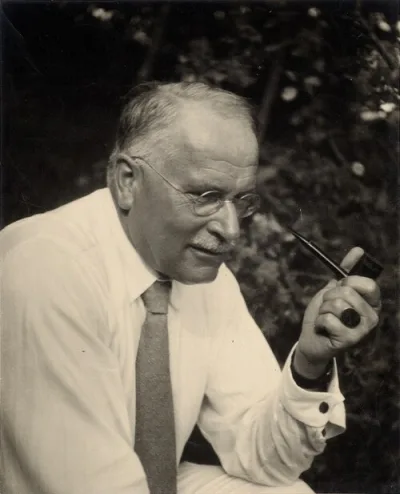
C G Jung
Carl Jung, founder of analytical psychology, explored archetypes, the collective unconscious, and individuation.
Carl Gustav Jung was a Swiss psychiatrist and psychologist who established the field of analytical psychology. He was a prolific writer and academic, deeply influential across various disciplines including psychiatry, anthropology, and religious studies. Jung initially worked with Sigmund Freud, developing a close relationship and correspondence, but their differing visions for psychology led to a painful separation. This divergence allowed Jung to forge his own path, creating a distinct school of thought. His work delved into profound aspects of the human psyche, proposing concepts that continue to resonate widely.
Central to Jung's theories is the concept of individuation, the process of psychological differentiation and integration of the self. He also introduced groundbreaking ideas such as the collective unconscious, archetypes, psychological complexes, and the distinctions between introversion and extraversion. Jung's insights extended beyond academic circles, influencing popular culture and even contributing to the formation of organizations like Alcoholics Anonymous through his understanding of spiritual experiences. His personal life, marked by early impressions of his parents and unique childhood experiences, informed his later psychological explorations.
Foundations of Analytical Psychology
Carl Gustav Jung, a Swiss psychiatrist, is recognized as the founder of analytical psychology. His career began with research at the Burghölzli psychiatric hospital in Zurich. He formed a significant intellectual bond with Sigmund Freud, the pioneer of psychoanalysis, engaging in extensive correspondence and sharing a vision for understanding the human mind. Freud viewed Jung as a successor and a means to legitimize psychoanalysis, especially given the rising antisemitism faced by Jewish analysts. Freud facilitated Jung's presidency of the International Psychoanalytical Association. However, Jung's independent research and personal perspectives eventually led to a profound disagreement with Freud's doctrines, resulting in their separation. This schism was personally difficult for Jung but ultimately paved the way for the development of his distinct analytical psychology, separate from Freudian psychoanalysis.
Key Concepts in Jungian Psychology
Jung's analytical psychology is characterized by several seminal concepts. A primary focus is individuation, described as the lifelong psychological journey of integrating conscious and unconscious elements to achieve a differentiated sense of self, which Jung considered the core of human development. He also proposed the existence of the collective unconscious, a universal reservoir of inherited experiences and patterns shared by all humanity. Within this collective unconscious reside archetypes, primordial images and patterns of thought that manifest in myths, symbols, and dreams. Other significant contributions include the concept of the psychological complex, clusters of emotionally charged ideas, and the fundamental personality orientations of extraversion and introversion. These ideas have had a far-reaching impact on psychology and beyond.
Early Life and Influences
Born in Kesswil, Switzerland, in 1875, Carl Jung's early life was shaped by his family background and his own introspective nature. His father was a pastor in the Swiss Reformed Church, while his mother came from a distinguished clerical family with a deep interest in the occult and Hebraic studies. Jung's relationship with his parents was complex; he saw his father as reliable but weak, and his mother as inconsistent and prone to eccentricity, experiencing visions. These early impressions of his parents, particularly his mother's mystical experiences, significantly influenced his later psychological theories. A solitary and introverted child, Jung experienced profound moments, such as a childhood ritual with a hidden mannequin, which he later recognized as an unconscious proto-archetypal act, hinting at his later theories on symbols and the collective unconscious.
Key Ideas
- Archetypes
- Collective unconscious
- Individuation
- Psychological complex
- Extraversion and introversion
- Synchronicity
Books by C G Jung
0 free public domain books · Read online or download
