Burroughs, Frank G., Freemasons. Grand Lodge of Idaho.
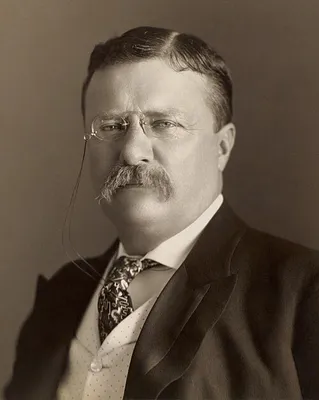
Theodore Roosevelt Jr. was the 26th U.S. President, a naturalist, historian, and progressive leader.
Theodore Roosevelt Jr., born in 1858, overcame a childhood of ill health, particularly severe asthma, through a dedicated regimen of physical activity. He was homeschooled and developed an early passion for naturalism, which continued throughout his life. After attending Harvard University, where he excelled in sciences and rhetoric but struggled with classical languages, he briefly attended Columbia Law School before entering politics. His early career included serving in the New York State Assembly, where he gained recognition for combating corruption. He also served in the military, notably leading the Rough Riders during the Spanish-American War.
Roosevelt's presidency, from 1901 to 1909, was marked by progressive policies under his "Square Deal" platform, focusing on fairness, trust-busting, and regulation. He was a strong proponent of conservation, establishing numerous national parks and forests. In foreign affairs, he oversaw the construction of the Panama Canal and expanded the U.S. Navy. His diplomatic efforts to end the Russo-Japanese War earned him the Nobel Peace Prize in 1906. Despite leaving office, he remained politically active, forming the Bull Moose Party in 1912, which inadvertently aided Woodrow Wilson's election. Roosevelt passed away in 1919, remembered as one of America's most significant presidents.
Early Life and Naturalist Interests
Born in 1858, Theodore Roosevelt Jr. experienced a challenging childhood marked by severe asthma and frail health. Despite these limitations, he possessed a curious and energetic spirit. His profound interest in zoology began at a young age, leading him to establish a "Roosevelt Museum of Natural History" with his cousins, where he practiced taxidermy. Family travels, including trips to Europe and Egypt, broadened his perspective. Recognizing the benefits of physical exertion for his health, Roosevelt adopted a rigorous exercise routine. He was primarily homeschooled, demonstrating strengths in subjects like history and biology, while finding mathematics and classical languages more challenging. His early academic pursuits included extensive reading and a published work on ornithology.
Political Ascent and Presidency
Roosevelt's entry into politics was somewhat unconventional for his social standing. After a brief stint at Columbia Law School, he became actively involved in the Republican Party in New York. He served in the New York State Assembly, where he quickly gained attention for challenging corrupt political practices, notably involving financier Jay Gould. His military service included a commission in the New York National Guard and, during the Spanish-American War, he co-founded and led the "Rough Riders." This military experience, combined with his political acumen, propelled him into higher office, eventually leading to his vice presidency and subsequent presidency following McKinley's assassination in 1901. He was the youngest president to assume office at age 42.
Progressive Leadership and Foreign Policy
As president, Roosevelt championed the progressive "Square Deal" agenda, advocating for consumer protection, regulation of corporations (earning him the "Trust Buster" moniker), and fair labor practices. A significant focus of his administration was conservation; he established numerous national parks, forests, and monuments, preserving vast tracts of natural land. In foreign policy, Roosevelt initiated the construction of the Panama Canal, expanded the U.S. Navy, and employed naval power projection, exemplified by the Great White Fleet's world tour. His successful mediation of the Russo-Japanese War led to him being awarded the Nobel Peace Prize in 1906, making him the first American recipient.
Key Ideas
- The strenuous life: a philosophy of vigorous physical and mental exertion to overcome challenges.
- Square Deal: a domestic policy platform focused on fairness for all citizens, including trust-busting and regulation.
- Conservationism: a commitment to preserving natural resources and establishing national parks and protected areas.
- Naval power: belief in the importance of a strong navy for national influence and defense.
Books by Burroughs, Frank G., Freemasons. Grand Lodge of Idaho.
0 free public domain books · Read online or download