Blaise Pascal Mortimer J Adler
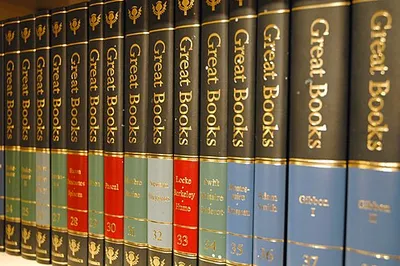
The Great Books of the Western World is a 54-volume series presenting seminal Western texts, emphasizing enduring ideas and intellectual dialogue.
Published initially in 1952 by Encyclopædia Britannica, the Great Books of the Western World is a 54-volume collection designed to present foundational works of Western civilization. The project aimed to provide readers with a comprehensive understanding of the "great conversation" of ideas throughout history, focusing on texts relevant to contemporary life and rewarding for repeated study. The selection criteria prioritized historical influence and the exploration of "Great Ideas" as cataloged in the accompanying Syntopicon index, rather than strict cultural inclusivity or agreement with the authors' viewpoints.
The initiative originated at the University of Chicago under Robert Hutchins and Mortimer Adler, evolving from a university course focused on liberal arts education. William Benton, then CEO of Encyclopædia Britannica, proposed the publication of these works. A significant challenge was the creation of the Syntopicon, an index designed to facilitate "random access" to the ideas within the books. This indexing process involved grappling with the evolving meanings of concepts across different historical periods, eventually leading to a refined methodology for organizing and cross-referencing the "Great Ideas."
Despite initial slow sales, the series achieved eventual widespread success through a revised marketing strategy. Subsequent editions and related publications, like "Gateway to the Great Books" and "The Great Ideas Today," further expanded the project's reach. The series continues to be recognized for its ambition in curating and presenting the core intellectual heritage of the Western world.
Origins and Editorial Philosophy
The Great Books of the Western World project began at the University of Chicago, spearheaded by President Robert Hutchins and Mortimer Adler. Their objective was to create a comprehensive collection of seminal Western texts, intended to fill gaps in liberal arts education and foster intellectual development. The series was not merely a historical compilation but aimed to highlight works relevant to contemporary concerns and valuable for ongoing, in-depth study. A key principle was that inclusion was based on historical significance and contribution to the "great conversation" of ideas, rather than on the editors' personal agreement with the authors' philosophies or a desire for broad cultural representation. The "Syntopicon," a detailed index, was developed to map the connections between these works and 102 "Great Ideas."
The Syntopicon and Idea Indexing
A crucial, and initially challenging, component of the Great Books project was the creation of the Syntopicon, an extensive index designed by Mortimer Adler and his team. The goal was to provide readers with a means of navigating the complex web of ideas presented across the 54 volumes, allowing for what Adler termed "random access" to the core concepts. The initial attempts at indexing, particularly for ancient Greek works, proved difficult due to the shifting meanings of philosophical terms over time. This led to a breakthrough in methodology, where texts were re-examined with specific subordinate ideas in mind, allowing for a more nuanced and interconnected mapping of "Great Ideas" and their development through history.
Publication and Reception
The first edition of the Great Books of the Western World was launched in 1952 by Encyclopædia Britannica, comprising 54 volumes. The initial public reception and sales were modest, leading to financial concerns for the publisher. However, a strategic shift to door-to-door sales, a method previously feared by Hutchins, proved highly effective, leading to significant sales figures. The series was later updated in 1990 with a second edition in 60 volumes, incorporating 20th-century additions and revised translations. The project's influence extended to related publications like "Gateway to the Great Books" and the annual "The Great Ideas Today," further solidifying its place in intellectual discourse.
Key Ideas
- The "Great Conversation" of Western thought
- Liberal education and intellectual development
- The "Great Ideas" as organizing principles
- The Syntopicon as an index of concepts
Notable Quotes
“This is more than a set of books, and more than a liberal education. Great Books of the Western World is an act of piety. Here are the sources of our being. Here is our heritage. This is the West. This is its meaning for mankind.”
Books by Blaise Pascal Mortimer J Adler
0 free public domain books · Read online or download
