Bess Matassa
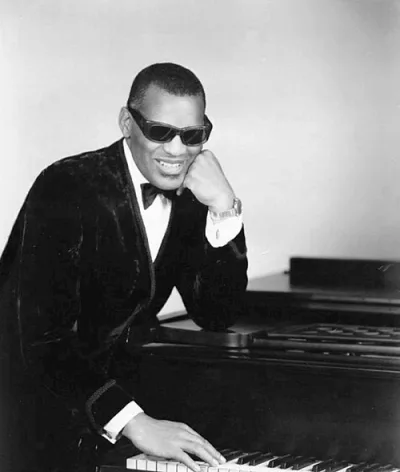
Ray Charles, known as 'The Genius', pioneered soul music by blending genres and achieved significant crossover success.
Ray Charles Robinson (1930-2004) was a profoundly influential American musician, celebrated for his pioneering work in soul music. Born in Albany, Georgia, he lost his sight in childhood, likely due to glaucoma, and attended the Florida School for the Deaf and the Blind. There, he honed his musical talents, learning to play various instruments and read music in Braille. Charles began his career in Florida before moving to Seattle and then Los Angeles, where he formed The McSon Trio and achieved his first national hit, "Confession Blues." He later signed with Atlantic Records, where he would develop his signature sound.
Charles's genius lay in his ability to fuse blues, jazz, rhythm and blues, and gospel music, creating the soul genre in the 1950s. His career took a significant turn in the 1960s with his crossover success on ABC Records, notably with the "Modern Sounds" albums, which integrated country and pop elements into his music. This made him one of the first Black musicians to receive artistic control from a major label. Throughout his career, he garnered numerous accolades, including multiple Grammy Awards, Kennedy Center Honors, and induction into the Rock and Roll Hall of Fame, solidifying his legacy as a musical icon.
Early Life and Musical Awakening
Ray Charles Robinson was born in Albany, Georgia, in 1930. His early life was marked by hardship and tragedy, including the loss of his younger brother and mother. He began losing his sight around age four or five, becoming completely blind by seven, a condition attributed to glaucoma. This loss of vision led him to wear his signature dark glasses. Despite these challenges, Charles found solace and expression in music. His musical journey began at a young age at Wylie Pitman's Red Wing Cafe, where he first heard boogie-woogie piano and was subsequently taught to play. He attended the Florida School for the Deaf and the Blind, where he developed his musical skills further, learning classical piano and various instruments, and mastering Braille music notation.
Pioneering Soul Music and Crossover Success
After leaving school, Charles embarked on his professional music career, performing in various bands and honing his craft. His early work laid the foundation for his groundbreaking contributions. During his tenure with Atlantic Records in the 1950s, he masterfully blended blues, jazz, R&B, and gospel, effectively creating the soul music genre. His innovative approach redefined popular music. In the 1960s, Charles achieved significant crossover success with ABC Records, notably with his "Modern Sounds" albums. These recordings integrated country and pop elements, broadening his appeal and making him one of the first Black artists to be granted substantial artistic control by a mainstream record company. This period cemented his status as a transformative figure in American music.
Musical Influence and Legacy
Ray Charles cited Nat King Cole as a major influence, alongside Art Tatum, Louis Jordan, and Charles Brown. His own impact on subsequent generations of musicians is immense. He received numerous prestigious awards, including Kennedy Center Honors, the National Medal of Arts, and 17 Grammy Awards, five of which were posthumous. He was an inaugural inductee into the Rock and Roll Hall of Fame in 1986 and later into the Country Music Hall of Fame. Publications like Rolling Stone have consistently ranked him among the greatest artists and singers of all time. His lifelong friendship and occasional collaborations with Quincy Jones also highlight his connections within the music industry. Frank Sinatra famously called him "the only true genius in show business."
Key Ideas
- Pioneering the soul music genre by blending blues, jazz, R&B, and gospel.
- Achieving crossover success by integrating country and pop music elements.
- Gaining artistic control as one of the first Black musicians with a mainstream label.
Notable Quotes
“the two great tragedies”
“the only true genius in show business”
Books by Bess Matassa
5 free public domain books · Read online or download