Bertrand Russell
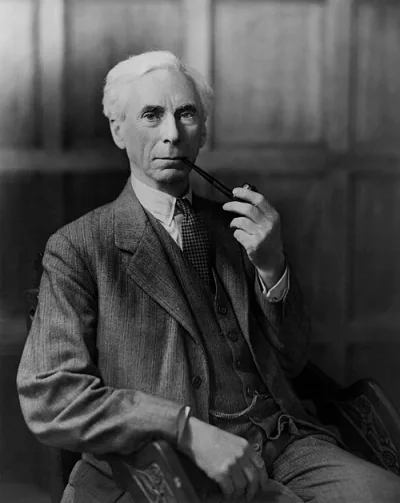
Bertrand Russell was a philosopher, logician, and mathematician who profoundly influenced analytic philosophy and logic.
Bertrand Arthur William Russell (1872-1970) was a distinguished English philosopher, logician, and mathematician, recognized as a pivotal figure in analytic philosophy. He made significant contributions to logic, set theory, and the philosophy of mathematics, famously collaborating with Alfred North Whitehead on the monumental "Principia Mathematica," an attempt to ground all of mathematics in logic. Russell was also a vocal public intellectual, advocating for pacifism, anti-imperialism, and later, nuclear disarmament. His intellectual journey began with a profound interest in mathematics, which he pursued at Trinity College, Cambridge, where he also engaged with philosophical debates, ultimately rejecting idealism for realism.
His early life was marked by personal tragedy and a profound intellectual awakening, particularly through mathematics and philosophy, which he credited with saving him from despair. He was educated at home and later at Cambridge, where he developed his philosophical ideas and established a reputation as a formidable thinker. Russell's work, including the influential essay "On Denoting," is considered foundational to modern philosophical logic. Despite his academic achievements, he was also known for his political activism, which led to imprisonment and academic censure, yet he continued to champion humanitarian ideals and freedom of thought throughout his long life, earning him the Nobel Prize in Literature in 1950.
Philosophical and Logical Foundations
Bertrand Russell was a principal architect of analytic philosophy and a leading logician of the early 20th century. Alongside contemporaries like G.E. Moore and Ludwig Wittgenstein, he spearheaded a "revolt against idealism" in British philosophy. His collaboration with Alfred North Whitehead on "Principia Mathematica" was a landmark effort to formalize logic and demonstrate that mathematics could be derived entirely from logical principles, a concept known as logicism. Russell's seminal essay "On Denoting" is regarded as a model of philosophical analysis, profoundly impacting how philosophers approach language and reference. His work at Cambridge, particularly his investigations into the logical underpinnings of mathematics and set theory, laid crucial groundwork for future developments in both logic and philosophy.
Intellectual Development and Early Influences
Russell's intellectual development was deeply shaped by his aristocratic background, early personal losses, and a profound engagement with mathematics and philosophy. Educated primarily at home, he found solace and intellectual stimulation in books and mathematics, famously stating that his pursuit of mathematics kept him from succumbing to despair. His encounter with Euclid's work was described as a life-altering event. Later, at Trinity College, Cambridge, he was influenced by Alfred North Whitehead and George Edward Moore, moving away from idealism towards a realist philosophical stance. His early philosophical inquiries focused on the foundations of geometry and logic, culminating in works that established his reputation as a rigorous and innovative thinker.
Pacifism, Activism, and Public Life
Beyond his academic contributions, Bertrand Russell was a prominent public figure known for his strong pacifist convictions and social activism. He chaired the India League, advocating for anti-imperialist causes, and was imprisoned for his pacifism during World War I. While initially advocating appeasement towards Nazi Germany, he later viewed war as a necessary evil. In the post-World War II era, he supported American global leadership over Soviet hegemony and later became a vocal critic of totalitarianism and the Vietnam War, advocating strongly for nuclear disarmament. His commitment to humanitarian ideals and freedom of thought was recognized with the Nobel Prize in Literature in 1950.
Key Ideas
- Logicism: the philosophical thesis that mathematics is reducible to logic.
- Analytic philosophy: a philosophical tradition characterized by its emphasis on logic and language analysis.
Notable Quotes
“I spent all my spare time reading him, and learning him by heart, knowing no one to whom I could speak of what I thought or felt, I used to reflect how wonderful it would have been to know Shelley, and to wonder whether I should meet any live human being with whom I should feel so much sympathy.”
“I found myself filled with semi-mystical feelings about beauty and with a desire almost as profound as that of the Buddha to find some philosophy which should make human life endurable”
“At the end of those five minutes, I had become a completely different person.”
“one of the great events of my life, as dazzling as first love”
Books by Bertrand Russell
2 free public domain books · Read online or download