Bell Telephone Laboratories, Incorporated
Bell Telephone Laboratories produced a series of educational television specials exploring science with philosophical and religious undertones.
Bell Telephone Laboratories, Incorporated, was the entity behind the Bell System Science Series, a collection of nine television specials aired between 1956 and 1964. These programs aimed to improve public understanding of science through a blend of storytelling, animation, scientific interviews, and clear explanations. Initially conceived by AT&T's advertising agency, N. W. Ayer & Son, the series leveraged the reputation of Bell Telephone Laboratories' research achievements. The first four films were produced by filmmaker Frank Capra, who sought to integrate scientific concepts with philosophical and religious perspectives, viewing scientific inquiry as a facet of humanity's quest for understanding. Subsequent films were produced by Warner Bros. Pictures and Walt Disney Pictures. The series, hosted primarily by USC professor Frank C. Baxter, was made available for free classroom use, reaching millions of students and influencing educational broadcasting techniques.
Philosophical and Religious Integration
A notable aspect of the Bell System Science Series, particularly the films produced by Frank Capra, was the deliberate incorporation of philosophical and religious themes. Capra insisted that the series explore the connection between science and religion, stating his belief that scientific research was an expression of the Holy Spirit and a part of humanity's search for God. This perspective led to discussions and some disagreements with the scientific advisory board. The first film, "Our Mr. Sun," for instance, was noted for its blend of science, documentary footage, and animation within a "religious-magical framework," beginning and ending with religious allusions. Capra aimed to establish common ground between science and religion, presenting both as avenues for optimistic and curious individuals to comprehend the world and their place within it.
Production and Educational Impact
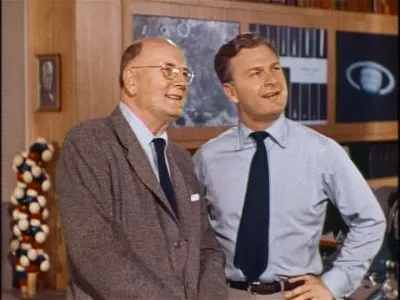
The Bell System Science Series utilized innovative production techniques for its time, including sophisticated animation that interacted with live-action segments, a novelty that influenced later educational programming. Frank Capra's initial four films, made in Technicolor, featured characters like "Dr. Research" (portrayed by Frank C. Baxter) and "Mr. Fiction Writer" (played by Eddie Albert and later Richard Carlson), who served to explain complex scientific ideas. The animation work, particularly for "Our Mr. Sun," was handled by United Productions of America (UPA) and Shamus Culhane Productions. Following their broadcast, these films were distributed freely for educational purposes, reaching an estimated 200 million students over three decades, significantly contributing to science education and demonstrating the potential of television for public enlightenment.
Key Ideas
- Science as a facet of humanity's quest for understanding.
- Integration of scientific concepts with religious and philosophical perspectives.
- Utilizing engaging storytelling and animation for science education.
- The role of television in public understanding of science.
Notable Quotes
“specials that combined clever story lines, sophisticated animation, veteran character actors, films of natural phenomena, interviews with scientists, and precise explanation of scientific and technical concepts—all in the pursuit of better public understanding of science.”
“among the best known and remembered educational films ever made, and enthroning Dr. Frank Baxter, professor at the University of Southern California, as something of a legend as the omniscient king of academic science films hosts.”
“Science was a natural topic choice, given the accomplishments and reputation of the company's research arm, Bell Telephone Laboratories.”
“Those four films about science, hand woven with bits of celluloid, were sprightly patterns of poesy and fact; fresh ideas were their main charm, a rather elegant charm, we thought, much like the light-hearted but disciplined charm of a Mozart composition.”
“If I make a science film, I will have to say that science research is just another expression of the Holy Spirit that works in all men. Furthermore, I will say that science, in essence, is just another facet of man's quest for God.”
Books by Bell Telephone Laboratories, Incorporated
1 free public domain book · Read online or download