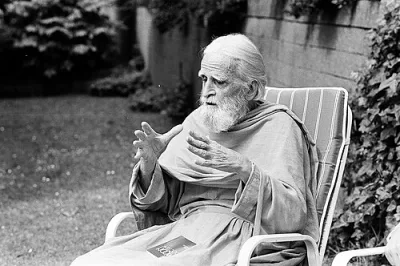
British Catholic priest and monk Bede Griffiths lived in South Indian ashrams, exploring Hindu-Christian dialogue.
Alan Richard Griffiths, later known as Bede Griffiths OSB Cam and Swami Dayananda, was a British Catholic priest and Benedictine monk who spent much of his life in South India. Born in 1906, he experienced a significant spiritual crisis after a period of communal living and study, which led him to convert to Catholicism and join the Benedictine order.
After his ordination, Griffiths was sent to India with the aim of establishing a monastery. He co-founded an ashram in Kerala, adopting the life of an Indian sannyasi and taking the name Dayananda. He later moved to another ashram in Tamil Nadu, where he continued his deep engagement with Indian spiritual traditions and Christian theology. Griffiths became known for his extensive writings on the dialogue between East and West, particularly between Hinduism and Christianity.
Early Life and Spiritual Awakening
Born Alan Richard Griffiths in 1906, he came from a middle-class English family. His early education led him to Oxford University, where he studied English literature and philosophy, benefiting from the tutelage of C. S. Lewis. Following graduation, Griffiths and friends experimented with a communal, nature-attuned lifestyle, reading scripture and finding connections between its teachings and the natural world. This experience profoundly influenced him, leading to a crisis of faith and eventual conversion to Roman Catholicism. He found inspiration in the writings of Cardinal John Henry Newman and was received into the Church at Prinknash Abbey in 1931.
Monastic Life and Indian Vocation
Griffiths entered the Benedictine order, taking the monastic name Bede and was ordained a priest in 1940. He served in monasteries in the UK, including Farnborough and Pluscarden Abbey, where he began writing his autobiography. A significant turning point came through his acquaintance with Father Benedict Alapatt, a monk of Indian descent interested in establishing a monastery in India. Despite initial refusal from his abbot, Griffiths was eventually authorized to go to India, though this meant relinquishing his monastic vows to be subject to a local bishop.
Ashram Life and East-West Dialogue
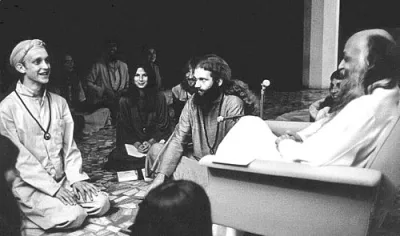
In 1955, Griffiths arrived in India and, after an initial attempt to establish a monastery that proved too 'Western', he joined Father Francis Acharya to found Kristiya Sanyasa Samaj, Kurisumala Ashram. Here, he embraced the life of an Indian sannyasi, adopting saffron robes and the Sanskrit name Dayananda. He delved deeply into Indian religions and cultures, writing "Christ in India". Later, he moved to Saccidananda Ashram (Shantivanam) in Tamil Nadu, a community already established with an authentic Indian religious expression. Here, he resumed his studies, seeking to integrate Indian thought with Christian theology, and became known as Swami Dayananda. He joined the Camaldolese congregation, allowing him to live his developed way of life within a monastic framework. Griffiths was a strict vegetarian following a sattvic diet.
Later Years and Legacy
In his later years, Griffiths continued his work, writing extensively on Hindu-Christian dialogue and becoming a prominent voice in East-West spiritual exchange. He suffered a stroke in 1990 but recovered and continued to travel and lecture internationally, meeting figures like the Dalai Lama. A documentary about his life, "A Human Search," was filmed shortly before he suffered further strokes. He passed away at Shantivanam in 1993. His legacy is preserved and promoted by the Bede Griffiths Trust and the Camaldolese Institute for East–West Dialogue.
Key Ideas
- Exploration of Hindu-Christian dialogue and the integration of Eastern spiritual traditions with Christian theology.
- Development of an authentic Indian form of Christian monasticism (ashram life).
- Belief in a deep connection between the teachings of scripture and the rhythms of nature.
- Advocacy for East-West spiritual and cultural exchange.
Notable Quotes
“I am going to discover the other half of my soul.”
“I do believe that he liked me.”
Books by
4 free public domain books · Read online or download