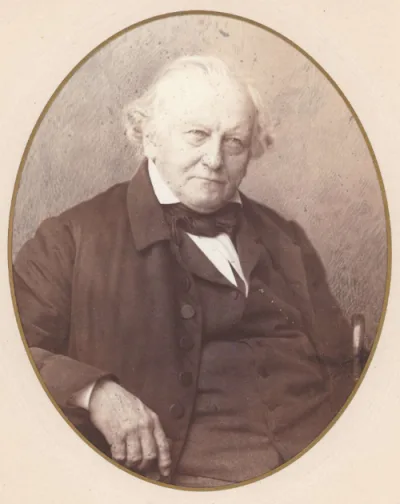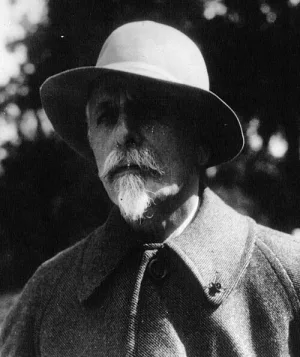
Basil Thompson
Flora Thompson penned the beloved 'Lark Rise to Candleford' trilogy, drawing from her rural English childhood.
Flora Jane Thompson, born Flora Jane Timms in 1876, was an English author celebrated for her semi-autobiographical writings about country life. Despite limited formal education, she developed into a skilled writer, encouraged by her sister Betty's success with a children's book. Thompson's early career involved working in post offices, a period that later informed her writing, particularly her reflections on personal growth and intellectual aspirations.
Her most famous work, the trilogy "Lark Rise to Candleford," began as essays about her rural upbringing in the 1880s. These were published separately and later compiled into a single volume. The books offer a detailed, though lightly fictionalized, portrayal of hamlet, village, and town life. Thompson also wrote poetry and numerous nature articles, some of which were collected posthumously. Her writing is noted for its sympathetic portrayal, literary skill, poetic descriptions of nature, and accessible prose, often used as a historical source for the period.
Early Life and Influences
Flora Jane Timms entered the world in Juniper Hill, Oxfordshire, in 1876, the eldest of twelve children born to a stonemason and a nursemaid. Life was challenging, with only six of the twelve children surviving childhood. Young Flora received her initial education at the village parish school, where she was recognized as being very much like her father. At the age of fourteen, her life took a significant turn when she moved to Fringford to work as a counter clerk at the local post office, learning from the postmistress. She continued to work in various post offices throughout her life, including locations in Grayshott, Yateley, and Bournemouth. In 1903, she married John William Thompson, a fellow post office employee, and they eventually had three children. A formative influence was her brother Edwin, whose death near Ypres in 1916 deeply affected her.
Literary Development and Major Works
Thompson was a writer who largely educated herself. By 1922, she was contemplating writing about her childhood experiences. An early success came in 1911 when she won an essay competition for her piece on Jane Austen. Her sister, Betty Timms, also a writer, published a children's book in 1926, which further motivated Flora to pursue her own literary ambitions. Thompson produced a significant body of work, including short stories and articles for magazines and newspapers. She was also an avid naturalist, and many of her nature writings were later compiled. Her seminal work, "Lark Rise to Candleford," originated from essays submitted to Oxford University Press in 1938. Published initially as three separate volumes between 1939 and 1943, they were later consolidated into the trilogy "Lark Rise to Candleford" in 1945. This collection vividly depicts the author's youth in the English countryside during the 1880s.
Writing Style and Critical Reception
Critics have praised Flora Thompson's writing for its literary power and sympathetic presentation. Her essays demonstrated a strong grasp of English literature and an ability to craft prose that was both intelligent and accessible to a broad readership. Her approach to fiction was artistic, and her descriptions of the natural world are particularly noted for their poetic quality. Biographers highlight that Thompson, despite her basic elementary education, managed to create enduring literature. Her trilogy is recognized for elegantly capturing the decline of Victorian rural England and has been widely utilized as a historical source for social history of the era, though some historians have raised questions about its complete accuracy for that purpose.
Books by Basil Thompson
2 free public domain books · Read online or download