Ba Dara Yan A
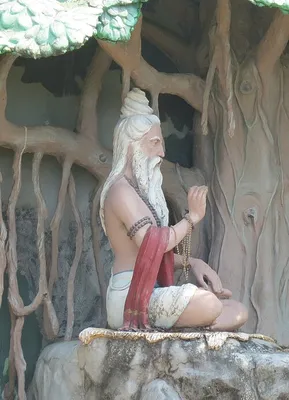
Vyasa, also known as Bādarāyaṇa, is a revered sage traditionally credited with compiling the Vedas and authoring key Hindu texts like the Mahabharata and Puranas.
Vyasa, also known by names such as Veda Vyasa and Krishna Dvaipayana, is a central figure in numerous Hindu traditions. He is revered as a sage and is traditionally credited with compiling the four Vedas, authoring the eighteen Puranas, and composing the Brahma Sutras. Many Hindus consider him a partial incarnation of the deity Vishnu and believe him to be one of the Chiranjivis, immortals who are still alive in the present age. His name, Vyasa, signifies 'compiler' or 'arranger,' reflecting his role in organizing and dividing the primordial Veda into accessible parts to aid human understanding. This act of classification earned him the title Veda Vyasa, meaning 'Splitter of the Vedas.'
Authorship and Compilation
Vyasa is traditionally regarded as the author of the epic Mahābhārata, a vast narrative that also features him as a character. Beyond this epic, Hindu traditions attribute to him the monumental task of compiling the Vedic mantras into four distinct texts. Furthermore, he is credited with the authorship of the eighteen Puranas, which cover a wide array of religious and philosophical topics, and the foundational Vedanta text known as the Brahma Sutras. The Brahma Sutras are specifically attributed to Bādarāyaṇa, also identified as Veda Vyasa, underscoring his role as an 'arranger' of profound spiritual knowledge.
The Division of the Veda
The title 'Veda Vyasa' highlights Vyasa's crucial role in dividing the singular, ancient Veda into four distinct branches: Rigveda, Samaveda, Yajurveda, and Atharvaveda. This division is seen not as a fragmentation, but as a pedagogical feat designed to make the divine knowledge more comprehensible to humanity, given the perceived decline in human capacity over successive ages. The Vishnu Purana elaborates on this, stating that in each third world age (Dvapara Yuga), Vishnu assumes the form of Vyasa to reclassify the Veda, adapting it to the understanding of mortals. This process has occurred multiple times throughout cosmic cycles, with different sages serving as Vyasa in each epoch.
Role in the Mahābhārata Narrative
Within the Mahābhārata, Vyasa's lineage is intricately woven into the narrative. He is depicted as the biological father of both the victors (the Pandavas, through the Niyoga practice with Kunti) and the vanquished (the Kauravas, through his union with Gandhari's maid, who was impersonating Gandhari). This familial connection makes his authorship of the epic a deeply personal account of the conflict within his own extended family. The core of the Mahābhārata, known as Jaya, features dialogues that form the basis of later philosophical discussions, including the highly influential Bhagavad Gita, which explores profound spiritual and ethical questions.
Key Ideas
- Vedic compilation and classification
- Authorship of major Hindu scriptures
- Revered as a divine incarnation and immortal sage
- The concept of cyclical cosmic ages and the role of Vyasa in each
Books by Ba Dara Yan A
0 free public domain books · Read online or download
