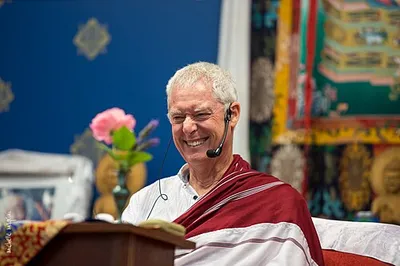
B Alan Wallace
B. Alan Wallace is a scholar of Tibetan Buddhism known for bridging contemplative science and traditional Buddhist practices.
B. Alan Wallace, born in 1950, is an American scholar specializing in Tibetan Buddhism and the field of contemplative science. His extensive work includes authoring texts on cultivating attention (Samatha) and lucid dreaming practices, as well as translating key Tibetan Buddhist scriptures like the Bardo Thodol. Wallace has been a significant voice in dialogues between Western science and Tibetan Buddhist psychology, advocating for the integration of introspective methods into academic research and offering critiques of purely materialistic views of the mind.
Wallace's academic journey began with studies in Tibetan language and Buddhism in Germany and India, where he was ordained as a monk by the Dalai Lama. He holds degrees in physics, philosophy of science, and Sanskrit, and a Ph.D. in religious studies from Stanford University, where his dissertation focused on sustained voluntary attention in Buddhism. He has lectured at the University of California, Santa Barbara, and founded the Santa Barbara Institute for Consciousness Studies to foster interdisciplinary exploration of consciousness. Wallace is widely recognized as a leading meditation teacher and Buddhist scholar, actively promoting the integration of contemplative practices into higher education.
Contemplative Science and Cross-Cultural Dialogue
B. Alan Wallace is a prominent figure in the development of contemplative science, a field that seeks to harmonize scientific inquiry with introspective Buddhist practices. He has actively engaged in dialogues between Western scientific paradigms and the sophisticated psychological frameworks found within Tibetan Buddhism. Wallace is known for his critical examination of materialistic philosophies that attempt to explain consciousness solely through physical processes, arguing instead for the inclusion of first-person introspective methods as a vital tool for academic research. His work highlights the potential for these traditions to inform and enrich one another, particularly in understanding the nature of the mind and consciousness.
Meditation, Attention, and Lucid Dreaming
A significant portion of Wallace's scholarly and practical contributions lies in the cultivation of attention and the exploration of advanced meditative states. His book, 'The Attention Revolution,' focuses on the practice of Samatha, a core Buddhist technique for developing sustained mental focus. He has also extensively researched and written about lucid dreaming, particularly within the context of Tibetan dream yoga, as explored in 'Dreaming Yourself Awake.' These works emphasize the transformative potential of dedicated meditation practice for enhancing cognitive abilities, emotional well-being, and gaining deeper insight into the nature of reality.
Foundational Work and Educational Initiatives
Wallace's academic and institutional contributions are substantial. He founded the Santa Barbara Institute for Consciousness Studies in 2003, an organization dedicated to integrating scientific and contemplative approaches to understanding consciousness. He has also been instrumental in initiating research projects, such as the shamatha project, which scientifically investigated the effects of intensive meditation retreats on participants. Furthermore, Wallace is a driving force behind the Center for Contemplative Research in Tuscany, Italy, aiming to create a collaborative environment for contemplatives and scientists. He advocates for incorporating contemplative study into higher education, drawing inspiration from thinkers like William James.
Key Ideas
- Contemplative science: Integrating scientific methods with first-person introspective experience from contemplative traditions.
- Critique of materialism: Advocating for the inclusion of subjective experience in the study of consciousness, challenging purely physical explanations.
- Cultivation of attention (Samatha): Focusing on developing sustained voluntary attention through Buddhist meditation techniques.
- Lucid dreaming and dream yoga: Exploring the practice of lucid dreaming within Tibetan Buddhist traditions for insight and transformation.
- Integration of introspection in research: Emphasizing the value of first-person methods alongside third-person scientific approaches.
Books by B Alan Wallace
0 free public domain books · Read online or download
