Avia Venefica
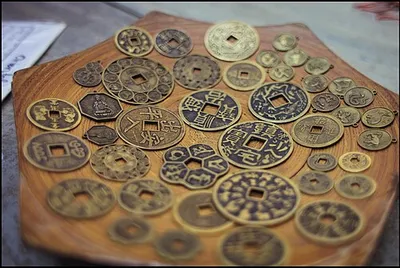
Chinese numismatic charms, or Yansheng coins, are decorative coins with symbolic meanings used for rituals, luck, and as currency alternatives.
Yansheng coins, also known as Chinese numismatic charms, are special decorative coins that originated in the Western Han dynasty. Initially evolving from standard cash coins, they developed into a distinct category used primarily for ritualistic purposes, including fortune-telling, warding off spirits, and promoting good fortune. These coins often feature intricate designs, hidden symbolism, and more characters or imagery than regular coinage.
While not legal tender, Yansheng coins circulated alongside official currency and were valued for their material, often made from copper alloys, and sometimes precious metals or jade. In specific historical contexts, such as during the Yuan dynasty when copper currency was scarce, certain charms functioned as a form of alternative currency. Their use saw a resurgence during the Republic of China era, and they continue to be appreciated for their aesthetic and symbolic value, often worn as personal adornments or kept as good luck charms.
Origins and Early Symbolism
The earliest forms of Chinese coinage, dating back to the Warring States period, featured inscriptions indicating origin and value, alongside symbolic marks like circles, crescents, and dots representing celestial bodies. These symbols, whether raised (yang wen) or incised (yin wen), evolved into the designs found on later numismatic charms. During the Han dynasty, dots were common on Ban Liang coins, likely added intentionally during the mold process. Crescent symbols and later, counting rod numerals and Chinese characters, also appeared on early coins. The coinage of Emperor Wang Mang's Xin dynasty served as a foundation for many subsequent amulets and charms. Ancient texts link the character for 'star' (星) to concepts of 'spreading' and 'disseminating,' suggesting a connection between coinage and widespread distribution. Hypotheses also suggest symbols like stars, moons, clouds, and dragons represented cosmological beliefs such as yin and yang and the five elements (wu xing), particularly the element of water, with the character for 'coin' (泉) also meaning 'water spring'.
Evolution and Diverse Usage
From the Han dynasty through the Northern and Southern dynasties, numismatic charms closely resembled circulating cash coins, distinguished primarily by symbols on the reverse, such as animals, celestial bodies, and zodiac figures. A significant evolution occurred from the Six Dynasties to the Yuan dynasty, when charms began prominently displaying auspicious inscriptions like 'longevity' and 'happiness.' This period also saw the emergence of Taoist and Buddhist amulets, marriage coin charms with erotic imagery, and charms made from a wider range of materials including iron, lead, silver, gold, jade, and paper. New scripts, including Taoist 'magic writing' (Fulu), were incorporated, adding layers of hidden symbolism. Open-work charms featuring dragons, mythical creatures, flora, and fauna became popular during the Tang and Song dynasties, used as fashion accessories or adornments. The inscription 'chang ming fu gui' (長命富貴) and Taoist symbols like yin-yang and the eight trigrams became common on charms. The Song dynasty saw a surge in charm production, including 'horse coins' used for gambling, and fish charms worn at the waist. Jin dynasty charms were influenced by steppe cultures, blending Jurchen traditions with Chinese administration.
Symbolism and Cultural Influence
Yansheng coins are rich with symbolism, often incorporating hidden meanings and visual puns. Unlike standard coins with minimal inscriptions, charms frequently feature multiple characters and pictorial elements. These coins were not merely decorative; they served practical and spiritual functions. During the Ming and Qing dynasties, the imperial government issued coins for national festivals and ceremonies, such as the emperor's birthday, with inscriptions like 'Wanshou Tongbao' (萬夀通寶) celebrating longevity. Beyond their ritualistic and decorative roles, some charms functioned as 'mnemonic coins' or even as gambling tokens. The tradition of Chinese numismatic talismans has also influenced similar practices in Japan, Korea, and Vietnam, leading to potential confusion between charms from different regions due to shared symbolism and inscriptions. Conversely, Chinese cash coins themselves have been regarded as lucky charms outside of China.
Key Ideas
- Numismatic charms (Yansheng coins) are decorative coins used for rituals, fortune-telling, and good luck.
- They originated in the Western Han dynasty as a variant of cash coins.
- Charms often contain hidden symbolism, puns, and more elaborate designs than standard coinage.
- While not legal tender, they sometimes circulated as alternative currency.
- Symbolism draws from cosmology, mythology, and auspicious wishes.
- The tradition has influenced neighboring cultures.
Books by Avia Venefica
1 free public domain book · Read online or download