Athos Publishing
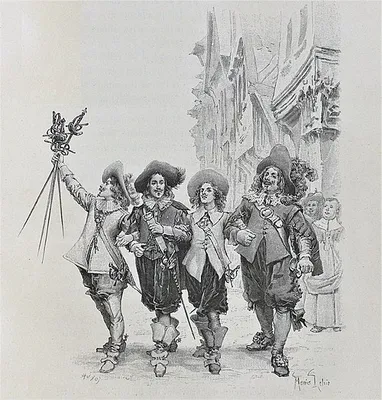
The Three Musketeers recounts d'Artagnan's adventures joining the Musketeers and navigating court intrigue and state affairs.
Alexandre Dumas's 1844 historical adventure novel, The Three Musketeers, follows the young d'Artagnan as he journeys to Paris with aspirations of joining the elite Musketeers of the Guard. Though initially unsuccessful, he befriends three seasoned musketeers: Athos, Porthos, and Aramis. The narrative unfolds between 1625 and 1628, detailing their involvement in significant political machinations and courtly affairs, often in opposition to Cardinal Richelieu. The novel is characterized by its swashbuckling genre, featuring heroic swordsmen fighting for justice. Beyond its adventure elements, the story critiques the injustices and absurdities of the Ancien Régime, lending it political resonance during a period of French republican versus monarchist debate.
Dumas presented the novel as a recovered manuscript, drawing inspiration from historical accounts. He collaborated with ghostwriter Auguste Maquet, who conducted historical research and proposed plot outlines, which Dumas then developed with his distinctive style. The story was initially serialized in the newspaper Le Siècle. It forms the first of Dumas's d'Artagnan Romances, with its narrative continued in subsequent works.
Literary Origins and Collaboration
Alexandre Dumas's The Three Musketeers was published in 1844, presented by Dumas as a dramatized discovery of historical manuscripts. He claimed inspiration from Gatien de Courtilz de Sandras's "Mémoires de Monsieur d'Artagnan," specifically an anecdote about d'Artagnan encountering three Béarnese men named Athos, Porthos, and Aramis. Dumas's narrative of finding these names in a manuscript titled "Mémoire de M. le comte de la Fère" is part of his fictionalized presentation of the work's genesis. Crucially, the novel was a product of collaboration with ghostwriter Auguste Maquet. Maquet's role involved historical research and the creation of plot outlines, which Dumas then elaborated upon, infusing the narrative with his unique voice and style. This collaborative process was also employed for the novel's sequels and other significant works by Dumas.
Themes of Justice and Political Commentary
While primarily a historical adventure and swashbuckler novel, The Three Musketeers delves into significant political and social commentary relevant to its time. Set against the backdrop of the Ancien Régime, the story frequently highlights and critiques the era's injustices, abuses of power, and systemic absurdities. This underlying political dimension resonated with the fervent debates between republicans and monarchists in France during the July Monarchy, the period of its publication. The narrative champions a sense of justice, embodied by the heroic, chivalrous swordsmen who fight for their ideals. The intricate plot involving Cardinal Richelieu, Queen Anne, and the Duke of Buckingham underscores themes of statecraft, espionage, and the complex interplay of personal honor and national interest.
Key Ideas
- The concept of "all for one, and one for all" as a motto for camaraderie and loyalty.
- Exploration of honor, duty, and personal vendetta within a historical context.
- Critique of political corruption and abuses of power within the French monarchy.
- The romanticized ideal of the swashbuckling hero fighting for justice.
Books by Athos Publishing
1 free public domain book · Read online or download