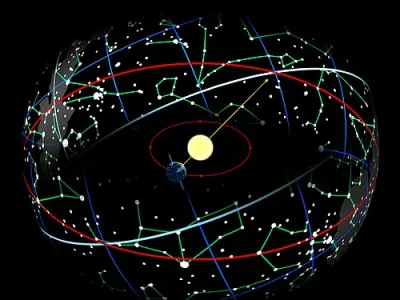
The zodiac is a celestial belt divided into twelve signs, originating in Babylonian astronomy and influential in Western astrology and modern astronomy.
The zodiac is a band of the sky, extending roughly 8 degrees north and south of the ecliptic, which is the Sun's apparent path over a year. This region contains the Moon and the brightest planets. It is divided into twelve equal segments, each 30 degrees, known as signs, which roughly align with constellations like Aries, Taurus, and Pisces. Historically, these signs were used to mark the time of year based on the Sun's position. Originating in Babylonian astronomy around the 1st millennium BC, the zodiacal system and its 360-degree division were adopted by Greek astronomy by the 2nd century BC and also influenced the Hindu zodiac. The precession of the equinoxes has caused a shift, so the Sun's position relative to constellations has changed since ancient times.
While the zodiac remains a basis for the ecliptic coordinate system in astronomy, its terms and sign names are now primarily associated with horoscopic astrology. The term 'zodiac' can also refer to the specific celestial band containing the paths of planets or other celestial bodies. Its name, derived from the Greek word for 'little animals,' reflects the prevalence of animal and hybrid figures among its twelve signs. The system has also seen parallels drawn with East Asian twelve-year cycles, particularly in the association of animal figures with personality traits.
Origins and Development
The zodiac's origins trace back to Babylonian astronomy in the first half of the 1st millennium BC, drawing on earlier star catalogs. Around the 5th century BC, Babylonian astronomers divided the ecliptic into twelve 30-degree segments, mirroring a 30-day month system, thus creating the first celestial coordinate system. This system was transmitted to Greek astronomy by the 2nd century BC and also influenced the development of the Hindu zodiac. Early astronomical records, such as Egyptian decans from as early as the 14th century BC, also show divisions of the celestial sphere. The term 'zodiac' itself comes from the Greek word for 'little animals,' highlighting the significance of animal and mythological figures within the twelve signs.
Astronomical and Astrological Usage
The zodiac serves as a celestial coordinate system, specifically an ecliptic coordinate system, using the ecliptic for latitude and the vernal equinox for longitude. This system is still employed in modern astronomy for tracking Solar System objects. However, the term and its associated sign names are now predominantly linked with horoscopic astrology, a practice that assigns attributes to the time of year each sign represents. The concept was adopted by Hellenistic astronomy from Babylonian sources and was further developed by figures like Ptolemy in the 2nd century AD, whose work significantly shaped Western astrological traditions. Ptolemy clarified the zodiac as a tropical coordinate system, aligned with equinoxes and solstices rather than fixed stars.
Historical Influence and Interpretations
The influence of the zodiac extended into various cultures and belief systems. Knowledge of the Babylonian zodiac is suggested to be reflected in Hebrew traditions, with interpretations linking zodiacal signs to biblical figures and the twelve tribes of Israel. By the Roman era, Babylonian concepts had been integrated into Hellenistic astronomy, to the point where 'Chaldean wisdom' became synonymous with astrological divination. The Dendera zodiac, a relief from around 50 BC, is noted as the earliest known depiction of the classical twelve-sign zodiac. Despite the shift in astronomical understanding due to the precession of the equinoxes, which alters the alignment of zodiac signs with constellations over centuries, the zodiac remains a foundational element in astrological practice.
Key Ideas
- A celestial belt divided into 12 signs of 30 degrees each.
- Originating in Babylonian astronomy and adopted by Greek and Hindu traditions.
- Basis for the ecliptic coordinate system in astronomy.
- Primarily associated with horoscopic astrology today.
- Name derived from Greek for 'little animals'.
- Influenced by precession of the equinoxes over time.
Books by
4 free public domain books · Read online or download