Arthur Edward Waite Darcy Kuntz
The Hermetic Order of the Golden Dawn was a secret society influential in Western esotericism, focusing on magic and spiritual development.
The Hermetic Order of the Golden Dawn, active in Britain during the late 19th and early 20th centuries, was a significant force in Western esoteric traditions. Drawing inspiration from Rosicrucianism and Freemasonry, its members engaged in the study and practice of occult Hermeticism and metaphysics. The Order is recognized for its influence on contemporary magical and spiritual practices, including Wicca and Thelema. Its structure was hierarchical, based on initiation and a curriculum derived from the Cipher Manuscripts, which outlined rituals and teachings on Hermetic Qabalah, astrology, tarot, and geomancy.
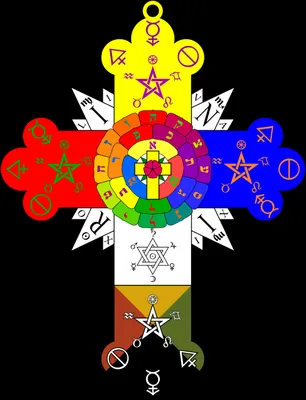
The Order was organized into three distinct levels: the First Order (Outer Order) for foundational esoteric philosophy, the Second Order (Inner Order, Rosae Rubeae et Aureae Crucis) for magical practices like scrying and astral travel, and the Third Order (Secret Chiefs) who were believed to guide the lower orders through spiritual communication. Founded by Freemasons and Rosicrucians, the Golden Dawn admitted women equally with men, a departure from some contemporary fraternal organizations. Its teachings and rituals profoundly shaped the landscape of 20th-century occultism.
Origins and Structure
The Hermetic Order of the Golden Dawn emerged from the Western esoteric tradition, with its roots in Rosicrucianism and inspiration from Freemasonry. Its founders, William Robert Woodman, William Wynn Westcott, and Samuel Liddell Mathers, were all Freemasons and members of the Societas Rosicruciana in Anglia. Westcott is considered the primary initiator of the Order. The Golden Dawn's system was built upon a structure of hierarchy and initiation, mirroring Masonic lodges, but uniquely allowed women to participate on equal terms with men. The Order comprised three tiers: the First Order focused on esoteric philosophy, Hermetic Qabalah, and personal growth through elemental study and divination techniques. The Second Order, known as the Rosae Rubeae et Aureae Crucis, delved into practical magic, including scrying and alchemy. The Third Order, the Secret Chiefs, were believed to be highly advanced spiritual entities who provided guidance to the lower orders.
The Cipher Manuscripts and Founding Rituals
The foundation of the original Golden Dawn lay in the Cipher Manuscripts, documents written in a cipher attributed to Trithemius. These manuscripts detailed the specific rituals for the Order's grades and outlined a curriculum covering Hermetic Qabalah, astrology, occult tarot, geomancy, and alchemy. The manuscripts reportedly passed from Masonic scholar Kenneth R. H. Mackenzie to Reverend A. F. A. Woodford, who then gave them to William Wynn Westcott. Westcott, with assistance from Samuel Liddell MacGregor Mathers and William Robert Woodman, deciphered and developed these manuscripts into a functional system for lodge activities. Mathers is particularly credited with designing the curriculum and rituals for the Second Order, named the Ordo Rosae Rubeae et Aureae Crucis.
Development and Internal Strife
The first temple, Isis-Urania, was established in London in 1888, with other temples following in various British cities and Paris. Initially, the Order functioned as a cohesive group known as the First Order. By 1892, the Second Order became active, comprising members who had completed the First Order's studies. The concept of the Secret Chiefs, believed to be guiding intelligences, played a crucial role, with Westcott initially claiming correspondence with Anna Sprengel, a Rosicrucian contact. Later, Mathers asserted direct communication with these Chiefs, supplying rituals for the Second Order. By the mid-1890s, the Golden Dawn had gained significant membership and attracted notable figures. However, by the end of the century, dissatisfaction grew regarding Mathers's leadership and his association with Aleister Crowley, leading to internal disputes and eventually a revolt and splintering of the Order.
Key Ideas
- Hermetic Qabalah: A system of Jewish mysticism adapted for esoteric study.
- Theurgy: Ritual magic intended to invoke divine forces or spirits.
- Spiritual Development: Focus on personal growth through occult study and practice.
- Secret Chiefs: Alleged spiritual guides directing esoteric orders.
- Cipher Manuscripts: Coded documents forming the basis of the Order's teachings and rituals.
Books by Arthur Edward Waite Darcy Kuntz
0 free public domain books · Read online or download
