Antonia Beattie
The phrase 'Think of the children' evolved from a genuine concern for children's welfare into a rhetorical tactic, often used to manipulate emotions in debates.
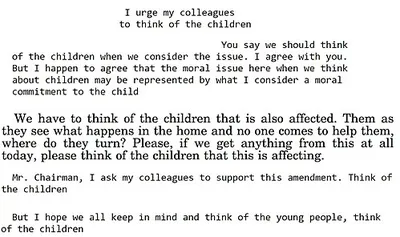
The phrase 'Think of the children,' also known as 'What about the children?', originated as a genuine plea for the rights and welfare of children, particularly concerning issues like child labor in the early 20th century. However, over time, it transformed into a rhetorical device frequently employed in debates and discussions. This evolution is attributed to its power to evoke strong emotional responses, often substituting pathos for logos, which can lead to it being classified as a logical fallacy.
Its popularization was significantly amplified by media, notably the 1964 film Mary Poppins and, more famously, the 1990s animated series The Simpsons, where it became a recurring satirical element. This media exposure led to various satirical and critical labels for the tactic, such as 'Lovejoy's Law' or 'think-of-the-children-ism'. While the phrase can still be used literally to advocate for child protection, its prevalent use as a debate tactic has led to widespread mockery and criticism for its potential to shut down rational discourse and manipulate public opinion, often in contexts of censorship and moral panics.
Evolution into a Rhetorical Tactic
The phrase 'Think of the children' has a dual nature, originating as a literal concern for children's rights and welfare, but evolving into a potent rhetorical tactic. Academic analyses, such as those in 'Art, Argument, and Advocacy' (2002), highlight how this appeal can substitute emotional manipulation for reasoned argument in debates. Ethicist Jack Marshall noted in 2005 that its popularity stems from its capacity to stifle rational discourse, particularly on moral issues. Proponents of censorship have frequently invoked the phrase to shield children from perceived dangers. Furthermore, classifying children as inherently innocent and in need of constant protection, as discussed in 'Community, Space and Online Censorship' (2009), can be seen as an obsession with purity. The phrase's trajectory reflects its growth from an earnest plea to a tool for emotional persuasion, often linked to moral panics and the desire to control information or behavior.
Media Popularization and Satirization
The phrase gained significant traction and became widely recognized through its appearance in popular media. An early notable instance was in the 1964 Disney film Mary Poppins, where Mrs. Banks uses it to implore her nanny to stay. However, its widespread satirization began with the animated television program The Simpsons in 1996. The character Helen Lovejoy's repeated, often contextually inappropriate, use of variations like 'Will someone please think of the children?' made the phrase a cultural touchstone for what was perceived as an overly emotional or irrational appeal. This popularization led to the coining of numerous terms to describe the tactic, including 'Lovejoy's Law,' 'the Lovejoy argument,' and 'think-of-the-children-ism,' reflecting its transformation into a recognizable, and often mocked, rhetorical device.
Literal Advocacy for Child Welfare
Despite its evolution into a rhetorical fallacy, the phrase 'Think of the children' has a history of sincere application in advocating for children's rights. Early 20th-century organizations like the National Child Labor Committee used it to critique exploitative labor practices. In 1999, U.S. President Bill Clinton invoked the sentiment in a speech to the International Labour Organization, envisioning children freed from dangerous work. This literal usage continues into the 21st century, with legal advocates and scholars employing the phrase to highlight issues such as child labor, debt bondage, and the need for international child rights protections. It has also been used to emphasize developmental considerations in counseling youth, demonstrating its enduring capacity for genuine child advocacy when applied thoughtfully.
Use in Censorship and Moral Panics
The phrase 'Think of the children' has been a recurring element in debates surrounding censorship and societal anxieties. Authors like Scott Beattie (2009) have noted its frequent use by those advocating for censorship, framing children as vulnerable to perceived online dangers and thus justifying increased regulation. This framing often infantilizes children and reflects an obsession with purity. Cory Doctorow (2011) identified its use to shut down rational discussion on issues like online dangers, terrorists, or organized crime. The phrase has been associated with 'moral panics,' where media amplification of perceived threats to children fuels public anxiety and supports calls for control. This tactic is often employed to stifle debate and prevent nuanced analysis of complex societal issues, particularly concerning media content and online activities.
Key Ideas
- The phrase 'Think of the children' can be both a genuine appeal for child welfare and a logical fallacy (appeal to emotion).
- Its use often serves to shut down rational debate by evoking emotional responses.
- Media, particularly television, has played a significant role in popularizing and satirizing the phrase.
- The tactic is frequently employed in censorship debates and contexts of moral panic.
- The phrase can be linked to societal obsessions with purity and the infantilization of children.
Notable Quotes
“Think of the children!”
“What about the children?”
“Think of the children ... freed of the crushing burden of dangerous and demeaning work, given back those irreplaceable hours of childhood for learning and playing and living.”
“I know this national missile defense plan has its detractors, but won't someone please think of the children?”
“How many kittens must die?”
Books by Antonia Beattie
9 free public domain books · Read online or download