Antares Stanislas
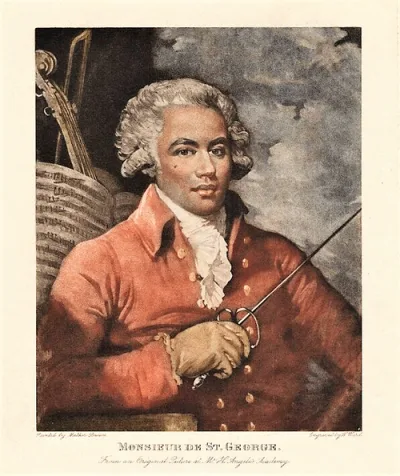
Joseph Bologne, Chevalier de Saint-Georges, was a pioneering French composer, violinist, and fencer of African descent.
Joseph Bologne, known as the Chevalier de Saint-Georges, was a remarkable figure of the late 18th century, excelling as a violinist, conductor, composer, soldier, athlete, and dancer. Born in Guadeloupe in 1745, he was the son of a white plantation owner and an enslaved African woman. Brought to France at age seven, he received a comprehensive education that included music and fencing, where he achieved significant recognition.
Saint-Georges rose to prominence in Parisian musical circles, becoming conductor of the orchestra Le Concert des Amateurs and later directing the Paris Opera, though his tenure there was cut short by racial prejudice. His musical output included symphonies, concertos, and operas. During the French Revolution, he served as a military officer and was briefly imprisoned. Despite facing discrimination, he is recognized as the first classical composer of African descent to gain widespread acclaim in Europe, a contemporary of Mozart, and sometimes referred to as the "Black Mozart."
Early Life and Rise to Prominence
Born Joseph Bologne in Guadeloupe on December 25, 1745, he was the illegitimate son of a wealthy white planter and an enslaved African woman. His father, Georges Bologne de Saint-Georges, acknowledged him and provided for his education. At the age of seven, Joseph was taken to France, where he received formal schooling. He distinguished himself early on as a fencer, earning the title "Chevalier de Saint-Georges" after an impressive victory and appointment as a "gendarme de la garde du roi." This period also saw him receive musical instruction, laying the groundwork for his future artistic career. His father's status as a "Gentilhomme ordinaire de la chambre du roi" added to his social standing, though legal barriers related to his birth status persisted.
Musical Career and Innovations
Saint-Georges's musical journey began in earnest in Paris. While details of his early training are scarce, his prodigious talent as a violinist was evident. He joined the esteemed orchestra Le Concert des Amateurs, eventually becoming its conductor in 1773, leading it to be considered one of the finest orchestras in Europe. He also took on the direction of the Paris Opera, though faced opposition from some performers due to his race. His compositional work, which included violin concertos, string quartets, and operas, was influenced by contemporaries like Haydn and Gossec. By 1785, he had shifted his focus entirely to composing, ceasing instrumental works to concentrate on stage pieces.
Revolutionary Era and Legacy
The French Revolution profoundly impacted Saint-Georges's life. He left for England and upon his return to France, joined the National Guard and later commanded the Légion St.-Georges, an army unit composed of men of color. His connections to influential figures like Marie Antoinette and the Duke of Orléans placed him under suspicion during the Reign of Terror, leading to his imprisonment for over eleven months. Despite these trials, Saint-Georges's legacy as a groundbreaking musician and athlete of African descent remains significant. He is often compared to Mozart, sometimes called the "Black Mozart," a designation that highlights his unique position in European classical music history.
Key Ideas
- Pioneering Black classical composer in Europe
- Excellence in multiple disciplines (music, fencing, athletics)
Notable Quotes
“I prefer to think of Mozart as the white Chevalier.”
Books by Antares Stanislas
12 free public domain books · Read online or download