Anna Bonus Kingsford
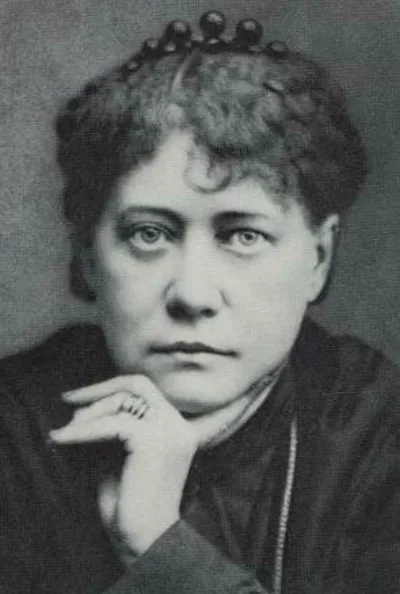
Helena Blavatsky was a Russian mystic and writer, co-founder of the Theosophical Society, known for her esoteric teachings.
Helena Petrovna Blavatsky, born in 1831, was a Russian-American mystic and writer who became a central figure in the development of modern esotericism. She co-founded the Theosophical Society in 1875, establishing Theosophy as a distinct belief system. Blavatsky's life was marked by extensive travels, though the authenticity of these journeys, particularly to Tibet, has been debated by scholars. She was involved in the Spiritualist movement before establishing her own unique philosophy.
Blavatsky's writings, such as "Isis Unveiled" and "The Secret Doctrine," presented Theosophy as a synthesis of science, religion, and philosophy, aiming to revive ancient wisdom. Her teachings drew heavily on Hermeticism and Neoplatonism, and she claimed to have been trained by spiritual adepts. Despite facing accusations of fraud and being a controversial figure throughout her life, her ideas significantly influenced Western understanding of Eastern religions and contributed to various esoteric movements, including the New Age Movement.
Early Life and Influences
Born Helena Petrovna Hahn von Rottenstern in 1831 into an aristocratic Russian family, Blavatsky's early life was marked by frequent moves across the Russian Empire due to her father's military career. Her mother, also a writer, died when Helena was young, and she was subsequently raised by her maternal grandparents. During her childhood, she was exposed to Tibetan Buddhism through interactions with Kalmyk leaders, which may have sparked her early interest in Eastern religions. She received a broad education in subjects like music, art, and languages, intended to prepare her for marriage. Biographers note that disentangling factual accounts from her later embellished narratives is challenging, as she often provided conflicting or fabricated details about her past.
Theosophy and Theosophical Society
Blavatsky's involvement in the Spiritualist movement led her to relocate to the United States in 1873. There, alongside Henry Steel Olcott and William Quan Judge, she co-founded the Theosophical Society in 1875. Her seminal work, "Isis Unveiled" (1877), laid out the foundational principles of Theosophy, which she described as a synthesis of science, religion, and philosophy, aiming to uncover the universal truths underlying all world religions. This system was presented as a revival of an "Ancient Wisdom." Later, in India, she and Olcott formally converted to Buddhism. Despite opposition and accusations of fraudulent phenomena, Theosophy gained traction, particularly in India.
Later Life and Legacy
In 1885, due to declining health, Blavatsky returned to Europe and established the Blavatsky Lodge in London. During this period, she published "The Secret Doctrine," a major work exploring ancient Tibetan manuscripts, along with "The Key to Theosophy" and "The Voice of the Silence." She passed away in 1891. Throughout her life, Blavatsky was a polarizing figure, seen by supporters as a wise sage and by critics as a fraud. Nevertheless, her dissemination of Hindu and Buddhist concepts in the West, and her role in shaping Western esoteric thought, had a lasting impact, influencing movements such as Anthroposophy and the New Age Movement.
Key Ideas
- Theosophy as a synthesis of science, religion, and philosophy
- Revival of the "Ancient Wisdom" underlying all religions
- Spiritual training by "Masters of the Ancient Wisdom"
Books by Anna Bonus Kingsford
3 free public domain books · Read online or download