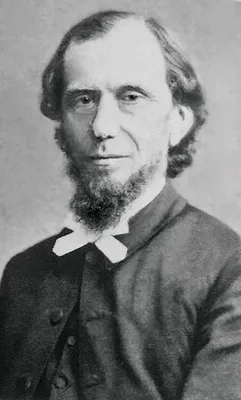
Andrew Murray was a South African pastor and prolific author known for his influential writings on the spiritual life and mission work.
Andrew Murray, born in 1828 in South Africa, was a prominent Dutch Reformed Church pastor, educator, and writer. His father, also a missionary, instilled in him a strong sense of Christian duty. Murray received his early education in Scotland and later studied theology in the Netherlands, where he was influenced by the Het Réveil revival movement. He married and had eight children.
Throughout his extensive ministry, Murray pastored churches in various South African locations and was a significant figure in the South African Revival of 1860. He co-founded the South African General Mission, which evolved into the Africa Evangelical Fellowship. Murray's prolific writings, numbering over 240 books and tracts, explored themes of the "Inner Life" and "Higher Life," positioning him as a precursor to the Pentecostal movement due to his views on faith healing and spiritual gifts. He died in 1917, leaving behind a substantial body of theological and devotional literature.
Early Life and Education
Andrew Murray was born in 1828 in Graaff Reinet, South Africa, the second child of a Dutch Reformed Church missionary from Scotland and a mother of French Huguenot and German Lutheran heritage. He pursued his initial education alongside his brother at the University of Aberdeen in Scotland, earning master's degrees in 1845. During their time in Scotland, they were influenced by revival meetings and the ministries of figures like Robert Murray McCheyne. Subsequently, both brothers studied theology at the University of Utrecht in the Netherlands, becoming involved with Het Réveil, a religious movement that opposed the prevailing rationalism. They were ordained in 1848 and returned to South Africa. Murray married Emma Rutherford in 1856, and they had eight children.
Ministry and Mission Work
Murray served as a pastor in several South African towns, including Bloemfontein, Worcester, Cape Town, and Wellington. He was a key proponent of the South African Revival of 1860. In 1889, he co-established the South African General Mission (SAGM), which later merged and evolved into the Africa Evangelical Fellowship (AEF). Murray's extensive writings contributed significantly to the "Inner Life" or "Higher Life" movements. His theological perspectives on faith healing and the continuation of apostolic spiritual gifts are considered foundational for the later Pentecostal movement. He also engaged with prominent figures in the Keswick Convention movement.
Literary Contributions
Andrew Murray was an exceptionally prolific author, with estimates suggesting over 240 books and tracts published. Many of his works were translated into both Dutch and English. His writings often focused on devotional and spiritual themes, exploring concepts of surrender, faith, and the indwelling of Christ. A notable series, the "Secret" series, was initiated by Murray with plans for twelve pocket books, with four published during his lifetime and the remainder released posthumously by his family. His literary output continues to be studied by those interested in spiritual growth and Christian theology.
Key Ideas
- The primary purpose of the church is missions.
- Emphasis on the "Inner Life" and "Higher Life" of believers.
- Belief in faith healing and the continuation of apostolic spiritual gifts.
- The importance of prayer, surrender, and abiding in Christ.
Notable Quotes
“missions to be "the chief end of the church"”
Books by
3 free public domain books · Read online or download