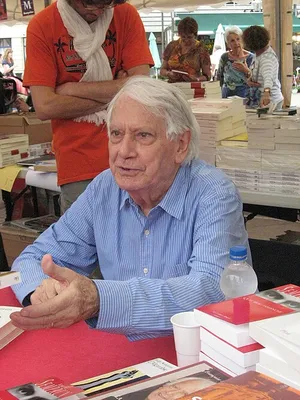
Andre Neher
Jorge Semprún was a Spanish writer, politician, and Holocaust survivor who wrote extensively about memory and persecution, primarily in French.
Jorge Semprún Maura was a Spanish writer, politician, and Holocaust survivor, born in Madrid in 1923. He spent much of his life in France and wrote predominantly in French. Semprún's early life was marked by political upheaval; his family fled Spain during the Civil War and later became refugees in France. During the Nazi occupation, he joined the Resistance and was deported to Buchenwald concentration camp. This experience profoundly shaped his literary work, which often explored themes of memory, persecution, and the human condition under duress.
After the war, Semprún was active in the exiled Communist Party of Spain, even working clandestinely within Spain. However, he was expelled from the party in 1964, after which he focused on his writing career. His literary output includes novels, plays, and screenplays. He gained international recognition for his screenwriting, particularly for Costa-Gavras films like 'Z' and 'The Confession,' and received an Academy Award nomination for 'La Guerre est finie.' Semprún also served as Spain's Minister of Culture from 1988 to 1991. He was the first non-French author elected to the Académie Goncourt and received the Jerusalem Prize for his engagement with Zionism.
Experiences of Persecution and Memory
Semprún's formative experiences, particularly his deportation to and survival of the Buchenwald concentration camp, form a central theme in his extensive body of work. He meticulously explored the act of remembering and the challenge of conveying such profound trauma to those who did not experience it. His writing often employed a non-linear, achronological structure, reflecting how memory itself operates, shifting between past, present, and future. Semprún also reflected on the historical continuum of persecution, noting how sites like Buchenwald were later repurposed and obscured, highlighting the ongoing struggle to confront difficult historical truths. His literary approach was deeply self-reflexive, examining the process of writing about traumatic events and their enduring impact.
Political Life and Literary Career
Beyond his literary achievements, Semprún was deeply involved in political life. He was an organizer for the exiled Communist Party of Spain during Franco's dictatorship and later served as Spain's Minister of Culture. His political engagement, particularly his Zionist leanings, set him apart from many left-wing figures in Spain. Semprún's writing career, which he pursued seriously after his expulsion from the Communist Party, garnered significant accolades. He was nominated for an Academy Award for his screenplays and was the first non-French author to be elected to the prestigious Académie Goncourt. His works often blended personal experience with broader political and historical commentary, examining themes of resistance, exile, and the complexities of political ideology.
Key Ideas
- The nature of memory and the challenge of representing trauma
- The continuum of persecution and the importance of confronting historical truth
- The intersection of personal experience, political engagement, and literary expression
- The exploration of identity within the context of exile and historical upheaval
Books by Andre Neher
0 free public domain books · Read online or download
