Andre Cherpillod
Bartitsu, an eclectic martial art developed in England around 1900, combined various fighting styles and was later revived.
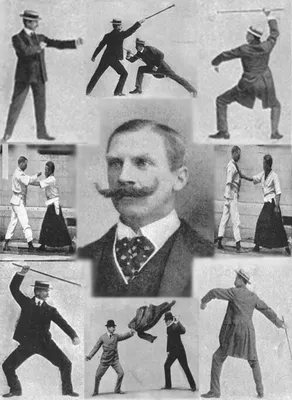
Bartitsu is a martial art and self-defense system that originated in England between 1898 and 1902. Developed by Edward William Barton-Wright, it synthesized elements from boxing, jujutsu, cane-fighting, and savate. Barton-Wright, an engineer with prior experience studying jujitsu in Japan, aimed to create a comprehensive self-defense method by integrating the most effective techniques from different disciplines. He named it Bartitsu, a portmanteau of his surname and "jujitsu", defining it as "self defence in all its forms".
The system was taught at the Bartitsu Club in London, which Barton-Wright established. The club employed instructors in various arts, including Yukio Tani and Sadakazu Uyenishi in jujutsu, Pierre Vigny in stick fighting, and Armand Cherpillod in wrestling. Bartitsu incorporated physical culture and, at one point, even electrotherapy machines. Although dormant for much of the 20th century, Bartitsu has seen a resurgence in interest since 2002. Sir Arthur Conan Doyle notably referenced a similar technique, mistakenly calling it "baritsu", in his Sherlock Holmes stories.
Origins and Development
Bartitsu emerged from the efforts of Edward William Barton-Wright, an English engineer who had spent time in Japan studying jujitsu. Upon returning to England in 1898, he announced a new self-defense system, Bartitsu, which he claimed unified the best aspects of various fighting styles. Barton-Wright had also trained in boxing, wrestling, fencing, and savate, and reportedly tested his methods against street fighters. The name Bartitsu itself was a blend of his surname and "jujitsu", signifying "self defence in all its forms". The system drew heavily from Shinden Fudo Ryu jujutsu and Kodokan Judo, incorporating techniques from British boxing, Swiss schwingen, French savate, and a defensive stick-fighting style developed by Pierre Vigny. Bartitsu also included a physical culture training regimen.
The Bartitsu Club and its Instructors
To promote his art, Barton-Wright established the Bartitsu Club in London, which served as an academy for arms and physical culture. The club featured a gymnasium and even electrotherapy machines. He arranged for Japanese jujutsu practitioners Yukio Tani and Sadakazu Uyenishi to teach at the club, alongside Swiss master-at-arms Pierre Vigny and wrestler Armand Cherpillod. These instructors demonstrated the effectiveness of their respective arts, particularly jujutsu, in challenge matches. The club also became a hub for historical fencing enthusiasts led by Captain Alfred Hutton. Membership included notable figures, and the club operated on a model similar to Victorian sporting clubs, with a committee reviewing applications.
Philosophy of Self-Defense
Bartitsu was designed as a holistic approach to self-defense, encouraging students to master multiple combat ranges. The system emphasized Vigny's cane fighting for striking and jujutsu for grappling, with boxing and savate used to transition between ranges or as initial responses. Barton-Wright modified boxing and savate techniques for self-defense, aiming to injure an attacker's limbs. He considered jujutsu a "secret weapon" due to its limited availability in England at the time. The stick fighting aspect involved preemptive strikes or "baiting" an opponent, targeting vital areas and often integrating close-combat techniques like trips and throws, a fusion unique to Bartitsu.
Key Ideas
- Eclectic martial art combining boxing, jujutsu, cane-fighting, and savate.
- Emphasis on cross-training across different combat ranges.
- Modification of sporting techniques for practical self-defense.
- Fusion of stick fighting with jujutsu for unique close-combat tactics.
Notable Quotes
“Under Bartitsu is included boxing, or the use of the fist as a hitting medium, the use of the feet both in an offensive and defensive sense, the use of the walking stick as a means of self-defence. Judo and jujitsu, which are secret styles of Japanese wrestling, (I) would call close play as applied to self-defence.”
“In order to ensure, as far as it is possible, immunity against injury in cowardly attacks or quarrels, (one) must understand boxing in order to thoroughly appreciate the danger and rapidity of a well-directed blow, and the particular parts of the body which are scientifically attacked. The same, of course, applies to the use of the foot or the stick.”
“Judo and jujitsu were not designed as primary means of attack and defence against a boxer or a man who kicks you, but are only to be used after coming to close quarters, and in order to get to close quarters it is absolutely necessary to understand boxing and the use of the foot.”
Books by Andre Cherpillod
0 free public domain books · Read online or download
