Alisher Farhadi
The story of Layla and Majnun, originating in 7th-century Arabia, gained widespread popularity through Nizami Ganjavi's 12th-century Persian poem, influencing mystical and secular literature.
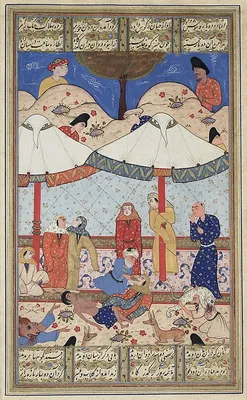
The ancient Arab tale of Layla and Majnun centers on Qays ibn al-Mulawwah, a poet who became known as Majnun ('the mad one') due to his consuming love for Layla bint Mahdi. Their union was forbidden by Layla's father, leading Qays to wander the desert in a state of obsession. The story, which originated in the 7th century, circulated in anecdotal forms before being immortalized by the Persian poet Nizami Ganjavi in 1188 CE. Nizami's rendition, the third part of his Khamsa, significantly popularized the romance across Persian, Turkish, and Indic cultures, drawing on existing legends and Udhrite love poetry characterized by unfulfilled longing.
Nizami's work inspired numerous subsequent poets to create their own versions, including notable adaptations by Amir Khusrow Dehlavi and Jami. The narrative also took on mystical dimensions, with Sufi mystics using Majnun's story to illustrate concepts like annihilation (fanaa) and divine madness. The tragic romance, often compared to Romeo and Juliet, represents a form of 'virgin love' where passion remains unconsummated. While Qays died in the wilderness near Layla's grave, Layla herself is depicted as having died earlier, possibly from a broken heart.
Origins and Early Circulation
The love story of Layla and Majnun traces its roots to 7th-century Arabia, focusing on the poet Qays ibn al-Mulawwah and his beloved Layla bint Mahdi. Qays's profound infatuation led to him being labeled 'Majnun,' meaning 'crazy' or 'possessed by Jinn.' Before its later poetic popularization, the legend existed in fragmented, anecdotal forms documented in early Arabic works like Kitab al-Aghani and Ibn Qutaybah's Al-Shi'r wa-l-Shu'ara'. These early accounts offered little plot development, primarily consisting of short, loosely connected narratives about the lovers. The tale's transmission from Arabic to Persian, Turkish, and Indic languages was significantly amplified by Nizami Ganjavi's 1188 CE epic poem.
Nizami Ganjavi's Popularization and Influence
Nizami Ganjavi's rendition of Layla and Majnun, incorporated as the third part of his Khamsa, became a pivotal moment in the story's history. He synthesized both secular and mystical sources, crafting a vivid and compelling portrayal of the lovers that resonated widely. Nizami's work was deeply influenced by Udhrite love poetry, which emphasizes intense attraction and longing, often unfulfilled. This masterful adaptation sparked a wave of imitations across Persian, Turkish, and Indian literature, with poets striving to emulate or surpass his version. The story's popularity grew exponentially, evident in its increased presence in lyrical poetry and mystical masnavis from the 12th century onward.
Mystical Interpretations and Thematic Significance
Beyond its romantic narrative, the Layla and Majnun story acquired profound mystical significance, particularly within Sufi traditions. Mystics adopted Majnun's tale as an allegory to explain complex spiritual concepts. His intense devotion and apparent madness were reinterpreted as symbols of divine love, self-sacrifice, and the annihilation of the ego (fanaa) in pursuit of the Divine. The concept of 'divanagi' or love-madness became central to illustrating the ecstatic state experienced by those deeply devoted to God. This allegorical layer elevated the story from a simple romance to a profound exploration of spiritual longing and transcendence, contributing to its enduring appeal in esoteric literature.
Later Adaptations and Legacy
Following Nizami's influential work, numerous poets across different cultures crafted their own versions of the Layla and Majnun romance. Notable among these are Amir Khusrow Dehlavi's Majnun o Leyli and Jami's version, alongside reworkings by Maktabi Shirazi, Hatefi, and Fuzuli, which gained popularity in the Ottoman Empire and India. The story's enduring appeal is also seen in modern adaptations, such as Shawqi's Arabic play, 'The Mad Lover of Layla.' The narrative's tragic arc and themes of unattainable love have led to comparisons with Western stories like Romeo and Juliet, solidifying its status as a timeless exploration of passionate, often unfulfilled, devotion.
Key Ideas
- Udhrite love: characterized by erotic abandon and unfulfillable longing.
- Virgin love: a type of love where lovers do not marry or consummate their passion.
- Fanaa: mystical concept of annihilation of the ego in Sufism.
- Divanagi: love-madness, often interpreted as divine ecstasy in mystical contexts.
Notable Quotes
“I pass by this town, the town of Layla And I kiss this wall and that wall It's not Love of the town that has enraptured my heart But of the One who dwells within this town”
Books by Alisher Farhadi
1 free public domain book · Read online or download