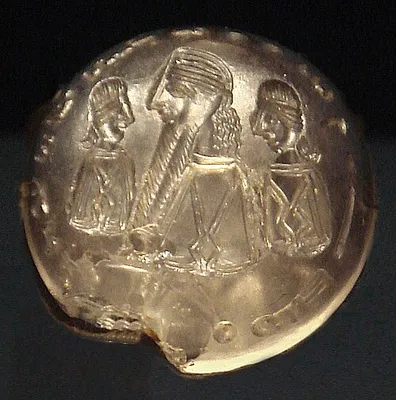
Alexander B Hlig
Mani was an Iranian prophet who founded Manichaeism, a syncretic religion blending various spiritual traditions.
Mani, born in Mesopotamia around 216 AD, was the Iranian prophet and founder of Manichaeism, a religion that gained prominence in late antiquity. His teachings synthesized elements from Christianity, Zoroastrianism, Buddhism, and various Gnostic and Mesopotamian traditions, centered on a dualistic struggle between good and evil. Mani wrote several major works, including the Shabuhragan in Middle Persian and others in Syriac. He traveled extensively, including to India, and presented his teachings to the Sasanian emperor Shapur I, who showed favor to his ideas.
Mani's life ended tragically under the persecution of Bahram I. He was imprisoned and died shortly thereafter, with accounts of his death varying, though some suggest mutilation. Despite the persecution, Manichaeism continued to spread, organized into a structure of 'elects' and 'auditors'. The primary source for understanding Mani's life and teachings is the Codex Manichaicus Coloniensis, discovered in 1969, though earlier accounts exist, often tinged with legend or polemic.
Origins and Early Life
Mani was born near Ctesiphon in Mesopotamia, at a time when it was part of the Parthian Empire. His father was from Ecbatana and belonged to the Jewish Christian sect of the Elcesaites, while his mother was of Parthian descent. Mani was raised in a religiously diverse environment, influenced by Elcesaitism, which had Gnostic leanings and Ebionite roots, and possibly by Marcion and Bardaisan. At a young age, he experienced visions of a divine companion, urging him to leave his father's sect and spread a new message. His appearance was noted as a blend of Iranian and Mesopotamian features, sometimes described as looking like a warrior or magician, and later texts suggest he was considered lame by opponents.
Travels and Ministry
Following his spiritual calling, Mani embarked on journeys to spread his teachings. He traveled to India, where he studied Hinduism and Buddhism, and engaged with their philosophical traditions. Upon his return, around 242 AD, he presented his work to the Sasanian emperor Shapur I. He dedicated his only known work in Persian, the Shabuhragan, to the emperor. While Shapur I did not convert to Manichaeism, he was favorable towards Mani's syncretic teachings, which blended Christianity, Buddhism, and Zoroastrianism, and allowed Mani to establish himself at court. Mani is said to have performed miracles and was also recognized for his artistic talents as a painter.
Persecution and Legacy
Mani's patronage continued under Shapur I's successor, Hormizd I. However, the situation changed drastically with Bahram I, who, influenced by the Zoroastrian reformer Kartir, initiated a persecution of Manichaeans. Mani was imprisoned by Bahram I and died within a month in 274 AD. Accounts of his death are varied, with some suggesting he was flayed and his body displayed, though historical evidence points more plausibly to post-mortem mutilation. Despite his demise, Mani's followers continued his work, organizing into a church structure with distinct classes of 'elects' and 'auditors'. His teachings aimed to synthesize major world religions, offering a dualistic worldview of an eternal struggle between good and evil.
Key Ideas
- Syncretic religion combining Christianity, Zoroastrianism, Buddhism, and Gnosticism.
- Dualistic cosmology of eternal struggle between good and evil.
- Salvation through education, self-denial, fasting, and chastity.
- Mani as the Paraclete and final prophet.
- Church organization with 'elects' and 'auditors'.
Books by Alexander B Hlig
0 free public domain books · Read online or download
