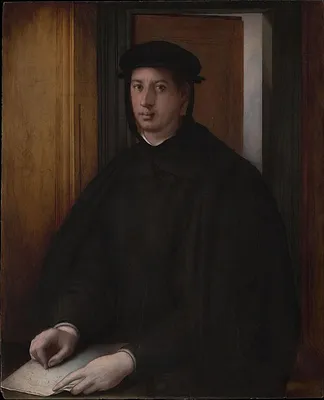
Alessandro Palazzo
Alessandro de' Medici, the first hereditary Duke of Florence, ruled briefly before his assassination.
Alessandro de' Medici, known as 'il Moro,' served as the first hereditary Duke of Florence from 1530 until his assassination in 1537. His parentage was a subject of contemporary debate, with some suggesting he was the illegitimate son of Cardinal Giulio de' Medici (later Pope Clement VII), while others believed him to be the son of Lorenzo II de' Medici. His dark complexion led to his nickname. Alessandro's early life included a humanist education in Rome, and he was later brought to Florence with other Medici heirs due to a series of deaths in the senior family line. Following a popular revolt and the Sack of Rome, Alessandro was eventually installed as the head of state in Florence. He was later made a hereditary duke, marking the end of the Florentine Republic and the beginning of over two centuries of Medici rule. His reign saw the consolidation of ducal power, the construction of Fortezza da Basso, and patronage of the arts, though it was also marked by criticism from exiles and tensions with his cousin Ippolito. Alessandro was married to Margaret of Austria but maintained a mistress, Taddea Malaspina, with whom he had two illegitimate children. He was assassinated by his cousin Lorenzino de' Medici in 1537.
Ascension and Rule
Alessandro de' Medici rose to power in Florence following a period of political upheaval. After a siege supported by Spanish troops, he was appointed head of state by Pope Clement VII, who favored him over his cousin Ippolito. This appointment solidified Medici control and ended the Florentine Republic, establishing a hereditary dukedom. His rule was further formalized by the Florentine Constitution of 1532. Initially governing with the advice of elected councils, Alessandro gradually exhibited more authoritarian tendencies. He commissioned the Fortezza da Basso, a significant military fortification, to ensure the Medici's grip on the city. His government was characterized by a dual perception: some viewed him as just and a champion of the poor, while exiled factions condemned his rule as corrupt and incompetent.
Patronage and Controversy
As Duke of Florence, Alessandro de' Medici was a patron of the arts, commissioning works from prominent artists of the time, including Giorgio Vasari and Benvenuto Cellini. This patronage contributed to the cultural vibrancy of Florence during his reign. However, his rule was not without significant controversy. Florence's exiled community actively sought to undermine his authority, even enlisting his cousin Cardinal Ippolito to appeal to Emperor Charles V. Following Ippolito's suspicious death, rumors of poisoning circulated, though official responses, like that from diplomat Francesco Guicciardini, defended Alessandro's character and governance. Emperor Charles V continued to support Alessandro, even arranging his marriage to Margaret of Austria.
Assassination and Succession
Alessandro's rule was cut short by his assassination on January 6, 1537, by his distant cousin, Lorenzino de' Medici, known as 'Lorenzaccio.' Lorenzino lured Alessandro into a trap under the pretense of a meeting with a widow and ambushed him. Despite a struggle in which Alessandro bit off part of his attacker's finger, he succumbed to his wounds. His body was secretly buried to prevent immediate unrest. Lorenzino later claimed his motive was to restore the Republic, but his efforts to incite an uprising failed, and he fled to Venice. The power vacuum was filled by Cosimo I de' Medici, from a junior branch of the family, who succeeded Alessandro as Duke, ushering in a new era of Medici rule.
Books by Alessandro Palazzo
2 free public domain books · Read online or download