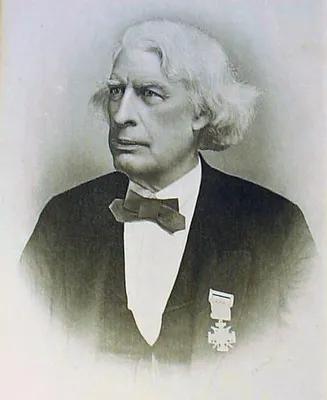
Albert Mackey
Albert Mackey was a physician and prolific author, renowned for his extensive writings on Freemasonry and esoteric symbolism.
Albert Gallatin Mackey (1807–1881) was an American physician and author, best known for his significant contributions to Masonic literature. Born in Charleston, South Carolina, he pursued a medical career, graduating in 1832 and later serving as a demonstrator of anatomy. However, he abandoned medical practice in 1844 to dedicate himself to writing and scholarly pursuits.
Mackey developed a deep interest in languages, the Middle Ages, and particularly Freemasonry. He established and edited Masonic periodicals, including The Southern and Western Masonic Miscellany. His scholarly work extended to acquiring proficiency in Greek, Latin, Hebrew, and continental languages, and he lectured on medieval intellectual history. Later in his career, he focused on abstruse symbolism, Kabbalistic, and Talmudic research. Mackey held prominent positions within Masonic organizations, including Master of Solomon's Lodge and Grand Secretary of the Grand Lodge of South Carolina, as well as Secretary General of the Scottish Rite's Southern Jurisdiction.
Beyond his Masonic work, Mackey was a unionist who participated in South Carolina's post-Civil War constitutional convention, serving as its president. He also held federal office as Collector of the Port of Charleston. He died in 1881, leaving behind a substantial body of work that continues to be influential in Masonic studies.
Masonic Scholarship and Esotericism
Albert Mackey dedicated a significant portion of his literary career to the study and explication of Freemasonry. He authored numerous influential books and articles, with his "Encyclopedia of Freemasonry" being considered his most important contribution to Masonic literature. Mackey's writings delved into the history, principles, and symbolism of the fraternity. He also explored "abstruse symbolism, and to cabalistic and Talmudic researches," indicating a deep interest in esoteric and mystical traditions beyond the standard Masonic curriculum. His acquisition of multiple languages, including Hebrew, facilitated his engagement with these ancient texts and symbolic systems. Mackey held high offices within Masonic bodies, including Grand Secretary and Secretary General of the Supreme Council of the Ancient and Accepted Scottish Rite for the Southern Jurisdiction, demonstrating his authoritative standing in the field.
Academic and Professional Life
Born in Charleston, South Carolina, Albert Gallatin Mackey followed in his physician father's footsteps, earning his medical degree from the College of South Carolina in 1832. He practiced medicine and served as a demonstrator of anatomy in Charleston. However, he transitioned away from active medical practice in 1844 to pursue his passion for writing and research. His intellectual curiosity was broad, encompassing languages, medieval history, and esoteric studies. Mackey was also involved in journalism, establishing a Masonic magazine and later conducting a quarterly journal dedicated to similar interests. His educational background and linguistic abilities allowed him to engage with diverse subjects and contribute significantly to scholarly discourse.
Civic and Political Engagement
Beyond his academic and fraternal pursuits, Albert Mackey was also engaged in civic and political life. A staunch unionist, he played a role in South Carolina's political landscape following the Civil War. He served as a delegate to the state's constitutional convention in 1868, where he was elected president of the body. His federal service included an appointment by President Andrew Johnson as Collector of the Port of Charleston in 1865. Mackey also made an attempt at higher office, running for the United States Senate in 1868, though he was narrowly defeated. He relocated to Washington, D.C. in 1870, continuing his work until his death in 1881.
Books by Albert Mackey
2 free public domain books · Read online or download