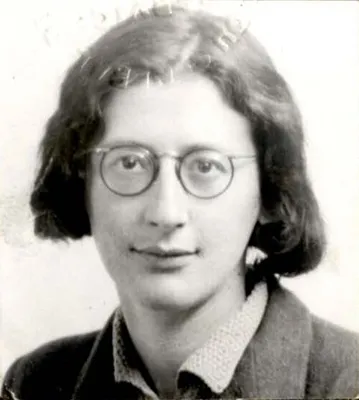
Alain Goldschl Ger
Simone Weil was a French philosopher, mystic, and activist whose influential ideas on spirituality and politics emerged from her experiences.
Simone Weil was a French philosopher, mystic, and political activist born in Paris in 1909 to an Alsatian Jewish family. Her intellectual and spiritual journey was marked by a deep engagement with social justice, leading her to experience life as a laborer and actively participate in political movements. Despite a life often challenged by poor health, Weil's philosophical and theological writings gained significant recognition posthumously, influencing contemporary thought across various disciplines.
Weil's early life was shaped by her intellectual family, including her mathematician brother André. Her experiences during World War I and her observations of working-class struggles fostered a profound sense of altruism and a commitment to social change. She pursued rigorous academic studies, excelling in philosophy and displaying a rebellious spirit, earning nicknames like the "Red Virgin" for her radical views and ethical devotion.
Throughout her life, Weil's work and activism were intertwined. She taught intermittently, taking breaks for political engagement, including supporting anarchists in the Spanish Civil War. Her period working in factories provided her with firsthand understanding of the plight of the working class, which she articulated as "affliction" or "le malheur." As she grew older, Weil became increasingly drawn to religious and mystical experiences, though her life was cut short in 1943 due to heart failure, possibly exacerbated by self-imposed food restrictions in solidarity with occupied France.
Early Life and Intellectual Development
Born in Paris in 1909, Simone Weil came from a culturally rich, albeit secular, Jewish background. Her early years were marked by intellectual curiosity, evident in her self-taught proficiency in Ancient Greek alongside her renowned mathematician brother, André. A significant childhood event was her father's absence during World War I, which scholars suggest may have contributed to her lifelong altruism. Even as a child, Weil demonstrated solidarity with those less fortunate, sharing her rations and showing empathy for striking workers. Her upbringing instilled a strong sense of ethics and a unique perspective on societal structures, leading her to question conventional norms from a young age.
Education and Political Awakening
Weil was a gifted student, excelling in her studies at the Lycée Henri IV, where her radical ideas and actions earned her the moniker "Red Virgin." She displayed an unwavering commitment to her ethical principles, often clashing with educational authorities over her non-conformist behavior and political activism. Her academic achievements were notable; she finished first in her philosophy and logic exams at the École Normale Supérieure, later earning a Master's degree with a thesis on Descartes. Weil's intellectual journey was deeply connected to her political awakening, as she saw philosophy and truth as intrinsically linked to lived experience and action, particularly concerning social justice.
Activism, Labor, and Mysticism
Weil's life was characterized by a profound desire to understand and alleviate human suffering, leading her to engage directly with the working class. She worked as a laborer in factories, experiencing firsthand the dehumanizing effects of repetitive labor, which she termed "le malheur" or affliction. This direct experience fueled her critique of Marxist theory, as she identified new forms of oppression stemming from power structures, not just economic exploitation. As her life progressed, Weil's spiritual and mystical inclinations deepened. Her intense personal ethics and solidarity with the oppressed, including restricting her food intake, may have contributed to her early death in 1943 while serving the Free French government in exile.
Key Ideas
- Le malheur (affliction): The experience of dehumanizing labor that reduces individuals to a machine-like existence.
- Critique of power structures: Identification of oppression stemming from 'la puissance' (power) beyond traditional Marxist analysis.
- Philosophy as lived action: Belief that truth and philosophical understanding must be grounded in direct experience.
Notable Quotes
“one thing alone mattered in the world today: the revolution that would feed all people on earth”
“it's easy to see you've never gone hungry”
Books by Alain Goldschl Ger
0 free public domain books · Read online or download
