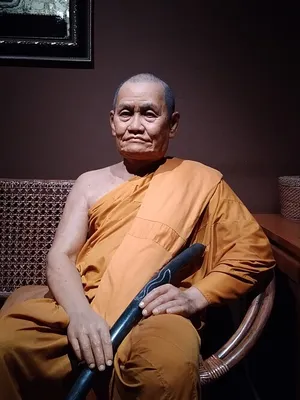
Ajahn Brahm, an American monk in the Thai Forest Tradition, is known for his translations and writings on Buddhist practice.
Born Geoffrey DeGraff in 1949, Ajahn Brahm is an American Buddhist monk and author belonging to the Thai Forest Tradition. He developed an early interest in Buddhist teachings while in high school. After studying European Intellectual History at Oberlin College, he traveled to Thailand, where he eventually found a teacher in Ajahn Fuang Jotiko. Brahm spent ten years studying under Ajahn Fuang, serving as his attendant during the latter's declining health. Ajahn Fuang encouraged Brahm to bring the forest tradition to the West, foreseeing its potential to take root there.
Since 1993, Ajahn Brahm has been the abbot of Metta Forest Monastery in California, the first U.S. monastery of the Thai Forest Tradition, which he cofounded. He is widely recognized for his extensive free translations of Buddhist scriptures, particularly nearly 1000 suttas from the Sutta Pitaka, made available on his website. He has also authored numerous works on Buddhist teachings and compiled study guides for his translations.
Early Life and Spiritual Awakening
Geoffrey DeGraff, later known as Ajahn Brahm, was born in 1949. His initial encounter with the Buddha's teachings, specifically the Four Noble Truths, occurred during his high school years while traveling from the Philippines. Described as a serious and independent child, he spent his early years on a potato farm in Long Island, New York, and later resided in the suburbs of Washington, D.C. During his time at Oberlin College in the early 1970s, he was drawn to a religious studies class that included meditation, viewing it as a practical skill, unlike prayer which he found less reliable. He intentionally avoided campus political activities, preferring to focus on personal development and finding comfort in individual practice.
Monastic Training in Thailand
Following his graduation from Oberlin College in 1971 with a degree in European Intellectual History, Ajahn Brahm traveled to Thailand on a fellowship. After a two-year search, he found his forest teacher, Ajahn Fuang Jotiko, a student of Ajahn Lee Dhammadaro. A brief period of study with Ajahn Fuang was interrupted by malaria, leading Brahm to return to the U.S. to contemplate his path. Upon his return to Thailand, he decided to ordain as a monk, with Ajahn Fuang setting a condition for him to either succeed in meditation or die in Thailand, a commitment Brahm readily accepted. He became Ajahn Fuang's attendant in his third year as a monk, caring for him during a severe psoriasis condition.
Establishing the Forest Tradition in the West
Ajahn Fuang expressed a strong conviction that the forest tradition would eventually flourish in the West, suggesting it might be Brahm's life's work. Before Ajahn Fuang's death in 1986, he had indicated a desire for Brahm to become abbot of Wat Dhammasathit. However, due to internal politics and the monastery's departure from its forest hermitage origins, Brahm declined the position. Instead, he went to San Diego County in 1991 at the request of Ajahn Suwat Suvaco to help establish Metta Forest Monastery. He became its abbot in 1993 and later, in 1995, became the first American-born non-Thai monk to be granted the title and responsibilities of Preceptor (Upajjhaya) within the Dhammayut Order, also serving as the order's Treasurer in the U.S.
Key Teachings and Publications
Ajahn Brahm's teachings emphasize the Pali Canon as the ultimate authority, leading him to question certain commentarial meditation practices, which he terms 'wrong concentration' due to their perceived lack of scriptural basis. He highlights the importance of the forest environment for cultivating the mental qualities necessary for Buddhist practice, drawing parallels to Thoreau's Walden in establishing Metta Forest Monastery as a similar sanctuary. Brahm also utilizes the term 'unbinding' when discussing nibbana. He views the sense of self as an active strategy to avoid suffering and attain happiness, advocating for a gradual release from grosser forms of happiness to more refined ones, ultimately leading to the cessation of all strategies as the path to true happiness. His extensive publications include translations of Buddhist texts, meditation guides, and analyses of core Buddhist concepts.
Key Ideas
- Rejection of commentarial meditation practices in favor of scriptural authority.
- Emphasis on the forest as a conducive environment for Buddhist practice.
- The self as an active strategy for managing happiness and suffering.
- The path to true happiness involves letting go of all strategies for happiness.
Notable Quotes
“he grew up 'a very serious, independent little kid'”
“'I didn't feel comfortable following a crowd.'”
“'I saw it as a skill I could master, whereas Christianity only had prayer, which was pretty hit-or-miss.'”
“'succeed in the meditation or die in Thailand. There was to be no equivocating.'”
“When I talked with Ajahn Fuang about going back to the West, about taking the tradition to America, he was very explicit. 'This will probably be your life's work,' he said. He felt, as many teachers have, that the forest tradition would die out in Thailand but would then take root in the West.'”
Books by
3 free public domain books · Read online or download