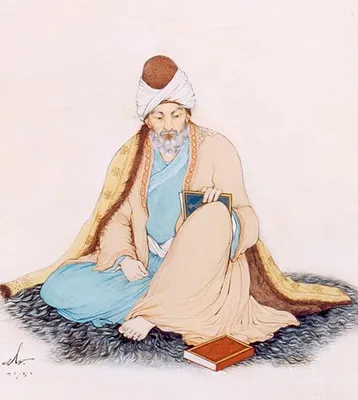
Abu Hamid Al Ghazali Muhammad Isa Waley
Jalāl al-Dīn Muḥammad Rūmī was a 13th-century Sufi mystic and poet whose profound spiritual experiences inspired his influential mystical poetry.
Jalāl al-Dīn Muḥammad Rūmī, widely known as Rumi, was a 13th-century Sufi mystic, poet, and the founder of the Mevlevi Order. Born in Balkh, his family fled westward due to Mongol invasions, eventually settling in Konya, Anatolia, where he earned the name "Rumi" meaning "the Roman." Initially expected to follow his father as an Islamic scholar, Rumi's life was profoundly transformed by his intense spiritual connection with the wandering dervish Shams Tabrizi. This encounter led him to neglect his scholarly duties and, following Shams' mysterious disappearance, spurred a period of intense grief that marked the beginning of his prolific poetic output. His works, particularly the Masnavi, are considered cornerstones of Persian literature and Islamic mysticism.
Rumi's legacy extends globally, with his translated works widely read and appreciated. He is recognized as a pivotal figure in Sufism, and his poetry continues to resonate with readers worldwide, making him one of the best-selling poets in recent history. The Mevlevi Order, which he founded with his followers, is renowned for its spiritual practices, including the Sama ceremony, a form of Sufi dance.
Spiritual Awakening and Poetic Genesis
Rumi's spiritual path took a dramatic turn with the arrival of the enigmatic dervish, Shams Tabrizi, in Konya. Their profound connection deeply affected Rumi, leading him to abandon his scholarly responsibilities. The subsequent unexplained disappearance of Shams plunged Rumi into a period of intense sorrow, which became the crucible for his creative expression. This transformative grief is powerfully reflected in his "Divan of Shams Tabrizi" and marked a pivotal evolution in his spiritual understanding, igniting his journey as a poet.
Founding the Mevlevi Order and Legacy
Following Rumi's passing in 1273, his devoted followers and son, Sultan Walad, established the Mevlevi Order. This Sufi brotherhood became famous for its unique spiritual practice known as Sama, often referred to as the "whirling dervishes." Rumi's resting place in Konya became a significant site of pilgrimage. His teachings and poetic works, particularly the Masnavi, which is often likened to a "Qur'an in Persian," continue to hold immense importance, especially within the Turko-Persian cultural sphere, where it is considered second only to the Quran in significance.
Early Life and Intellectual Influences
Born in Wakhsh, present-day Tajikistan, Rumi's early life was shaped by his father, Bahâ' uddîn Walad, a theologian and jurist. Due to the encroaching Mongol invasions, his family embarked on a westward migration, traversing various cities across Iran, Baghdad, and Damascus before settling in Konya. During his formative years, Rumi was exposed to the rich intellectual and spiritual traditions of Greater Balkh, a significant center for Persian culture and Sufism. He was deeply influenced by Persian poets like Attar and Sanai, whose works he acknowledged as foundational to his own spiritual and literary development.
Key Ideas
- Sufi mysticism
- The transformative power of love and grief
- The master-disciple relationship in spiritual development
- The concept of 'fana' (spiritual annihilation)
Notable Quotes
“Attar was the spirit, Sanai his eyes twain, And in time thereafter, Came we in their train”
“Attar has traversed the seven cities of Love, We are still at the turn of one street”
Books by Abu Hamid Al Ghazali Muhammad Isa Waley
0 free public domain books · Read online or download
