Abraham Arden Brill M D
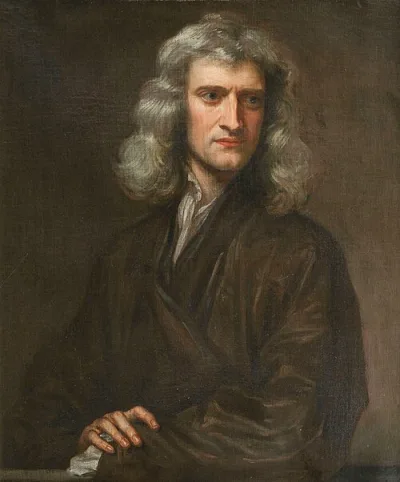
Isaac Newton was a pivotal figure in the Scientific Revolution, known for his work in mathematics, physics, and astronomy, and also studied alchemy and theology.
Sir Isaac Newton was a highly influential English scholar whose work spanned mathematics, physics, astronomy, alchemy, and theology. He was a central figure in the Scientific Revolution and the subsequent Enlightenment. Newton's groundbreaking publication, "Philosophiæ Naturalis Principia Mathematica," established classical mechanics and unified physics. His contributions extended to optics, and he co-developed infinitesimal calculus. Newton also refined the scientific method, profoundly shaping modern science.
Beyond his scientific achievements, Newton delved into alchemy and biblical chronology, though much of this work remained unpublished during his lifetime. He held academic positions at the University of Cambridge, including the Lucasian Professorship of Mathematics. Despite his scientific pursuits, Newton was a devout but unconventional Christian who held private theological views that diverged from established doctrines. He also served in Parliament and held leadership roles at the Royal Mint and the Royal Society.
Foundations of Modern Science
Isaac Newton's "Principia Mathematica," published in 1687, provided the first comprehensive unification in physics and laid the groundwork for classical mechanics. His formulation of the laws of motion and universal gravitation became the dominant scientific perspective for centuries. These laws accurately described phenomena from planetary orbits to terrestrial motion, solidifying the heliocentric model of the solar system. Newton's work also greatly advanced the field of optics, with his book "Opticks" detailing his theories on light and color. He is credited with developing calculus, a fundamental tool in mathematics and science, and refining the scientific method itself.
Broader Scientific and Mathematical Contributions
Newton's scientific inquiries extended into numerous other areas. He developed the first reflecting telescope and made significant contributions to understanding heat transfer and acoustics, including an empirical law of cooling and the first theoretical calculation of the speed of sound. His mathematical work was extensive, including generalizations of the binomial theorem, contributions to numerical integration, and the initiation of the field of calculus of variations. He also devised early forms of linear regression and vector analysis, demonstrating a remarkable breadth of innovation across scientific disciplines.
Theological and Alchemical Pursuits
While renowned for his scientific achievements, Isaac Newton dedicated considerable time to theological studies and alchemy. Although these pursuits were largely kept private and unpublished during his life, they represent a significant aspect of his intellectual life. Newton was a deeply religious individual, albeit with unorthodox views, privately questioning established doctrines such as the Trinity. His alchemical investigations and extensive work on biblical chronology reveal a mind that sought understanding across both the natural and the spiritual realms, reflecting a holistic approach to knowledge that extended beyond the purely empirical.
Key Ideas
- Laws of motion
- Universal gravitation
- Classical mechanics
- Infinitesimal calculus
- Theory of color
- Scientific method
Books by Abraham Arden Brill M D
0 free public domain books · Read online or download
