A L Khosroev
The Nag Hammadi library is a collection of early Christian and Gnostic texts found in Egypt, primarily containing 52 Gnostic treatises.
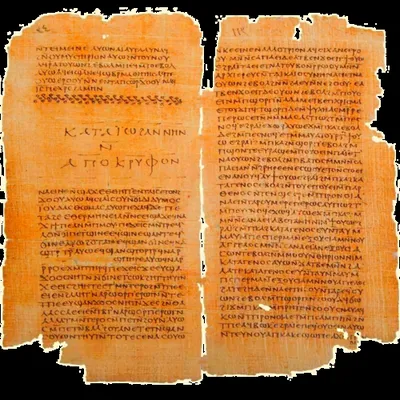
Discovered near Nag Hammadi in Upper Egypt in 1945, the Nag Hammadi library consists of twelve bound papyrus codices and a fragment of a thirteenth. These texts, unearthed by a local farmer, contain 52 mostly Gnostic writings, alongside three works from the Corpus Hermeticum and a version of Plato's Republic. Scholars propose these texts may have belonged to a nearby Pachomian monastery, possibly buried after Saint Athanasius's condemnation of non-canonical books in 367 AD, with later research suggesting their use by an intellectual monastic elite. The codices are written in Coptic, with the Gospel of Thomas being the most famous, as the Nag Hammadi collection holds its only complete manuscript. While the manuscripts date from the 3rd and 4th centuries, the Gospel of Thomas is generally believed to have been composed in the 2nd century, based on even earlier sources. The collection is now housed at the Coptic Museum in Cairo.
Discovery and Provenance
The existence of the Nag Hammadi library became known to scholars in 1946. Investigations revealed that a local farmer had unearthed the texts from a desert graveyard. The farmer, Muhammad ‘Ali al-Samman, recounted a complex story involving a blood feud, the search for agricultural soil, and the discovery of the manuscripts in a sealed jar. Superstitions about a jinn reportedly caused hesitation in opening the jar. Some accounts suggest parts of the library were burned by al-Samman's mother. Later analysis of al-Samman's story has led to theories that the discovery might have originated from grave robbing, with more elaborate tales serving as a cover. Alternative hypotheses suggest the codices were privately commissioned and buried as prestige items. The majority of the texts eventually came into the possession of an antiques dealer in Cairo before being secured by the Department of Antiquities. Following the 1952 revolution, the manuscripts were transferred to the Coptic Museum and declared national property.
Translation and Scholarly Dissemination
The initial scholarly awareness of the Nag Hammadi texts led to a slow process of translation and publication, complicated by political circumstances in Egypt. A significant turning point occurred in 1966 at the Messina Congress, where James M. Robinson organized a team dedicated to producing a bilingual English edition of the codices. Robinson later chaired the International Committee for the Nag Hammadi Codices, established by UNESCO and the Egyptian Ministry of Culture. This oversight resulted in a twelve-volume facsimile edition published between 1972 and 1977, making the texts widely accessible for study. Concurrently, German scholars were preparing the first German translation. Robinson's own English translation was published in 1977, marking a new phase in Nag Hammadi scholarship. Subsequent paperback and revised editions further facilitated the dispersal of these Gnostic texts to a global audience in multiple languages. Other significant English translations and scholarly works, such as Bentley Layton's 'The Gnostic Scriptures,' also emerged, providing critical context and analysis.
Textual Contents and Dating
The Nag Hammadi library comprises a significant collection of early Christian and Gnostic writings, with 52 primarily Gnostic treatises forming the bulk of the content. Among the notable inclusions are three works from the Corpus Hermeticum and a partial adaptation of Plato's Republic. The Coptic language is used for the majority of the texts. The Gospel of Thomas is perhaps the most well-known work found within the collection, as the Nag Hammadi codices preserve its only complete version. While the manuscripts themselves are generally dated to the 3rd and 4th centuries AD, the composition of texts like the Gospel of Thomas is often placed earlier, typically in the 2nd century, potentially drawing on even more ancient sources. There is ongoing scholarly discussion regarding the precise dating and the classification of some texts, with debates about whether all the library's contents should be definitively labeled as Gnostic.
Key Ideas
- Gnosticism: A diverse set of religious ideas and systems, often characterized by a belief in a transcendent God and a lesser creator deity, with salvation achieved through secret knowledge (gnosis).
- Corpus Hermeticum: A body of philosophical and religious writings, originating in the Hellenistic period, attributed to Hermes Trismegistus, dealing with cosmology, astrology, alchemy, and theology.
- Pachomian Monastery: Early Christian monastic communities established by Pachomius, known for their structured organization and communal living.
Books by A L Khosroev
0 free public domain books · Read online or download
