A Course in Miracles International
A Course in Miracles is a spiritual self-study program dictated to Helen Schucman, presenting love's presence as the greatest miracle.
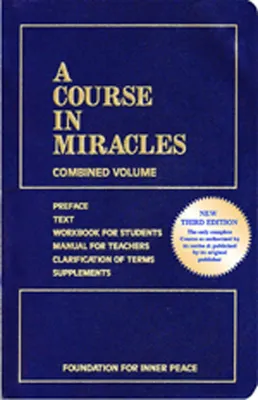
A Course in Miracles, first published in 1976, is presented as a spiritual text dictated to Helen Schucman by an inner voice she identified as Jesus. Schucman, a research associate at Columbia–Presbyterian Medical Center, collaborated with psychologist William Thetford on its transcription, which occurred over several years starting in 1965. The work, comprising a Text, Workbook for Students, and Manual for Teachers, gained significant popularity throughout the 1980s and 1990s, boosted by endorsements from figures like Gerald Jampolsky and Marianne Williamson. Its core message emphasizes the realization of love's presence as the ultimate miracle, advocating for the dissolution of the ego as an illusion that obscures one's divine connection.
The Course has been met with diverse reactions, ranging from enthusiastic adoption to criticism from various religious and secular perspectives. Some view it as a path to spiritual awakening, while others, particularly within Christian circles, consider it incompatible with biblical teachings, sometimes describing its terminology as recontextualized New Age concepts or even potentially dangerous distortions. Scholars have also noted its resemblances to Gnostic thought and its integration of psychological and spiritual frameworks. The text's origins and its author's alleged dictation have been subjects of legal and academic discussion, with US courts ultimately assigning copyright to Schucman.
Origins and Transcription
A Course in Miracles originated from a collaborative effort between Helen Schucman and William Thetford, who worked together at Columbia–Presbyterian Medical Center. Following a period of intense workplace conflict, Schucman reported experiencing visions and an inner voice she identified as Jesus, instructing her to transcribe a "Course in Miracles." This process, which began in 1965, involved Schucman taking notes dictated by this inner voice, with Thetford assisting in typing them. The main body of the text was completed by 1972. While Schucman perceived the dictation as coming from Jesus, legal proceedings later determined Schucman to be the author for copyright purposes, with some scholars interpreting her experience as a manifestation of her own internal spiritual dialogue.
Content and Core Teachings
The Course is structured into three main parts: the Text, the Workbook for Students, and the Manual for Teachers. Its central tenet posits that the most significant "miracle" is achieving full awareness of love's presence in one's life. A key concept is the "ego," which the Course defines as an illusionary construct that separates individuals from their true, divine nature and their connection to God. The teachings advocate for the relinquishing of this ego, asserting that its dissolution leads to true reality and alignment with God's creation. The Course's philosophical underpinnings have been described as integrating psychological perspectives with spiritual ones, and it has been linked to transpersonal psychology.
Reception and Interpretations
Since its 1976 publication, A Course in Miracles has been translated into numerous languages and has fostered a global community. Its reception has been varied and often polarized. While some embrace it as a profound spiritual guide, others, particularly from traditional Christian viewpoints, have criticized it for redefining biblical terminology and for its perceived incompatibility with Christian doctrine, with some labeling it as "New Age psychobabble" or even a "Satanic seduction." Academics have noted its neo-Gnostic elements and its parallels with Christian Science. The book's commercial success, amplified by public mentions on popular media, has also led to its characterization as a "minor industry" and a subject of debate regarding its origins and influence, including theories about its potential infiltration by intelligence agencies.
Key Ideas
- The greatest miracle is the awareness of love's presence.
- The ego is an illusion that obscures one's oneness with God.
- Letting go of the ego leads to true reality and alignment with God.
Notable Quotes
“This is a Course in Miracles, please take notes.”
“the ego's death is your life.”
“When you have given up the illusion of the ego, you will realize that the ego never existed, and that the only thing that ever existed, and still exists, is God and His creations.”
“When the ego has been dispelled, there will be no separation, and you will be wholly real.”
Books by A Course in Miracles International
1 free public domain book · Read online or download