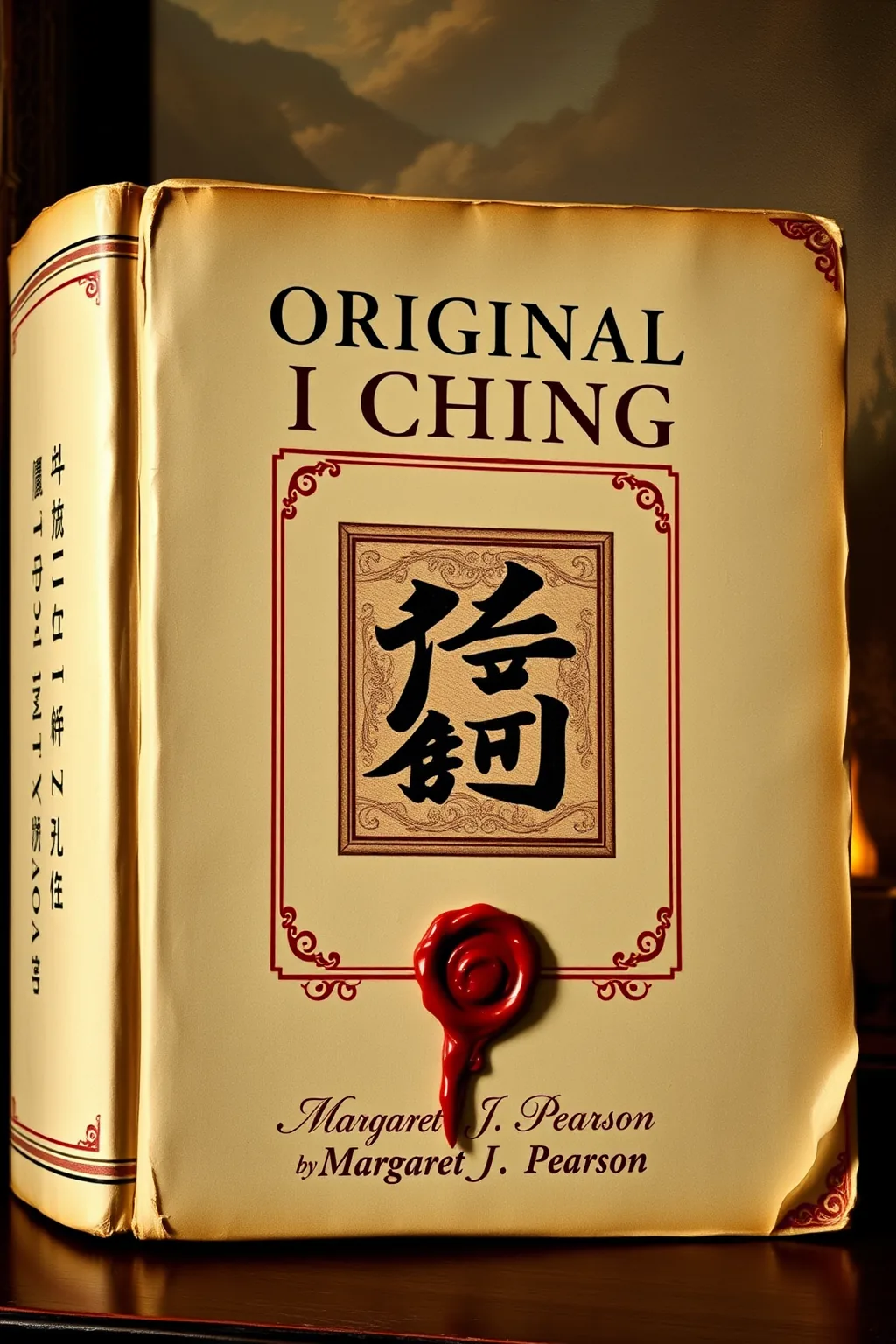
Original I Ching
 61
61

Original I Ching



Isolde Whitaker (Sacred Texts Editor) — Margaret J. Pearson’s 'Original I Ching' is a revelation, illuminating the ancient Chinese oracle with an esoteric clarity that resonates deeply. Pearson’s scholarly yet accessible approach unpacks the profound philosophical layers and mystical symbolism, transforming the I Ching from a mere divinatory instrument into a sophisticated map of consciousness. This edition is indispensable for practitioners and scholars alike, offering unparalleled insights into the dynamic principles of change and balance. Its strength lies in its ability to connect the reader directly to the source wisdom, fostering a profound understanding of cosmic patterns and personal destiny. A truly essential read for anyone dedicated to the path of self-discovery and spiritual enlightenment.
📝 Description
61
Margaret J. Pearson's 'Original I Ching' (2009) presents the classic text as a cosmic blueprint, not just a divination system.
Pearson's 2009 book, 'Original I Ching,' examines the classic Chinese text as more than a tool for divination. She argues it functions as a guide to understanding cyclical patterns in existence, mirroring the natural order. The author breaks down the symbolism within the hexagrams, detailing their philosophical foundations and their relationship to the world around us.
The book guides readers to grasp the dynamic balance of yin and yang, the constant state of flux, and the primary forces that influence both personal experience and external reality. Pearson aims her work at those seriously interested in the I Ching, whether for personal growth or academic study. It encourages reflection and a deeper intuitive awareness, assisting individuals who wish to connect with broader universal principles.
This book engages with the I Ching tradition, a foundational text in Chinese philosophy and cosmology. It situates the I Ching within esoteric thought by interpreting its hexagrams not merely as predictive devices but as expressions of universal laws governing change and balance. Pearson's approach emphasizes the text's capacity to illuminate the interconnectedness of human experience with cosmic cycles, aligning with broader esoteric interests in understanding hidden order and achieving personal harmony through correspondence with these principles.
💡 Why Read This Book?
Uncover the profound philosophical depths of one of humanity's oldest wisdom traditions. 'Original I Ching' offers a unique lens through which to understand the universal forces of change and balance, fostering personal growth and intuitive development. Ideal for seekers of ancient knowledge, spiritual practitioners, and philosophers eager to explore the interconnectedness of all things.
⭐ Reader Reviews
Honest opinions from readers who have explored this book.
❓ Frequently Asked Questions
What makes this 'Original I Ching' edition unique?
Pearson's edition distinguishes itself through its deep dive into the esoteric and philosophical dimensions of the I Ching, moving beyond simple divination to explore its role as a cosmic blueprint for understanding universal principles and consciousness.
Is this book suitable for beginners in I Ching study?
Yes, while rich in depth, Pearson's clear exposition makes the complex symbolism and philosophy accessible to dedicated beginners, guiding them through its profound teachings.
How does the I Ching relate to personal transformation?
The I Ching reveals the patterns of change inherent in life, enabling individuals to understand their current circumstances and make choices aligned with natural cycles, thereby facilitating personal growth and transformation.
What is the significance of the hexagrams?
Hexagrams are symbolic representations of fundamental cosmic situations and archetypal patterns. They serve as a language of change, offering insights into the dynamic interplay of forces and potential outcomes.
Can the I Ching be used for more than just fortune-telling?
Absolutely. Beyond predicting outcomes, the I Ching serves as a profound philosophical text and a guide for ethical conduct, self-reflection, and understanding the Tao, the fundamental Way of the universe.
🔮 Key Themes & Symbolism
The Unfolding Cosmic Dance
This theme studies the I Ching's portrayal of the universe as a dynamic, ever-changing entity governed by the ceaseless interplay of yin and yang. It explores how these fundamental forces manifest in all aspects of existence, from the celestial bodies to the human psyche. Pearson illuminates the cyclical nature of creation and dissolution, providing a framework for understanding the ebb and flow of life and the interconnectedness of all phenomena. Readers are invited to perceive the grand cosmic ballet, recognizing their own part within its intricate choreography and learning to harmonize with its inherent rhythms.
Wisdom as a Mirror of the Soul
Pearson presents the I Ching as a profound mirror reflecting the inner field of the individual. The hexagrams are not external pronouncements but symbolic keys that unlock the hidden chambers of the heart and mind. This theme emphasizes the introspective power of the oracle, encouraging users to engage in deep self-examination and to understand their own motivations, fears, and potentials. By contemplating the archetypal situations presented, readers can gain clarity on their personal journeys, make more conscious choices, and cultivate a deeper understanding of their true nature.
The Art of Harmonious Adaptation
Central to the I Ching's philosophy is the concept of adapting to the ever-present flux of existence. This theme explores how the wisdom embedded within the hexagrams offers guidance on navigating life's challenges with grace and efficacy. It teaches the importance of discernment, timing, and flexibility, emphasizing that true strength lies not in resisting change, but in flowing with it. Pearson's interpretation reveals how understanding the patterns of hexagrams can empower individuals to find opportune moments for action and stillness, thereby fostering resilience and cultivating a life of balance and fulfillment.
💬 Memorable Quotes
Direct passages from the work, attributed to the author.
“Within stillness lies the seed of all movement.”
— Highlighting the paradoxical nature of yin and yang, this suggests that periods of rest and reflection are essential for generating future action and growth.
“The wise heart perceives the pattern before the storm.”
— Emphasizes the foresight and intuitive understanding cultivated through study of the I Ching, enabling proactive engagement with life's unfolding events.
“To know the self is to know the universe.”
— Connects the micro- and macrocosm, suggesting that internal self-awareness is a pathway to comprehending the larger cosmic order and principles.
“Harmony arises from the balanced tension of opposing forces.”
— Illustrates the dynamic equilibrium that the I Ching promotes, showing that true peace and stability are found not in uniformity, but in the skillful management of duality.
💡 Key Ideas
Editorial paraphrase of the work's core concepts — not direct quotes.
Change is the only constant, the eternal river of existence.
This quote expresses the core tenet of the I Ching – that all things are in perpetual motion and transformation, urging acceptance and understanding of life's fluidity.
🌙 Esoteric Significance
Tradition
The 'Original I Ching' is a central to Taoist and Buddhist esoteric traditions, as well as a vital text within the broader framework of Chinese metaphysics. It is deeply entwined with principles of Yin-Yang philosophy, the Five Elements, and the concept of the Tao, the ineffable cosmic principle. Esoterically, it serves as a map of consciousness, illustrating the archetypal forces at play within the universe and the human psyche. Its practice is considered a form of spiritual alchemy, guiding the practitioner towards inner harmony and alignment with the natural order.
Symbolism
The I Ching's power lies in its potent symbolism, primarily the 64 hexagrams formed by combinations of broken (Yin) and unbroken (Yang) lines. Each hexagram represents a fundamental situation or archetype, laden with layered meanings. The trigrams (three-line combinations) further break down these concepts into elemental forces: Heaven, Earth, Thunder, Wind, Water, Fire, Mountain, and Lake. These symbols are not static but dynamic, illustrating the ever-present flow of change and the potential outcomes of various interactions.
Modern Relevance
In contemporary times, the 'Original I Ching' offers a profound antidote to the fragmentation and rapid pace of modern life. Its emphasis on cyclical patterns, balance, and mindful adaptation provides a timeless framework for navigating complexity and uncertainty. Esoterically, it remains a powerful tool for self-discovery, intuitive development, and connecting with deeper spiritual currents. Its philosophical insights continue to resonate with seekers of wisdom, offering guidance on ethical living, personal growth, and fostering a sense of interconnectedness in an increasingly individualized world.
👥 Who Should Read This Book
This key work is essential for seasoned practitioners of divination and ancient philosophies, offering a deeper, more nuanced understanding of the I Ching's esoteric dimensions. Scholars of Eastern thought and comparative religion will find Pearson's meticulous research and insightful interpretations useful for academic study. Spiritual seekers yearning for a profound connection to universal wisdom and the principles of change will discover a guiding light. Furthermore, individuals drawn to self-reflection, personal growth, and the art of living in harmony with natural cycles will find this book to be a transformative companion on their journey.
📜 Historical Context
The 'Original I Ching' emerges from a collection of ancient Chinese thought, primarily the Zhou Dynasty (c. 1046–256 BCE), a period of significant philosophical and political upheaval. It is believed to have evolved from earlier divination practices, coalescing into its structured form through the contributions of sages like King Wen, Duke of Zhou, and Confucius. This era witnessed the development of foundational Chinese philosophies, including Confucianism and Taoism, both of which deeply influenced and were influenced by the I Ching's cosmology. The text served not only as a tool for predicting the future and guiding decisions for rulers and commoners alike but also as a profound philosophical treatise on the nature of change, morality, and the cosmos. Its enduring influence spans millennia, shaping East Asian culture, spirituality, and intellectual thought, making it a central to esoteric wisdom.
📔 Journal Prompts
Reflect on a recent period of significant change in your life. How did the principles of yin and yang manifest?
Consider a hexagram that speaks to your current situation. What wisdom does its imagery offer for your path forward?
Explore a personal challenge you are facing. How might understanding the dynamic interplay of forces, as depicted in the I Ching, offer a new perspective?
Journal about a time you felt out of sync with your surroundings. What steps could you have taken to harmonize with the natural flow?
Contemplate the concept of 'balance' in your life. Where do you find equilibrium, and where do you seek it?
🗂️ Glossary
Yin
The passive, receptive, feminine principle in Taoist philosophy, often associated with darkness, coolness, and the moon. It represents the receptive aspect of the cosmic dance.
Yang
The active, creative, masculine principle, associated with light, warmth, and the sun. It embodies the dynamic, outward-moving force within the universal interplay.
Hexagram
A symbol composed of six stacked lines, either solid (Yang) or broken (Yin). There are 64 unique hexagrams in the I Ching, each representing a fundamental situation or archetype.
Trigram
A symbol composed of three stacked lines, either solid (Yang) or broken (Yin). There are eight basic trigrams, representing fundamental elements and forces of nature.
Tao
The fundamental, ineffable principle of the universe in Taoism. It represents the natural order, the Way, and the underlying current that governs all existence and change.
This book appears in 1 collection
🔮 Readers Also Liked
Browse all →






More by Margaret J. Pearson
All books →
From the “Divination” Collection
View all →









More Free Divination & Tarot Books
View all →