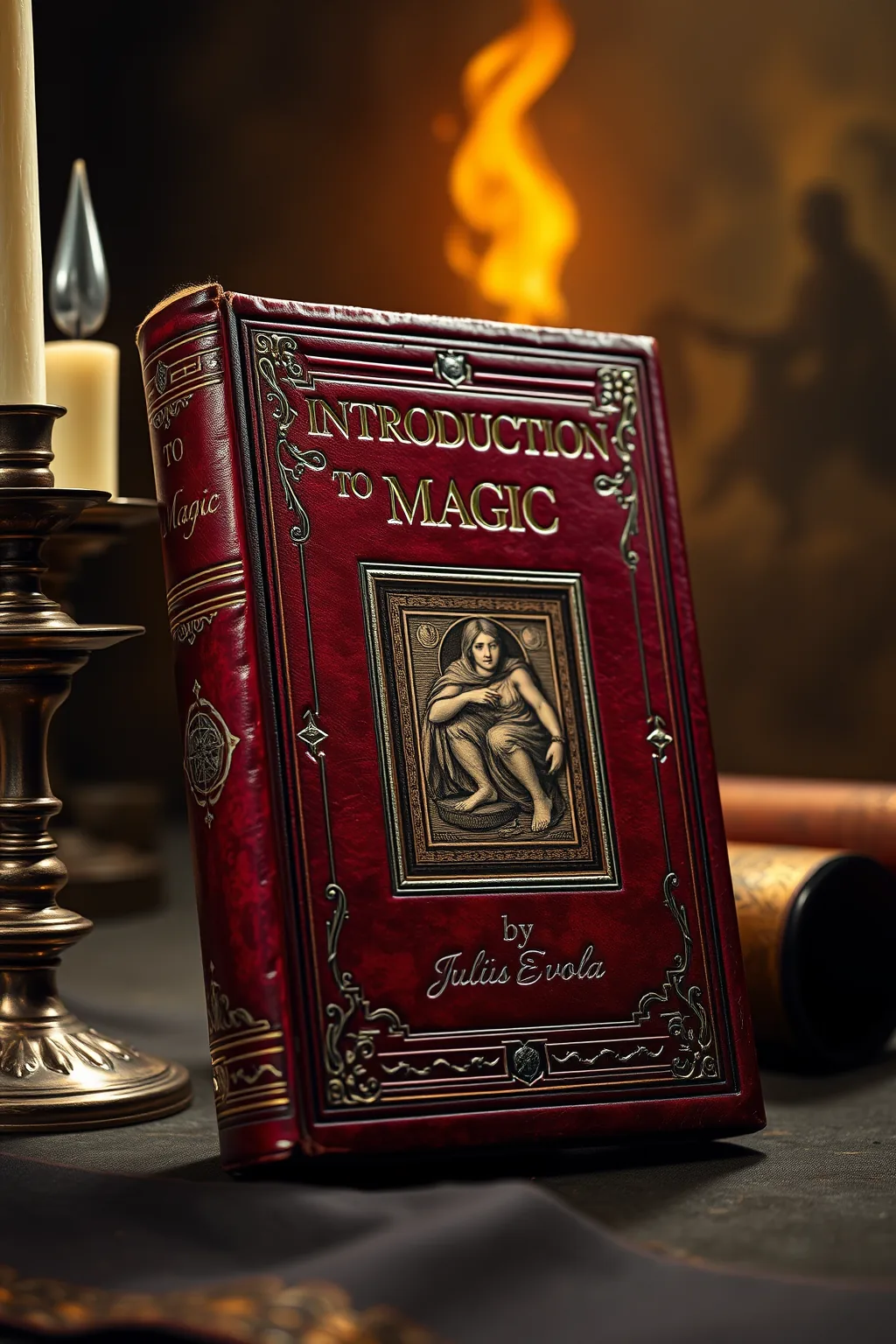
Introduction to Magic
 61
61

Introduction to Magic



Cassian Rothmann (Senior Critic, Ancient Wisdom) — Evola's "Introduction to Magic" stands as a monumental testament to the enduring power of esoteric discipline. This text eschews superficial sensationalism, delving instead into the rigorous, psychological, and philosophical dimensions of magical work. Evola's profound understanding of traditional doctrines is evident on every page, offering a clarity that is both challenging and deeply rewarding. It is an indispensable resource for those who approach magic not as mere parlor tricks, but as a serious path to self-transformation and a deeper engagement with the forces that shape reality. Highly recommended for advanced students and seasoned practitioners seeking to refine their understanding and practice.
📝 Description
61
Julius Evola's 'Introduction to Magic' was first published in 1925.
This book details Julius Evola's approach to magic, presented in 1925. It covers the practical and theoretical aspects of magical action, focusing on the role of will and consciousness. Evola discusses sympathetic magic and the directed use of psychic energy. The text aims to guide those interested in transcending ordinary existence through disciplined practice.
Evola distinguishes his view from common occultism, emphasizing a rigorous, spiritual path. He critiques materialism and argues for a reawakening of latent human capacities through magical means. The book is written with a specific philosophical outlook, intended for readers who seek a deeper understanding of reality beyond the material. It serves as a guide to a particular kind of spiritual discipline.
Published in 1925, 'Introduction to Magic' emerged from the currents of European esotericism in the early 20th century. It reflects a period of intense interest in occultism, spiritualism, and non-traditional philosophical systems. Evola's work, however, sought to differentiate itself from more popular or sensationalist occult movements, aiming for a more rigorous and spiritually oriented practice. It stands as an example of a particular philosophical interpretation within the broader esoteric landscape of its time, connecting occult theory with a distinct worldview.
💡 Why Read This Book?
Delve into the foundational principles of Western esotericism with a master guide. "Introduction to Magic" is essential for spiritual seekers, occult scholars, and practitioners who wish to understand the philosophical depth and rigorous discipline behind true magical practice. It offers a potent framework for personal transformation and the cultivation of will, moving beyond mere theory into actionable wisdom.
⭐ Reader Reviews
Honest opinions from readers who have explored this book.
❓ Frequently Asked Questions
Is this book suitable for complete beginners?
While Evola is a demanding author, the book serves as a foundational text. Beginners should approach it with a willingness to engage deeply and perhaps supplement with introductory readings on esoteric philosophy.
What is the primary focus of Evola's magical system?
Evola's focus is on the development of will and consciousness as the primary tools of magic, emphasizing inner transformation and the manipulation of psychic forces rather than external rituals alone.
Does the book provide practical magical exercises?
Yes, while conceptual, the book lays the groundwork for understanding and applying principles that can inform practical exercises. It emphasizes the psychological and energetic aspects of practice.
What is the philosophical stance of Julius Evola?
Evola's philosophy is deeply rooted in Traditionalism, emphasizing a hierarchical worldview, the importance of spiritual authority, and a critique of modern secularism and egalitarianism.
How does this book differ from modern occult guides?
Unlike many contemporary guides, Evola's work is less about quick fixes or sensationalism and more about profound metaphysical understanding, rigorous mental discipline, and a connection to ancient, potent traditions.
🔮 Key Themes & Symbolism
The Cultivation of Will and Consciousness
Evola posits that true magical power originates not from external incantations or elaborate rituals, but from the disciplined cultivation of inner will and consciousness. He argues that by mastering one's own psychic energies and directing them with unwavering intent, the practitioner can influence reality. This involves rigorous self-awareness, the transcendence of egoic limitations, and the development of a focused, potent inner force capable of manifesting desired outcomes. The book meticulously outlines the psychological architecture required to harness this internal power, making it a central to the practitioner's journey.
Sympathetic Magic and Correspondences
A central tenet explored is the principle of sympathy, the idea that like influences like and that the universe is interconnected through a web of subtle correspondences. Evola looks at how understanding these hidden links allows the magician to work with the energetic fabric of existence. This includes exploring the significance of symbols, talismans, and the resonant frequencies between different elements of creation. The book guides the reader to perceive these connections, enabling them to enact change by working through these sympathetic relationships.
The Warrior of the Spirit
Evola presents the ideal practitioner as a 'warrior of the spirit' – an individual who engages in magical practice with the same discipline, courage, and strategic acumen as a soldier in battle. This involves confronting and overcoming internal obstacles, such as fear, doubt, and inertia, which are seen as the primary adversaries. The aim is not merely to achieve external results but to forge a stronger, more resilient spiritual self, capable of reading through the challenges of both the mundane and the hidden worlds with unwavering resolve and inner fortitude.
💬 Memorable Quotes
Direct passages from the work, attributed to the author.
“Man is not born, but rather made.”
— This highlights Evola's emphasis on active self-creation and spiritual discipline as the means to achieve true being, rather than passive acceptance of fate.
“The world is a magical phenomenon.”
— This profound statement underscores the book's core premise: that reality itself is imbued with potent forces accessible through understanding and directed will.
“The true magician is a conqueror of himself.”
— This emphasizes that the primary battlefield of magic is the inner self, where mastery over one's own limitations is the prerequisite for external influence.
“Know thyself, and know the world.”
— This classic aphorism, central to many esoteric traditions, is presented here as the foundational principle for understanding both the inner landscape and the outer reality.
💡 Key Ideas
Editorial paraphrase of the work's core concepts — not direct quotes.
Will is the primordial force.
This quote points to the central role of focused intention and directed energy as the engine of all magical and transformative action.
🌙 Esoteric Significance
Tradition
Evola's work is deeply rooted in the perennial philosophy, synthesizing elements from ancient Hermeticism, Gnosticism, Neoplatonism, and Eastern esoteric disciplines like Tantra. It represents a modern articulation of a timeless spiritual science, emphasizing the active, volitional aspect of magical practice and its potential for spiritual realization within a hierarchical cosmos.
Symbolism
The book employs a wide range of symbolism, drawing from alchemical processes, astrological archetypes, and mythological narratives. These symbols are not mere decorative elements but are presented as keys to understanding the underlying energetic and psychological mechanisms of magic. Evola guides the reader to interpret these symbols as maps of consciousness and as conduits for accessing specific forces and states of being.
Modern Relevance
In an age often characterized by fragmentation and disillusionment, Evola's "Introduction to Magic" offers a potent framework for re-enchanting the world and reclaiming individual agency. It provides a rigorous methodology for self-mastery, spiritual development, and a deeper engagement with the hidden dimensions of reality, resonating with contemporary seekers yearning for authentic meaning and transformative practice.
👥 Who Should Read This Book
This important work is essential for serious students of esotericism, occult philosophy, and comparative religion. Beginners seeking a rigorous introduction to magical principles will find a challenging but rewarding foundation. Scholars will appreciate Evola's synthesis of diverse traditions and his critical philosophical insights. Spiritual seekers yearning for a path of active self-transformation and practitioners looking to deepen their understanding of will, consciousness, and ritual will find "Introduction to Magic" an indispensable guide.
📜 Historical Context
Published in the early 20th century, "Introduction to Magic" emerged during a period of intense intellectual and spiritual ferment across Europe. This era witnessed a resurgence of interest in esoteric traditions, occultism, and Eastern philosophies, often as a reaction against the perceived materialism and spiritual emptiness of modern society. Evola, a key figure in this intellectual milieu, drew heavily from ancient Hermeticism, Gnosticism, Tantra, and Western ceremonial magic, synthesizing them into a unique and formidable system. His work stood in contrast to more popular or sensationalist occult writings, offering a rigorous, philosophical, and aristocratic approach that appealed to those seeking deeper truths and a path to spiritual authority.
📔 Journal Prompts
Reflect on a personal experience where your focused will significantly altered an outcome. How did this align with Evola's principles of magical action?
Identify a personal limitation or 'inner adversary' that hinders your spiritual progress. How can you begin to 'wage war' against it using the principles discussed?
Consider the concept of 'sympathy' in your daily life. Where do you observe connections and correspondences that might be leveraged for intentional action?
Evola emphasizes the 'warrior of the spirit.' What qualities define this archetype for you, and how can you cultivate them?
How does the idea of the world as a 'magical phenomenon' change your perception of everyday reality?
🗂️ Glossary
Will
In Evola's context, not mere desire, but a potent, focused, and disciplined force of intention, cultivated through rigorous mental and spiritual practice, capable of influencing reality.
Consciousness
The faculty of awareness and subjective experience, which Evola posits can be expanded, refined, and directed through magical discipline to achieve higher states of being and perception.
Sympathy
The principle of interconnectedness and resonance between seemingly disparate elements of the cosmos, allowing for influence and action through analogous relationships.
Perennial Philosophy
The concept that all major religions and spiritual traditions share a common, underlying truth or wisdom, which Evola sought to reveal and synthesize.
Traditionalism
Evola's philosophical stance emphasizing the importance of ancient wisdom, spiritual authority, and hierarchical order, often in critique of modern secularism.
This book appears in 2 collections
🔮 Readers Also Liked
Browse all →







More by Julius Evola
All books →



From the “Ritual Magic” Collection
View all →






More Free Magic & Ritual Books
View all →