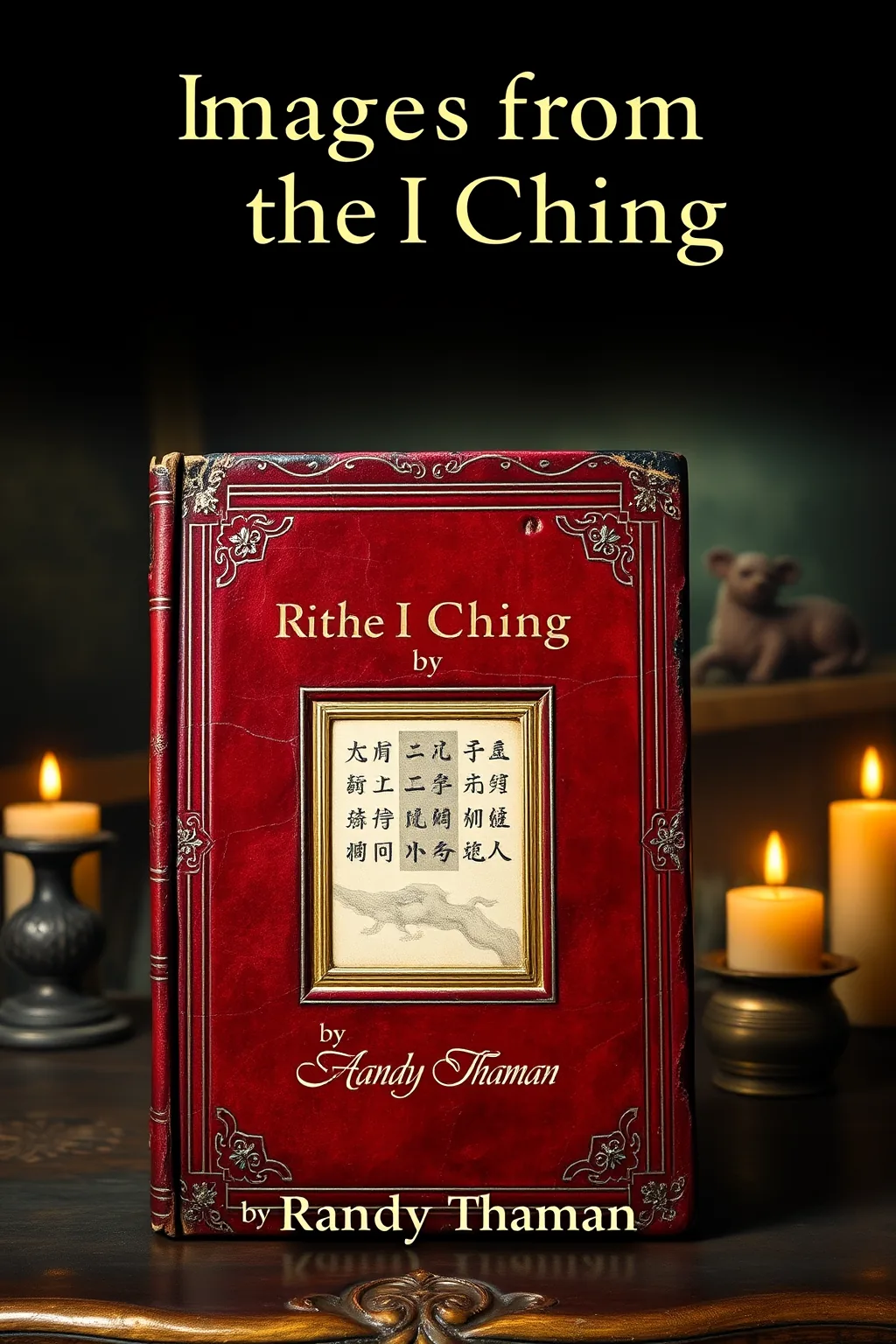
Images from the I Ching
 61
61

Images from the I Ching



Sophia Crane (Associate Editor) — Randy Thaman's "Images from the I Ching" offers a luminous and deeply insightful exploration of this foundational divination text. Moving beyond mere interpretation, Thaman crafts a visual and philosophical bridge, making the esoteric wisdom of the hexagrams palpable. His evocative prose and keen understanding of symbolic resonance are particularly striking, revealing the I Ching not just as a tool for prediction, but as a profound map of the human psyche and cosmic order. This book is essential for anyone seeking to engage with the I Ching on a more intuitive and spiritual level, offering clarity and profound contemplation for both novice and seasoned practitioners. Its strength lies in its ability to inspire awe and a deeper connection to ancient wisdom.
📝 Description
61
Randy Thaman's "Images from the I Ching" translates the abstract hexagrams of the Book of Changes into concrete visual metaphors.
Randy Thaman's "Images from the I Ching" approaches the ancient Chinese oracle through visual representation. The book translates the abstract lines and structures of the I Ching's hexagrams into accessible imagery, aiming to make the text's symbolic language more readily understood. Thaman seeks to reveal the patterns and knowledge contained within the oracle, suggesting it can reflect both personal experiences and broader universal principles. The work is intended for those engaged in serious study or practice of the I Ching, offering a way to gain deeper insight into its meanings.
This approach moves beyond simple interpretation to a visualization of the hexagrams' inherent qualities and their relationships. The goal is to foster a more intuitive grasp of concepts like cyclical change and balance as presented in the I Ching. It invites readers to consider the oracle not just as a divinatory tool but as a framework for understanding fundamental cosmic forces and their influence on individual lives. The book encourages a perception of the world informed by the I Ching's philosophy.
This book engages with the I Ching, a foundational text in Chinese philosophy and esoteric traditions, particularly Taoism. It treats the oracle not merely as a tool for divination but as a complex symbolic system that mirrors universal laws and personal psychology. Thaman's work fits within a lineage of interpreters who seek to bridge the gap between the I Ching's abstract structure and its practical application or philosophical depth. The focus on 'images' suggests an alignment with methods that favor intuitive understanding and visualization, common in certain streams of esoteric study that aim to access deeper, often non-verbal, layers of meaning.
💡 Why Read This Book?
Embark on a visual and philosophical odyssey into the heart of the I Ching. "Images from the I Ching" offers a unique, imagery-driven approach to unlocking the Book of Changes' profound wisdom. Ideal for seekers of esoteric knowledge, practitioners seeking a deeper connection to their divination practice, and scholars interested in the symbolic richness of ancient texts. Discover transformative insights into personal growth, cosmic cycles, and the art of mindful decision-making.
⭐ Reader Reviews
Honest opinions from readers who have explored this book.
❓ Frequently Asked Questions
What is the I Ching?
The I Ching, or Book of Changes, is an ancient Chinese divination text and wisdom book, revered for its philosophical depth and insights into the patterns of change in the universe and human life.
Who is Randy Thaman?
Randy Thaman is an author and scholar known for his insightful interpretations of esoteric and philosophical texts, particularly focusing on ancient wisdom traditions and their application to modern life.
How does this book differ from other I Ching guides?
This book emphasizes the visual and symbolic aspects of the I Ching, using evocative imagery to convey the meaning of hexagrams, making the wisdom more accessible and intuitive than purely textual explanations.
Is this book suitable for beginners?
Yes, the book's focus on imagery and clear explanations makes it an excellent entry point for those new to the I Ching, while also offering depth for experienced practitioners.
What kind of 'images' are discussed?
The book explores the archetypal imagery inherent in the I Ching's hexagrams, using vivid descriptions and symbolic associations to illuminate their meanings and applications.
🔮 Key Themes & Symbolism
The Art of Symbolic Perception
This theme explores how the I Ching's hexagrams are not merely abstract concepts but potent symbolic forms that mirror the archetypal forces at play in the cosmos and within the human psyche. Thaman guides the reader to perceive the world through a richer, more symbolic lens, revealing the interconnectedness of all phenomena and the subtle language of the universe. It encourages a shift from linear thinking to a more holistic, intuitive understanding, where images become keys to unlocking deeper truths about destiny and personal transformation.
Working through the Currents of Change
Fundamentally, the I Ching is a text on transformation and flux. This theme looks at the philosophical underpinnings of cyclical change, emphasizing the dynamic interplay of Yin and Yang as the fundamental drivers of all movement and evolution. Thaman illustrates how understanding these currents allows for greater adaptability, foresight, and a more harmonious engagement with life's inevitable shifts. It's about learning to flow with, rather than resist, the ever-present tides of existence, finding wisdom in both ascent and descent.
The Oracle as Mirror of the Soul
This theme positions the I Ching as a profound tool for self-discovery and spiritual introspection. The 'images' presented are revealed as reflections of the reader's inner landscape, offering clear insights into their motivations, challenges, and potential. Thaman illuminates how the oracle can serve as a guide for ethical decision-making, personal growth, and the cultivation of inner wisdom, encouraging a dialogue between the conscious mind and the deeper, intuitive self, ultimately fostering a more integrated and authentic existence.
💬 Memorable Quotes
Direct passages from the work, attributed to the author.
“The hexagram paints a scene, a cosmic whisper.”
— This highlights the I Ching's power to convey complex truths through evocative imagery, transforming abstract concepts into relatable, clear insights.
“Within each symbol lies a universe of potential.”
— Suggests that the I Ching's imagery holds infinite layers of meaning, inviting continuous exploration and discovery for the dedicated seeker.
“Change is the only constant, and wisdom lies in its embrace.”
— Expresses the I Ching's central philosophy: accepting and understanding the nature of flux as the path to true insight and harmony.
“The oracle mirrors not what will be, but what can be understood.”
— Emphasizes the I Ching's role as a tool for insight and understanding, rather than deterministic prophecy, empowering the user's agency.
“See the patterns, and you begin to see yourself.”
— Connects the external cosmic order revealed by the I Ching with the internal field of the individual, fostering self-awareness.
🌙 Esoteric Significance
Tradition
The I Ching is a foundational text within the Taoist and Neo-Confucian traditions, deeply intertwined with ancient Chinese cosmology and philosophical thought. Esoterically, it is viewed as a living oracle, a symbolic map of the universe's cyclical processes and the archetypal forces that govern existence. Its system of hexagrams, derived from the interplay of Yin and Yang, is seen as a microcosm of the macrocosm, offering clear insights into the nature of reality, consciousness, and the human condition.
Symbolism
The core symbolism of the I Ching lies in its 64 hexagrams, each composed of six lines that are either solid (Yang) or broken (Yin). These lines and their combinations represent fundamental archetypes, natural phenomena, and human situations. The trigrams (three-line combinations) like Heaven, Earth, Fire, and Water are elemental symbols, and their fusion into hexagrams creates a body of meaning. The imagery invoked by each hexagram acts as a symbolic language, communicating principles of balance, change, action, and consequence in a profound, multi-layered manner.
Modern Relevance
In contemporary times, the I Ching's esoteric significance remains potent. It offers a profound framework for understanding the complexities of modern life, providing guidance for navigating uncertainty, fostering personal growth, and cultivating a deeper connection to the natural world. Its emphasis on adaptability, balance, and the acceptance of change resonates powerfully in an era of rapid transformation. The book's focus on symbolic imagery makes its wisdom accessible to a modern audience, offering a path to intuitive understanding and mindful decision-making for those seeking spiritual depth.
👥 Who Should Read This Book
This informative text is a treasure for a diverse range of readers. Novice seekers of esoteric wisdom will find a welcoming entry point, with clear, vivid language explaining the I Ching's complexities. Scholars and practitioners of divination will appreciate Thaman's insightful interpretations and unique approach to symbolic resonance, deepening their engagement with the text. Those interested in philosophy, comparative religion, and the study of ancient wisdom traditions will discover a rich exploration of universal themes. Ultimately, anyone on a path of self-discovery, seeking to understand the ebb and flow of life, and yearning for a more profound connection to the universe will find immense value within these pages.
📜 Historical Context
The I Ching, or Book of Changes, traces its origins back to the Zhou Dynasty (c. 1046–256 BCE) in ancient China, evolving over millennia into a core part of Chinese philosophy, religion, and divination. Initially a system for divination, it was later imbued with profound philosophical interpretations by Confucian scholars, particularly in the Ten Wings attributed to Confucius, transforming it into a text that explored cosmology, ethics, and the nature of change itself. Its influence permeated East Asian culture, shaping thought and practice in Korea, Japan, and Vietnam. During the 20th century, the I Ching experienced a resurgence in Western interest, particularly through translations by figures like James Legge and Richard Wilhelm, captivating intellectuals, artists, and spiritual seekers alike. Randy Thaman's work emerges within this modern context, seeking to bridge the gap between the text's ancient origins and contemporary understanding by focusing on its potent symbolic and visual dimensions.
📔 Journal Prompts
Reflect on a recent 'change' in your life. Which hexagram's imagery best represents this transition, and why?
Consider a recurring pattern or challenge you face. How does the symbolic language of the I Ching offer a new perspective on this situation?
If the I Ching were to offer you a single piece of visual advice today, what image would you hope to 'see' and what might it signify?
How can the archetypal images presented in this book inform your daily decision-making and interactions?
Explore the concept of balance within your own life. Which elements feel out of sync, and what 'images' of harmony can you cultivate?
🗂️ Glossary
Hexagram
A figure composed of six stacked horizontal lines, which may be either solid (Yang) or broken (Yin). Each of the 64 hexagrams represents a specific situation or archetypal pattern within the I Ching.
Trigram
A figure composed of three stacked horizontal lines, either solid (Yang) or broken (Yin). There are eight basic trigrams (e.g., Heaven, Earth, Fire), which are the building blocks of hexagrams.
Yang
In the I Ching, Yang represents the active, masculine, light, and expansive principle. It is symbolized by a solid line (—).
Yin
In the I Ching, Yin represents the receptive, feminine, dark, and contracting principle. It is symbolized by a broken line (- -).
Divination
The practice of seeking knowledge of the future or the unknown by supernatural means. In the context of the I Ching, it involves casting coins or yarrow stalks to generate hexagrams for guidance.
This book appears in 2 collections
🔮 Readers Also Liked
Browse all →









From the “I Ching” Collection
View all →








More Free Divination & Tarot Books
View all →