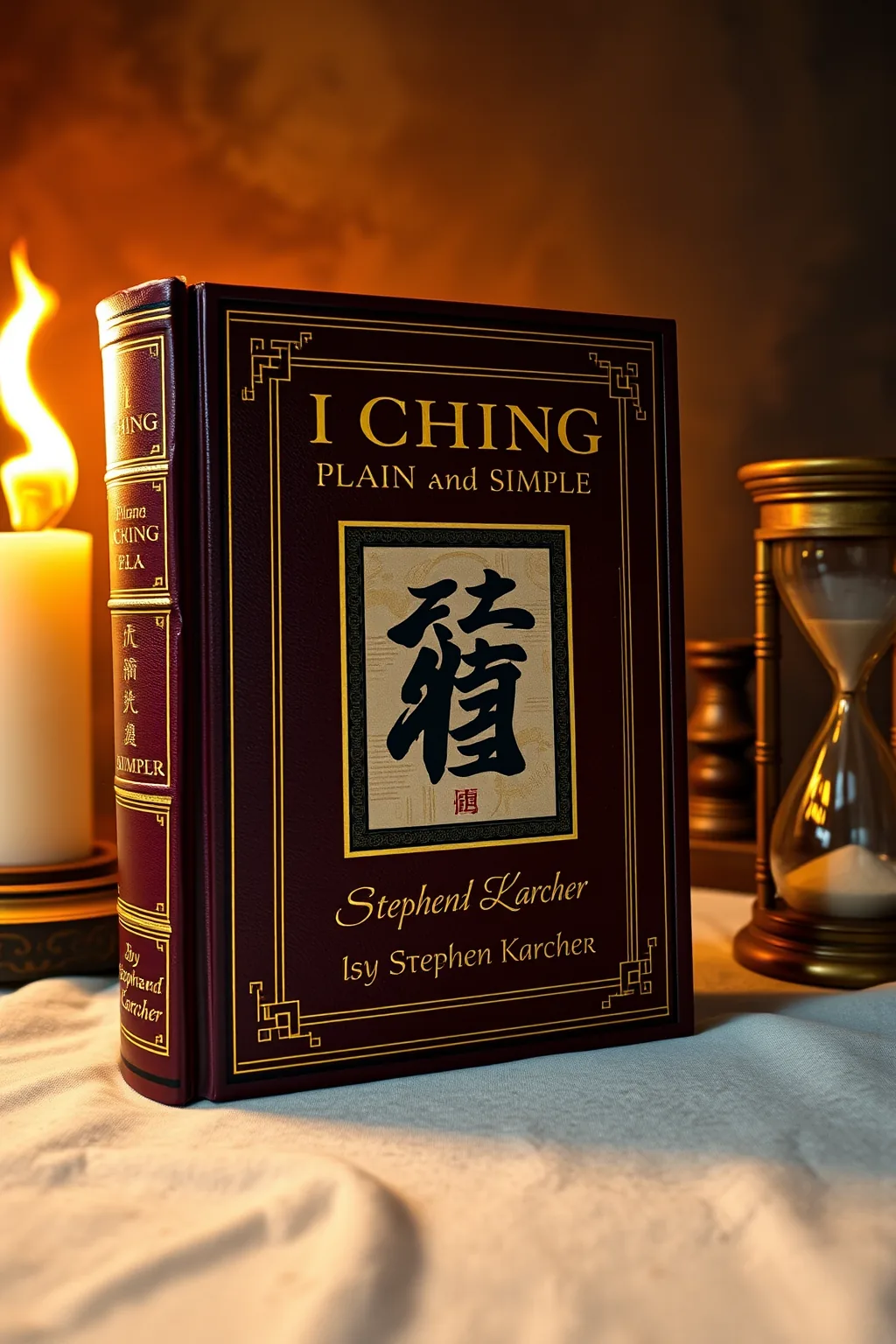
I Ching Plain and Simple
 61
61

I Ching Plain and Simple



Isolde Whitaker (Sacred Texts Editor) — Stephen Karcher's "I Ching Plain and Simple" is a luminous beacon for anyone seeking to engage with the venerable Book of Changes. Karcher's prose, both accessible and deeply resonant, strips away the intimidation often associated with this ancient oracle, revealing its profound philosophical and spiritual core. He artfully elucidates the complex symbolism of the hexagrams, offering practical interpretations that speak directly to contemporary challenges. This work is an essential resource for practitioners, scholars, and spiritual seekers alike, providing a clear pathway to harnessing the I Ching's transformative power for personal insight and guidance. A true gem for the discerning library.
📝 Description
61
Stephen Karcher's 2002 book, 'I Ching Plain and Simple,' presents the ancient Chinese oracle for contemporary readers.
Stephen Karcher's 'I Ching Plain and Simple' aims to make the ancient Chinese oracle accessible. The book breaks down the complex system of hexagrams into understandable insights. Karcher discusses the fundamental principles of Yin and Yang and the trigrams, showing how they relate to the patterns of destiny. He presents the I Ching not just as a method for fortune telling, but as a philosophical tool that reflects universal structures. The text guides readers through life's events, encouraging a connection with broader principles. It is intended for those seeking self-knowledge and personal growth through understanding the I Ching's symbolism.
The I Ching, or 'Book of Changes,' is one of the oldest Chinese classical texts. Its origins are traced to shamanistic divination practices and early cosmology. For centuries, it has served as a source for philosophy, statecraft, and personal guidance. The text's sixty-four hexagrams, built from combinations of eight trigrams, are seen as representing all possible situations and transformations. Its study is traditionally linked to understanding the Tao, the natural order of the universe, and aligning oneself with its flow.
💡 Why Read This Book?
Unravel the ancient mysteries of change and destiny. "I Ching Plain and Simple" offers a clear, profound gateway to understanding the universe's subtle guidance. Ideal for seekers of spiritual wisdom, practitioners of divination, and scholars of Eastern philosophy who desire a direct, insightful connection to this powerful oracle. Discover actionable wisdom for navigating life's transitions and unlocking your inner potential.
⭐ Reader Reviews
Honest opinions from readers who have explored this book.
❓ Frequently Asked Questions
What is the I Ching?
The I Ching, or Book of Changes, is an ancient Chinese text and divination system that uses hexagrams—six-line figures—to offer insights into the nature of change and provide guidance for decision-making.
Is this book suitable for beginners?
Absolutely. Stephen Karcher's "Plain and Simple" approach makes the I Ching's complex symbolism and philosophy accessible to those with no prior knowledge, guiding them step-by-step.
How is the I Ching used for divination?
Divination involves posing a question and then using methods like coin tosses or yarrow stalks to generate a hexagram, which is then interpreted using the text's wisdom.
What are hexagrams?
Hexagrams are fundamental to the I Ching. They are composed of six stacked lines, each either broken (Yin) or solid (Yang), representing various cosmic states and situations.
Does this book offer practical advice?
Yes, beyond philosophical insights, the I Ching provides practical counsel on how to approach situations, understand underlying dynamics, and make more informed choices.
🔮 Key Themes & Symbolism
The Philosophy of Change
At its heart, the I Ching is a profound exploration of the constant flux and evolution inherent in the universe. It teaches that change is not chaotic but follows predictable patterns governed by the interplay of Yin and Yang. Understanding these principles allows one to navigate life's inevitable shifts with greater wisdom, adaptability, and equanimity. This theme emphasizes the cyclical nature of existence and the importance of aligning oneself with the natural flow of transformation rather than resisting it.
Symbolic Language of the Cosmos
The I Ching's power lies in its rich and intricate symbolism, primarily through its 64 hexagrams. Each hexagram is a miniature cosmic map, depicting archetypal situations and energies. The trigrams (three-line combinations) further condense these meanings, representing fundamental forces like Heaven, Earth, Water, and Fire. Karcher masterfully deciphers this visual language, revealing how these symbols offer clear insights into the underlying structure of reality and the human experience, connecting the microcosm to the macrocosm.
Guidance for the Modern Seeker
While rooted in ancient tradition, the I Ching remains remarkably relevant for contemporary life. "I Ching Plain and Simple" bridges the gap, presenting its oracle not as a mystical relic but as a practical tool for self-awareness, ethical decision-making, and spiritual growth. It empowers readers to consult the I Ching for guidance on personal relationships, career challenges, and existential questions, fostering a deeper connection to their inner knowing and the wisdom of the ages.
💬 Memorable Quotes
Direct passages from the work, attributed to the author.
“The sage observes the signs of the times.”
— This highlights the I Ching's role as an oracle that helps one perceive and understand the opportune moments and underlying currents of any given situation.
“Change is the only constant.”
— A fundamental tenet of the I Ching, reminding us that embracing impermanence is key to wisdom and adaptability.
“The superior person acts when it is time.”
— Emphasizes the importance of timing and discerning the right moment for action, a core principle of I Ching consultation.
“To know the patterns is to know the way.”
— Suggests that by understanding the underlying principles of change, one can navigate life more effectively and harmoniously.
“The hexagrams are mirrors of the soul.”
— Illustrates how the I Ching's symbolic language reflects our inner states and helps us gain self-awareness.
🌙 Esoteric Significance
Tradition
The I Ching is a foundational text within Chinese esoteric traditions, particularly Taoism and its various branches, as well as certain schools of Confucianism that emphasize inner cultivation. It is viewed as a cosmic map, revealing the Taoist principles of Yin and Yang, the Five Elements, and the cyclical nature of the universe. Its divinatory aspect is considered a form of sympathetic magic or ritualistic communication with the underlying forces of existence, allowing for alignment and harmonious action.
Symbolism
The core symbolism resides in the 64 hexagrams, each formed by six lines (solid for Yang, broken for Yin). These lines and their combinations represent archetypal situations, natural phenomena, and human relationships. Trigrams, the three-line building blocks of hexagrams, symbolize fundamental cosmic forces (Heaven, Earth, Water, Fire, etc.). The interpretation of these symbols offers clear insights into the dynamics of any given situation, revealing hidden potentials, challenges, and the most auspicious path forward.
Modern Relevance
In the modern era, the I Ching's esoteric significance lies in its ability to provide a framework for understanding complex contemporary issues through a lens of timeless principles. It offers a counterpoint to fragmented, materialistic worldviews by emphasizing interconnectedness and cyclical patterns. For individuals seeking meaning, guidance, and a deeper connection to universal wisdom, the I Ching serves as a powerful tool for self-reflection, ethical navigation, and fostering a sense of cosmic harmony in a rapidly changing world.
👥 Who Should Read This Book
This accessible guide is a treasure for a wide spectrum of readers. Beginners to the I Ching will find a clear, unpretentious entry point into its profound wisdom. Scholars of Eastern philosophy and comparative religion will appreciate Karcher's insightful interpretations and the text's historical context. Spiritual seekers and practitioners of divination will discover a potent tool for self-discovery, decision-making, and aligning with universal energies. Anyone yearning to understand the ebb and flow of life and to find guidance amidst uncertainty will benefit immensely.
📜 Historical Context
The I Ching, or Book of Changes, boasts a lineage stretching back over three millennia, making it one of the oldest and most influential texts in Chinese civilization. Its origins are shrouded in legend, attributed to figures like Fu Xi and King Wen, and later elaborated upon by Confucius and his disciples. Initially a system for divination, the I Ching evolved into a complex philosophical and cosmological treatise, deeply embedded in Taoist and Confucian thought. During the Han Dynasty (206 BCE – 220 CE), it was canonized as one of the Five Classics, solidifying its status as a central to Chinese intellectual and spiritual life. Its influence permeated governance, medicine, art, and personal conduct, shaping the worldview of countless individuals and dynasties. The text's enduring appeal lies in its universal themes of change, balance, and the interconnectedness of all things, which have continued to resonate across cultures and epochs.
📔 Journal Prompts
Reflect on a recent situation where you felt resistance to change. How did the I Ching's philosophy of flux offer a different perspective?
Consider the symbolism of a specific hexagram that speaks to your current life circumstances. What hidden messages or guidance does it reveal?
How can the principle of balancing Yin and Yang be applied to a personal relationship or a professional challenge you are facing?
Explore your understanding of 'fate' versus 'free will' as presented through the I Ching's oracle. Where do you see agency within the patterns of change?
Journal about the nature of 'timeliness' as suggested by the I Ching. How can you cultivate a greater awareness of opportune moments in your daily life?
🗂️ Glossary
Hexagram
A figure composed of six stacked lines, either solid (Yang) or broken (Yin), used as the primary symbolic unit in the I Ching for divination and interpretation.
Trigram
A basic building block of a hexagram, consisting of three lines. There are eight fundamental trigrams, each representing a core natural element or concept (e.g., Heaven, Earth, Water).
Yin
In I Ching philosophy, the passive, receptive, dark, cool, and feminine principle, represented by a broken line (---).
Yang
In I Ching philosophy, the active, creative, light, warm, and masculine principle, represented by a solid line (—).
Tao
The fundamental principle in Taoism, often translated as 'the Way.' It represents the natural order of the universe and the underlying force that guides all existence.
This book appears in 2 collections
🔮 Readers Also Liked
Browse all →








More by Stephen Karcher
All books →





From the “I Ching” Collection
View all →








More Free Divination & Tarot Books
View all →