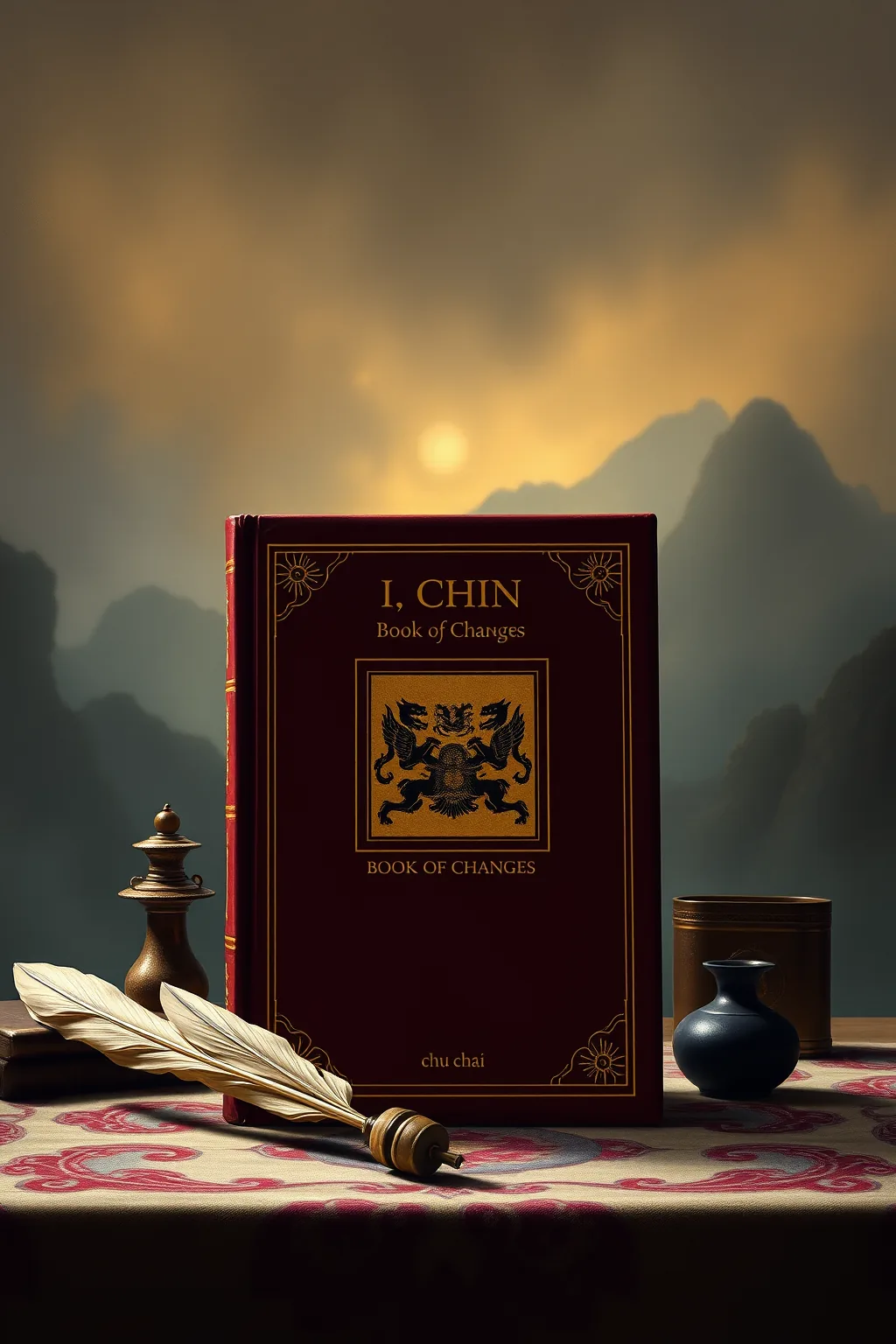
I Ching Book of Changes
 61
61

I Ching Book of Changes



Silas Hawthorne (Hermetic Studies Editor) — This rendition of the I Ching by ch'u chai is an indispensable treasure for any serious student of esoteric knowledge. It transcends the superficiality of simple fortune-telling, delving deep into the philosophical underpinnings and symbolic language that have captivated mystics for millennia. The lucid prose and insightful commentary reveal the profound cyclical nature of existence, offering a sophisticated framework for self-discovery and spiritual growth. Its strength lies in its ability to bridge the gap between ancient wisdom and contemporary application, making it an essential guide for practitioners and scholars alike who seek to understand the subtle forces at play in the cosmos and within themselves.
📝 Description
61
Ch'u chai's 1970 translation of the I Ching offers a direct engagement with this ancient Chinese oracle.
This edition of the I Ching, translated by ch'u chai, presents the classic oracle text. It details the sixty-four hexagrams, each formed by six lines, which are interpreted as representing universal situations and their transformations. The book functions as a guide for understanding change and interconnectedness, rather than a system of simple prediction. It aims to provide insight into the underlying patterns of existence and human experience.
The text suggests that by studying these patterns, individuals can gain a better understanding of their circumstances and potential outcomes. It focuses on the cyclical nature of events and the interplay between destiny and personal action. The translation seeks to make the oracle's wisdom accessible to those interested in its philosophical and divinatory aspects.
The I Ching, or 'Book of Changes,' is a foundational text in Chinese cosmology and philosophy, dating back at least to the Western Zhou Dynasty. Its use as an oracle system, interpreting patterns of change through hexagrams, has influenced Taoism and Confucianism. This translation by ch'u chai engages with the text's divinatory and philosophical dimensions, positioning it within the broader stream of esoteric traditions that seek to understand universal order and human place within it.
💡 Why Read This Book?
For the discerning seeker and the dedicated scholar, this edition of the I Ching offers an unparalleled portal into one of humanity's most enduring systems of wisdom. It provides not just methods of divination, but a profound philosophical framework for understanding change, destiny, and personal agency. Ideal for those who wish to cultivate intuition, deepen their philosophical understanding, and master the art of navigating life's inevitable transformations with grace and insight.
⭐ Reader Reviews
Honest opinions from readers who have explored this book.
❓ Frequently Asked Questions
What is the I Ching?
The I Ching, or 'Book of Changes,' is an ancient Chinese text that serves as a fundamental source of wisdom and divination. It comprises 64 hexagrams, each representing a different state or situation, and provides guidance on how to act in accordance with the natural flow of the universe.
Who is ch'u chai?
ch'u chai is the author and translator of this specific edition of the I Ching, known for their deep understanding and nuanced interpretation of the classic text, making its profound wisdom accessible to modern readers.
How is the I Ching used for divination?
Divination with the I Ching typically involves casting yarrow stalks or coins to generate a hexagram. The resulting hexagram, along with its changing lines, is then consulted for guidance on a specific question or situation, offering insights into potential outcomes and recommended actions.
What is the philosophical significance of the I Ching?
Philosophically, the I Ching emphasizes the concept of constant change and the cyclical nature of existence. It teaches about balance, harmony, and the importance of adapting to circumstances, reflecting a Taoist worldview of effortless action and natural flow.
Is this book suitable for beginners?
Yes, while rich in depth, this edition is presented in a way that is accessible to beginners. However, a genuine interest in esoteric studies and a willingness to engage with complex symbolism are recommended for the most rewarding experience.
🔮 Key Themes & Symbolism
The Philosophy of Change
Fundamentally, the I Ching is a profound exploration of the Taoist principle of perpetual flux. It posits that change is the only constant, and understanding its patterns is key to navigating life. This theme examines the dynamic interplay of yin and yang, the fundamental forces that drive all transformation, offering a lens through which to perceive the ebb and flow of events and to cultivate adaptability and resilience in the face of life's inevitable shifts. It encourages a harmonious alignment with the cosmic rhythm, fostering wisdom and equanimity.
Symbolic Language of the Hexagrams
The 64 hexagrams are the visual and conceptual heart of the I Ching. Each is a unique arrangement of six lines, either solid (yang) or broken (yin), creating a collection of archetypal imagery. This theme examines the profound symbolism embedded within each hexagram, illustrating how these patterns represent universal human experiences, cosmic forces, and stages of development. Understanding this intricate symbolic language is akin to learning the alphabet of the universe, enabling the reader to interpret the subtle messages conveyed by the text and apply them to their own life.
Divination as Self-Reflection
Far from being a mere predictive tool, the I Ching's divinatory aspect serves as a powerful catalyst for self-reflection and introspection. This theme explores how consulting the oracle encourages individuals to examine their intentions, motivations, and the underlying dynamics of their situations. The guidance offered is not prescriptive but suggestive, prompting the user to consider different perspectives and to make conscious, informed choices aligned with the natural order. It is a method for cultivating wisdom, discerning the opportune moment, and acting with clarity and purpose.
💬 Memorable Quotes
Direct passages from the work, attributed to the author.
“Change is the only constant.”
— This fundamental axiom expresses the I Ching's core philosophy, emphasizing the ceaseless nature of transformation in the universe and in human experience.
“The superior man understands the signs of the times.”
— This highlights the importance of discernment and awareness, urging individuals to be attuned to the subtle shifts and opportunities presented by their circumstances.
“In stillness, one can perceive the movement of the world.”
— This paradoxical statement suggests that true understanding often arises from quiet contemplation and inner peace, allowing one to grasp the larger cosmic dance.
“When there is an obstacle, it is best to pause.”
— This offers practical wisdom for navigating challenges, advocating for patience and strategic assessment rather than impulsive action when faced with difficulty.
“The wise man makes his plans according to the changes.”
— This underscores the adaptive nature of intelligence and foresight, emphasizing the need to align one's actions with the prevailing forces of change.
🌙 Esoteric Significance
Tradition
The I Ching is a core part of East Asian esoteric traditions, deeply intertwined with Taoism and its emphasis on the natural order (Tao). It is also a key text in Chinese metaphysics, geomancy (Feng Shui), and various forms of Chinese astrology and divination. Its principles of balance, transformation, and interconnectedness are central to understanding the subtle energies that govern both the macrocosm and the microcosm, offering a path to spiritual insight and alignment with universal forces.
Symbolism
The core symbolism lies in the binary system of yin (broken line) and yang (solid line), which represent complementary opposites such as feminine/masculine, passive/active, dark/light. These lines combine to form trigrams, and then 64 hexagrams, each a potent archetypal image. These symbols represent the myriad states of the cosmos and human experience, from creation and growth to conflict and resolution, serving as a visual language to decipher the patterns of existence and guide one's actions.
Modern Relevance
In the modern era, the I Ching continues to offer profound relevance as a tool for psychological exploration, ethical guidance, and spiritual growth. Its emphasis on adaptability, understanding the nature of change, and making conscious choices resonates deeply in a world characterized by rapid transformation and uncertainty. It provides a timeless perspective on navigating personal challenges, fostering inner harmony, and cultivating a deeper connection to the underlying order of the universe, serving as a vital resource for those seeking wisdom and balance.
👥 Who Should Read This Book
This edition of the I Ching is a profound resource for a diverse audience. Beginners in esoteric studies will find it an accessible yet deep introduction to one of the world's most ancient wisdom systems. Scholars of philosophy, comparative religion, and Asian studies will appreciate its rich historical and cultural context. Spiritual seekers and practitioners of divination or mindfulness will discover a powerful tool for self-reflection, guidance, and understanding the subtle currents of life. It is for anyone yearning to cultivate wisdom, navigate change with grace, and deepen their connection to the universal patterns of existence.
📜 Historical Context
The I Ching, or 'Book of Changes,' has a lineage stretching back over three millennia, originating in ancient China. Its earliest layers are believed to date from the Western Zhou dynasty (c. 1046–771 BCE), evolving through the Spring and Autumn period (771–476 BCE) and the Warring States period (475–221 BCE) with the addition of commentaries by Confucian scholars, most notably the 'Ten Wings' attributed to Confucius himself, though this is debated. Initially used for divination and later integrated into philosophical and political discourse, it became a foundational text of Chinese culture, influencing not only Confucianism but also Taoism and a wide range of esoteric practices. Its enduring relevance lies in its ability to provide a framework for understanding cyclical patterns, societal dynamics, and personal development, resonating across centuries and cultures.
📔 Journal Prompts
Reflect on a recent significant change in your life. How does the I Ching's concept of 'change as constant' apply to this experience?
Choose a hexagram that appeals to you today. What message does its symbolism convey about your current state or potential path?
Consider a challenge you are currently facing. How can the principles of balance and adaptability, as taught by the I Ching, inform your approach?
What does 'acting in accordance with the natural flow' mean to you in your daily life? Provide specific examples.
How can you cultivate greater awareness of the subtle signs and 'signs of the times' in your personal and professional life?
🗂️ Glossary
Hexagram
A figure composed of six stacked horizontal lines, each either solid (yang) or broken (yin). There are 64 distinct hexagrams in the I Ching, each representing an archetypal situation or state of being.
Yin
The feminine, passive, dark, and receptive principle in Taoist philosophy, represented by a broken line (--) in I Ching hexagrams.
Yang
The masculine, active, light, and creative principle in Taoist philosophy, represented by a solid line (—) in I Ching hexagrams.
Trigram
A figure composed of three stacked lines (yin or yang). There are eight basic trigrams, which are the building blocks of the 64 hexagrams.
Tao
The fundamental principle of the universe in Taoism, often translated as 'the Way.' It represents the natural order, the inherent flow, and the underlying unity of all things.
This book appears in 2 collections
🔮 Readers Also Liked
Browse all →









From the “I Ching” Collection
View all →








More Free Divination & Tarot Books
View all →