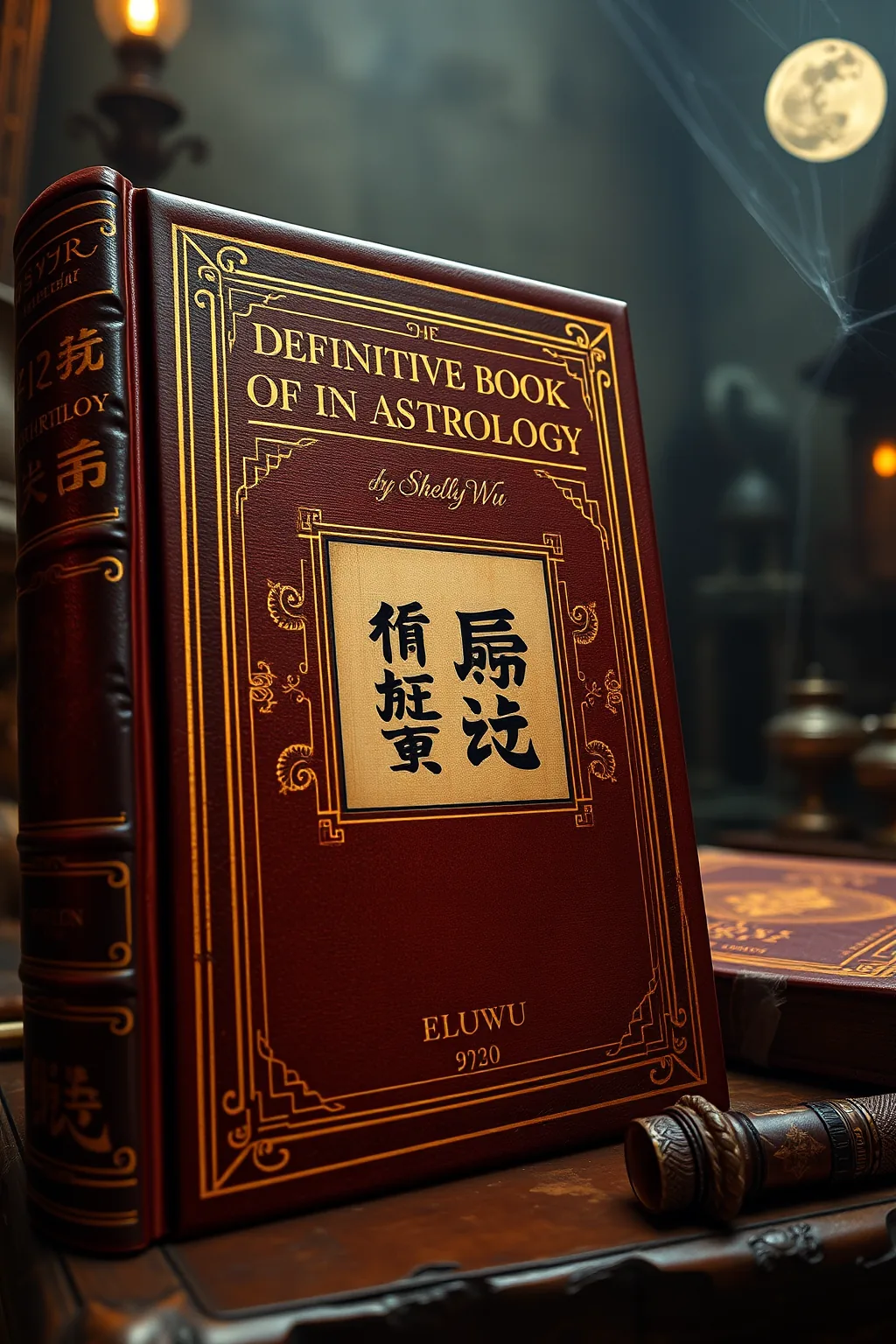
Definitive Book of Chinese Astrology
 61
61

Definitive Book of Chinese Astrology


Ophelia Vance, Mystical Literature Reviewer — Shelly Wu's "Definitive Book of Chinese Astrology" is a luminous beacon in the realm of esoteric studies. It transcends mere fortune-telling, offering a profound exploration of cosmic interconnectedness and the subtle energies that shape our lives. Wu's scholarly yet accessible prose illuminates the deep philosophical underpinnings of this ancient art, revealing its power as a tool for self-understanding and spiritual growth. The book is exceptionally well-structured, making complex concepts like the Five Elements and Heavenly Stems digestible for both neophytes and those with prior astrological knowledge. A truly essential volume for anyone seeking to harmonize with the cosmic currents.
📝 Description
61
Shelly Wu's 1994 book explains Chinese astrology using the Five Elements and Yin/Yang.
This book examines the principles of Chinese astrology. It details the twelve zodiac animals, their characteristics, and how they interact. The text also explains the concepts of Yin and Yang and the Five Elements (Wood, Fire, Earth, Metal, Water) and how these forces influence personality and destiny. Wu connects these astrological components to broader philosophical ideas within Chinese thought. The aim is to provide a comprehensive understanding of this ancient system, going beyond simple fortune telling to explore life's patterns and connections.
The author breaks down how to interpret birth charts based on these elements and animal signs. It covers how different combinations create unique profiles and potential life paths. The book also touches upon the cyclical nature of time as understood in Chinese cosmology and its relation to astrological interpretations. It seeks to make the complex system accessible to those interested in its deeper meanings.
Chinese astrology is rooted in ancient Chinese cosmology, a system that views the universe as an interconnected whole governed by natural forces and cycles. It draws heavily on Taoist philosophy, particularly the concepts of Yin and Yang as complementary opposites and the Five Elements as fundamental energies that interact and transform. This tradition seeks to understand human life and destiny not in isolation, but as part of these larger cosmic rhythms. The practice aims to harmonize human affairs with the natural order, offering insights into personality, relationships, and future possibilities through the analysis of birth dates and times.
💡 Why Read This Book?
Unravel the profound mysteries of your birth chart and understand the energetic blueprint of your life. This book offers a gateway to ancient Chinese wisdom, revealing the symbolic language of the cosmos and its influence on personality, relationships, and destiny. Ideal for seekers of self-knowledge, practitioners of esoteric arts, and scholars of comparative cosmology.
⭐ Reader Reviews
Honest opinions from readers who have explored this book.
❓ Frequently Asked Questions
What is the significance of the Twelve Animal Signs?
The Twelve Animal Signs represent archetypal energies and cyclical patterns of time, each embodying unique characteristics and influences that shape personality and destiny according to Chinese Astrology.
How do the Five Elements (Wood, Fire, Earth, Metal, Water) function in Chinese Astrology?
The Five Elements represent fundamental forces of nature that interact in dynamic cycles of creation and destruction. Their interplay within a birth chart reveals inherent strengths, challenges, and potential transformations.
Can Chinese Astrology be used for compatibility analysis?
Absolutely. By examining the elemental interactions and animal sign correspondences between two individuals, Chinese Astrology provides deep insights into relationship dynamics, potential harmonies, and areas requiring conscious effort.
Is this book suitable for beginners?
Yes, Shelly Wu's "Definitive Book of Chinese Astrology" is crafted to be accessible to beginners while offering profound depth for experienced practitioners. It guides readers through core concepts with clarity and insight.
What is the difference between Chinese and Western Astrology?
While both systems chart celestial influences, Chinese Astrology is rooted in a lunar calendar, focuses on elemental interactions, and uses a cyclical animal zodiac, offering a distinct philosophical framework and predictive approach.
🔮 Key Themes & Symbolism
The Twelve Animal Zodiacs
Explore the profound symbolism of the twelve animal signs – Rat, Ox, Tiger, Rabbit, Dragon, Snake, Horse, Goat, Monkey, Rooster, Dog, and Pig. Each animal embodies distinct personality traits, inherent strengths, and potential challenges, offering a body of archetypal energies that influence an individual's life path and interactions. Understanding your birth animal provides a powerful lens through which to view your innate nature and understand the cyclical energies that govern the year.
The Five Elements (Wu Xing)
Look at the dynamic interplay of the Five Elements: Wood, Fire, Earth, Metal, and Water. These fundamental forces are not static entities but vibrant energies that constantly interact through cycles of creation and destruction. Their balance or imbalance within a birth chart, as well as in the environment, profoundly affects health, relationships, career, and overall destiny. This section illuminates the esoteric principles of balance and harmony through elemental wisdom.
Yin and Yang Principles
Uncover the ancient Taoist concept of Yin and Yang, the complementary and opposing forces that permeate the universe. This dualistic philosophy is central to understanding the ebb and flow of cosmic energies, the balance of opposing qualities, and the interconnectedness of all things. Within Chinese Astrology, Yin and Yang principles help to interpret the subtler nuances of a person's character and the energetic dynamics present in their life.
💬 Memorable Quotes
Direct passages from the work, attributed to the author.
“In the dance of the elements, find your rhythm.”
— This speaks to the importance of understanding and harmonizing the Five Elements within oneself and one's environment for a balanced and fulfilling life.
“The Dragon's power is matched by the Rabbit's grace.”
— Illustrates the diverse archetypes of the zodiac, showcasing how seemingly disparate energies can coexist and influence different facets of existence.
“Wisdom is the illumination gained from the celestial mirror.”
— Suggests that astrological study is a form of introspection, using cosmic patterns to gain self-awareness and deeper understanding.
“The cycle of the year mirrors the cycle of the soul.”
— Connects the macrocosm (yearly astrological cycles) with the microcosm (the individual soul's journey of growth and evolution).
💡 Key Ideas
Editorial paraphrase of the work's core concepts — not direct quotes.
The stars do not command, they merely suggest pathways.
This quote highlights the deterministic versus free-will aspect of astrology, emphasizing that celestial alignments offer guidance and potential rather than immutable fate.
🌙 Esoteric Significance
Tradition
Rooted deeply in Taoist philosophy and ancient Chinese cosmology, this tradition views the universe as a dynamic, interconnected web of energies. It is an integral part of a holistic system that includes Traditional Chinese Medicine, Feng Shui, and the I Ching, aiming for balance and harmony between humanity and the natural world. The esoteric significance lies in understanding these cosmic currents as guides for spiritual growth and alignment.
Symbolism
The core symbolism revolves around the Twelve Animal Signs, each representing a specific archetypal energy, and the Five Elements (Wood, Fire, Earth, Metal, Water), which symbolize fundamental forces and their dynamic interactions. The Yin and Yang duality further enriches this symbolic language, illustrating the interplay of opposing yet complementary forces essential for cosmic order and personal equilibrium.
Modern Relevance
In the modern era, Chinese Astrology offers a powerful framework for self-discovery, personal development, and navigating life's complexities. It provides insights into innate strengths, challenges, and relationship dynamics, fostering greater self-awareness and enabling individuals to make more conscious choices. Its emphasis on balance, harmony, and cyclical understanding offers a grounding perspective in a rapidly changing world, promoting a sense of connection to ancient wisdom.
👥 Who Should Read This Book
This definitive guide is essential for earnest seekers of self-knowledge looking to understand their unique cosmic blueprint. Astrologers, both novice and experienced, will find a wealth of detailed information and nuanced interpretations. Scholars of comparative mythology, Eastern philosophies, and ancient cosmological systems will discover a rich resource. Practitioners of related esoteric arts like Feng Shui and Traditional Chinese Medicine will gain deeper insights into the energetic underpinnings of their practices. Ultimately, anyone drawn to the profound wisdom of the East and the mysteries of the celestial dance will find this book invaluable.
📜 Historical Context
Chinese Astrology, with roots stretching back thousands of years, emerged from ancient Chinese cosmology, philosophy, and astronomical observation. It developed alongside concepts like Yin and Yang, the Five Elements, and the I Ching, forming an integral part of a holistic worldview that sought to understand the interconnectedness of humanity, earth, and the cosmos. This system was not merely a tool for prediction but a profound philosophical framework for understanding life, governance, and the natural world. Its influence permeated imperial courts, traditional medicine, and daily life, shaping cultural practices and spiritual beliefs. The development of the lunar calendar and the systematic mapping of celestial bodies were crucial in its evolution, making it a sophisticated and enduring system of divination and self-understanding.
📔 Journal Prompts
Reflect on the core traits of your birth animal. How do they manifest in your daily life, both positively and negatively?
Consider the Five Elements present in your birth chart. Which elements feel dominant or lacking, and how does this imbalance affect you?
How does the concept of Yin and Yang resonate with your personal experiences and relationships?
Identify a recurring pattern or challenge in your life. Can you see its reflection in the cyclical nature of Chinese Astrology?
Imagine you could harmonize one elemental imbalance in your life. What would it be and how would you approach it?
🗂️ Glossary
Zi Wei Dou Shu (Purple Star Astrology)
A complex branch of Chinese Astrology that utilizes a system of 'stars' and palaces to map out destiny, often considered more intricate and deeply predictive than the animal zodiac system.
Ba Zi (Four Pillars of Destiny)
A system that uses the year, month, day, and hour of birth to create a chart of eight characters (four pillars, each with two characters), revealing a person's destiny and personality.
Gan Zhi (Heavenly Stems and Earthly Branches)
The fundamental sixty-year cycle of timekeeping in Chinese Astrology, combining the ten Heavenly Stems and twelve Earthly Branches into unique combinations that influence each year, month, day, and hour.
Wu Xing
The Chinese term for the Five Elements (Wood, Fire, Earth, Metal, Water), representing fundamental forces and their interactions that are central to understanding the universe and human destiny.
Gua
In the context of the I Ching and related systems, a 'gua' refers to a hexagram or trigram, representing fundamental patterns of change and cosmic influence.
This book appears in 2 collections
🔮 Readers Also Liked
Browse all →








More by Shelly Wu
All books →



From the “Astrology” Collection
View all →








More Free Astrology & Cosmology Books
View all →