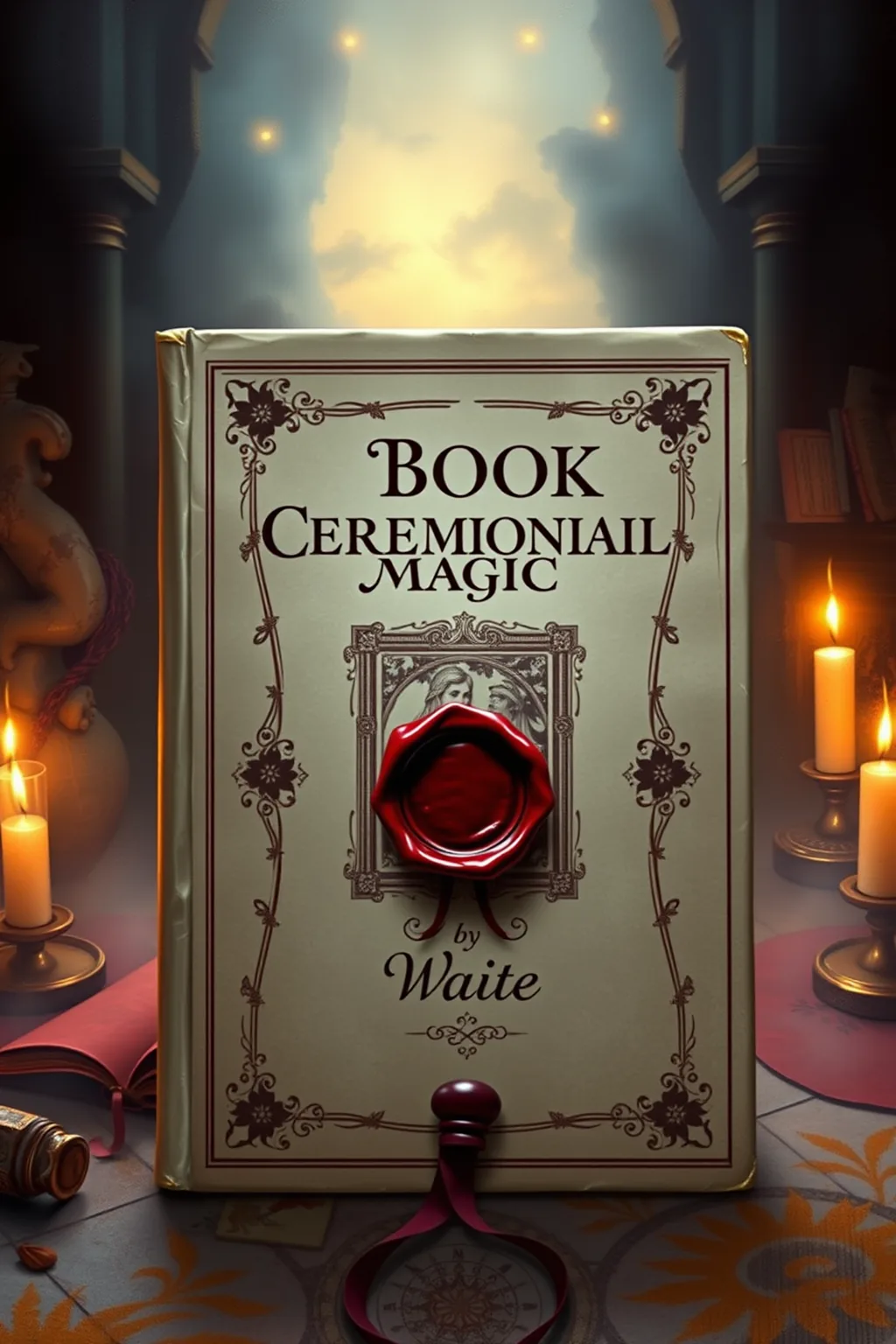
Book Ceremonial Magic
 61
61

Book Ceremonial Magic



Alaric Kestrel, Metaphysical Studies Reviewer: Arthur Edward Waite's 'Book Ceremonial Magic' stands as a cornerstone for serious students of the occult. Waite's rigorous scholarship illuminates the complex theoretical underpinnings and practical applications of ceremonial magic, particularly its relationship with demonological symbolism. He eschews sensationalism, offering instead a deeply insightful exploration of ritual as a means of spiritual discipline and self-transformation. The work is invaluable for its historical perspective and its nuanced understanding of the psychological and philosophical dimensions of magical practice. Essential reading for adepts and scholars aiming to grasp the profound depths of Western esotericism.
📝 Description
61
Arthur Edward Waite's 1911 'Book of Ceremonial Magic' details methods for conjuration and the evocation of spirits.
Published in 1911, Arthur Edward Waite's 'Book of Ceremonial Magic' is a comprehensive study of ritualistic practices. Waite examines various methods of conjuration and the invocation of unseen entities, drawing from historical grimoires and traditions. He treats demonology not as literal beings but as symbolic representations of psychological forces that can be integrated into the self. The book details the symbolic significance of sacred rites and their role in spiritual development. Waite argues that ceremonial magic is a valid path for personal transformation and achieving a higher state of consciousness.
This work aims to demystify aspects of ritual magic for the serious student. It covers the practical application of certain rites, the necessary preparations, and the symbolic meanings behind the actions. Waite's approach is analytical, seeking to understand the underlying principles and psychological effects of these practices. The text invites readers to consider magic as a discipline for self-mastery and spiritual awareness, connecting it to the broader human pursuit of knowledge and enlightenment.
Arthur Edward Waite's work is situated within the late 19th and early 20th-century revival of Western esotericism. It engages with the tradition of ceremonial magic, which seeks to achieve specific results through ritualized actions, invocations, and the manipulation of symbolic energies. Waite's specific focus on the psychological interpretation of magical phenomena places him alongside other thinkers who sought to reconcile occult traditions with emerging psychological theories. His scholarship connects with the historical study of grimoires and the practices of earlier magical orders, offering a detailed account of this esoteric lineage.
💡 Why Read This Book?
Delve into the foundational principles of Western ceremonial magic and its intricate relationship with demonology. Waite's authoritative text offers a profound understanding of ritual, symbolism, and spiritual discipline. Ideal for serious practitioners, occult scholars, and seekers of hidden knowledge who wish to explore the transformative power of ancient magical arts and their psychological resonance.
⭐ Reader Reviews
Honest opinions from readers who have explored this book.
❓ Frequently Asked Questions
What is ceremonial magic?
Ceremonial magic is a structured system of ritualistic practices aimed at invoking or banishing spiritual entities, achieving altered states of consciousness, and effecting transformations in the material or spiritual realms through symbolic actions and precise incantations.
Is demonology in this book literal?
Waite often interprets demonology symbolically, viewing these entities as representations of primal psychological forces, shadow aspects of the self, or cosmic energies rather than solely as external beings.
Who was Arthur Edward Waite?
Arthur Edward Waite was a prolific author and occult scholar, a co-founder of the Hermetic Order of the Golden Dawn, and a leading figure in the esoteric revival of the late 19th and early 20th centuries.
What kind of rituals are discussed?
The book covers a range of rituals, including conjurations, invocations, banishings, and the preparation of magical tools, often drawing from Kabbalistic and hermetic traditions.
Is this book suitable for beginners?
While comprehensive, the book's depth and scholarly approach may be best suited for those with some prior exposure to esoteric concepts or a strong inclination for rigorous study.
🔮 Key Themes & Symbolism
The Art of Ritual and Invocation
This theme explores the meticulous construction and execution of magical rituals, emphasizing the importance of intention, symbolism, and precise formulation. It explores how specific actions, words, and tools are employed to create sacred space, establish contact with unseen forces, and direct energetic currents for desired outcomes. The focus is on ritual as a profound art form and a sophisticated technology for engaging with the subtle dimensions of existence, thereby facilitating spiritual growth and the manifestation of will.
Symbolic Language of Demonology
Waite's treatment of demonology transcends simplistic interpretations, presenting these entities as potent archetypes and symbolic representations of psychological energies, primal instincts, and cosmic forces. This section examines how understanding and engaging with these symbolic figures can lead to a deeper self-awareness, the integration of shadow aspects, and the mastery over internal challenges. It highlights the occult principle that what is understood and confronted can be transformed and utilized for spiritual advancement.
Spiritual Evolution Through Magic
Fundamentally, the book posits ceremonial magic as a path toward profound spiritual evolution and self-realization. It argues that through disciplined practice, symbolic understanding, and the skillful manipulation of subtle energies, individuals can transcend their limitations, attain higher states of consciousness, and connect with the divine. This theme underscores the idea that magic is not merely about external control but about internal transformation, leading to a more enlightened and empowered existence.
💬 Memorable Quotes
Direct passages from the work, attributed to the author.
“Symbolism is the language of the soul.”
— This highlights the crucial role of symbols in esoteric traditions, suggesting they are the primary means by which deeper, spiritual truths are communicated and understood.
“To know is to possess.”
— This aphorism points to the power inherent in true knowledge and understanding, implying that acquiring esoteric wisdom grants one a form of mastery or control.
“The veil is thin for the prepared mind.”
— This emphasizes the importance of mental discipline and spiritual readiness in accessing hidden knowledge and experiencing the supernatural.
“Inner transformation precedes outer manifestation.”
— This principle underscores the belief that true magical efficacy stems from changes within the practitioner, rather than solely from external ritualistic actions.
💡 Key Ideas
Editorial paraphrase of the work's core concepts — not direct quotes.
The art of magic is the art of life.
This quote suggests that the principles and practices of magic are not confined to ritualistic acts but are fundamental to navigating and shaping all aspects of existence.
🌙 Esoteric Significance
Tradition
This work is deeply rooted in the Western Esoteric Tradition, drawing heavily from Hermeticism, Kabbalah, and ceremonial magic as developed and practiced within influential occult orders like the Hermetic Order of the Golden Dawn. It represents a significant attempt to synthesize and systematize these diverse streams of mystical thought and practice for a wider audience.
Symbolism
The book is rich in symbolism, interpreting elements such as divine names, angelic hierarchies, planetary correspondences, and the specific tools and gestures used in ritual. These symbols are not merely decorative but are understood as keys to unlocking deeper psychic and spiritual potentials, acting as conduits for energetic forces and correspondences.
Modern Relevance
Despite its historical origins, 'Book Ceremonial Magic' remains profoundly relevant. Its exploration of psychological symbolism, the power of focused intention, and the disciplined application of ritual offers enduring insights for contemporary practitioners seeking self-mastery, spiritual growth, and a deeper connection to the subtle dimensions of reality in a rapidly changing world.
👥 Who Should Read This Book
This text is essential for serious students of Western esotericism, occult practitioners, and scholars of comparative religion and mysticism. Beginners with a strong inclination for academic study and a commitment to disciplined learning will find it a foundational, albeit challenging, resource. Experienced practitioners will appreciate Waite's nuanced interpretations and historical context. Seekers of hidden knowledge and those interested in the psychological underpinnings of ritual and symbolism will also find immense value within its pages.
📜 Historical Context
Arthur Edward Waite penned 'Book Ceremonial Magic' during a vibrant period of occult revival in the late 19th and early 20th centuries. This era witnessed a resurgence of interest in ancient mysteries, Kabbalah, hermeticism, and various forms of esoteric thought, often as a reaction against burgeoning materialism and scientific rationalism. Waite himself was a central figure in organizations like the Hermetic Order of the Golden Dawn, a crucible for much of this intellectual and spiritual ferment. His work reflects the scholarly yet practical approach of the time, aiming to codify and disseminate complex magical traditions, bridging the gap between historical grimoires and contemporary spiritual seekers, and influencing generations of occultists.
📔 Journal Prompts
Reflect on a personal 'demon' (a fear, limitation, or shadow aspect) and how its symbolic representation might be understood through ritual.
Consider a specific symbol from the book and meditate on its potential personal significance and application in your life.
How can the principles of intention and symbolic action be applied to mundane tasks to imbue them with greater purpose?
What are the ethical considerations when engaging with the concepts of 'invoking' and 'banishing' in a modern context?
Explore the relationship between internal psychological states and external ritualistic expression. How does one inform the other?
🗂️ Glossary
Kabbalah
An esoteric system of Jewish mysticism that seeks to understand the nature of God and the universe through the study of divine emanations and symbolic interpretations of scripture.
Hermeticism
A philosophical and religious tradition based on the writings attributed to Hermes Trismegistus, emphasizing divine wisdom, the interconnectedness of all things, and the pursuit of spiritual enlightenment.
Invocation
A ritual act of calling upon a divine being, spirit, or force to manifest or to grant assistance or knowledge.
Banishing
A ritual act aimed at repelling or dispelling unwanted energies, spirits, or influences from a space or person.
Grimoire
A textbook of magic, typically containing instructions on how to create magical tools, perform rituals, and invoke spirits, often dating from the Middle Ages or Renaissance.
This book appears in 3 collections
🔮 Readers Also Liked
Browse all →




More by Waite
All books →


From the “Ritual Magic” Collection
View all →





More Free Magic & Ritual Books
View all →