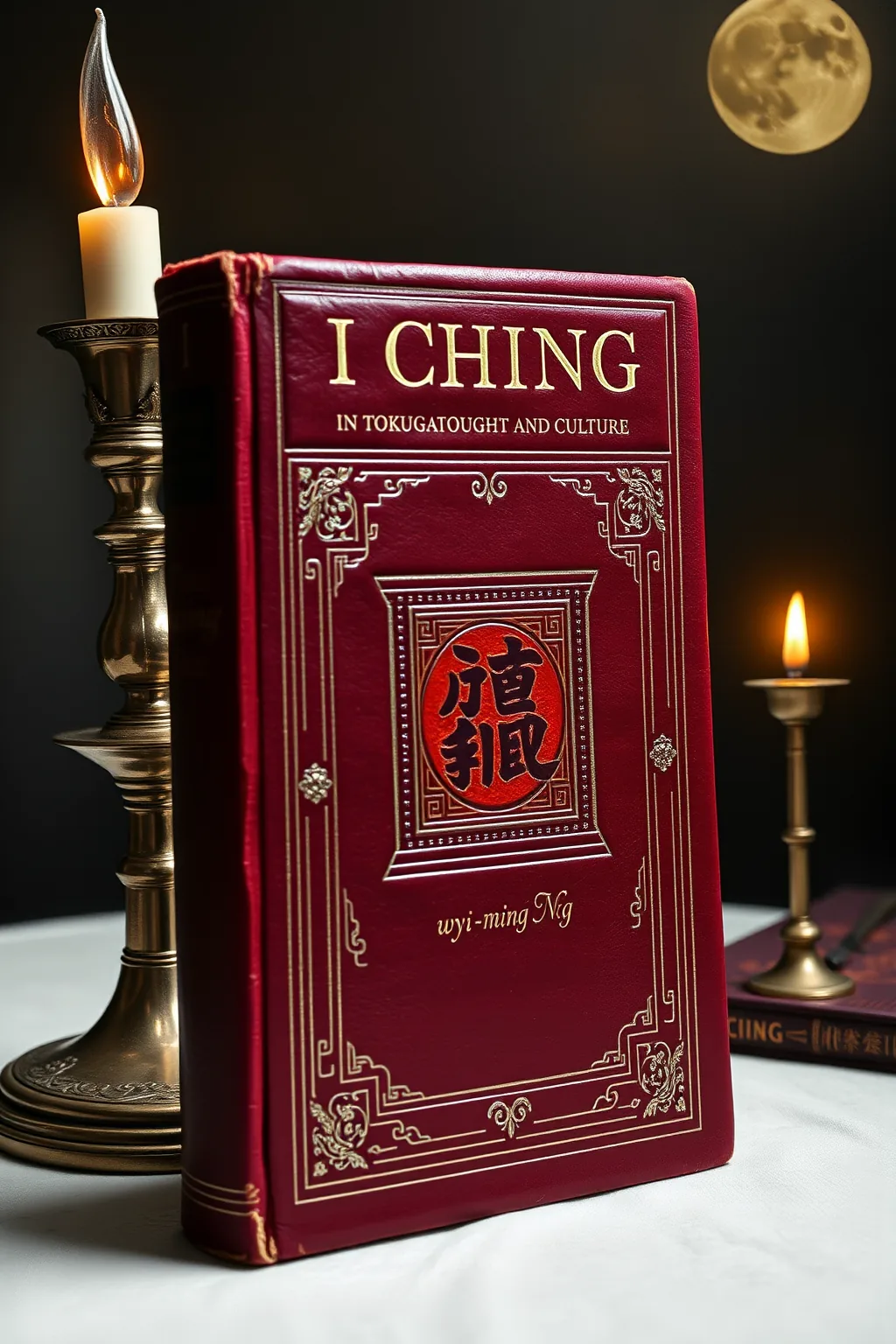
I Ching in Tokugawa Thought and Culture
 61
61

I Ching in Tokugawa Thought and Culture



Silas Hawthorne (Hermetic Studies Editor) — Wai-ming Ng masterfully excavates the profound influence of the I Ching on Tokugawa Japan, moving beyond superficial interpretations to reveal its deep philosophical and esoteric resonance. This work is a revelation for anyone seeking to understand the intellectual currents that shaped Eastern thought. Ng’s scholarly rigor is matched by a clear, evocative prose that illuminates the complex interplay between the Book of Changes and the era’s cultural fabric. Essential reading for students of Asian philosophy, comparative religion, and those drawn to the enduring power of ancient wisdom traditions. A truly illuminating journey into the heart of Japanese esoteric thought.
📝 Description
61
Wai-ming Ng's 2015 book traces the I Ching's impact on Tokugawa Japan.
This book examines the I Ching's role in Tokugawa Japan, from the mid-17th to the mid-19th century. Wai-ming Ng shows how the Book of Changes was more than a divinatory text; it was a framework for understanding the world. Its hexagrams and philosophical concepts informed discussions on cosmology, ethics, and governance among intellectuals of the period.
The study details how the I Ching provided a structure for thought, influencing scholars and spiritual practitioners alike. It was seen as a guide to living in harmony with natural cycles and moral principles. The book argues that the I Ching offered both personal solace and a conceptual tool for navigating societal challenges during an era focused on order and self-improvement.
The I Ching, originating in ancient China, is one of the world's oldest philosophical texts and a central work in East Asian esoteric traditions. Its system of divination, based on hexagrams derived from combinations of broken and unbroken lines, was believed to reveal cosmic patterns and guide human action. In Tokugawa Japan, the I Ching was adopted and adapted by various schools of thought, including Neo-Confucianism and Shinto, demonstrating its capacity to integrate with and shape existing spiritual and intellectual currents.
💡 Why Read This Book?
Unearth the hidden philosophical underpinnings of Tokugawa Japan through the lens of the I Ching. This book offers a unique perspective on divination as a profound spiritual and intellectual framework, revealing its impact on culture and thought. Ideal for seekers of ancient wisdom, historians of Eastern philosophy, and practitioners interested in the esoteric dimensions of Chinese classics.
⭐ Reader Reviews
Honest opinions from readers who have explored this book.
❓ Frequently Asked Questions
What is the primary focus of this book regarding the I Ching?
The book focuses on how the I Ching was interpreted, utilized, and integrated into the intellectual and cultural landscape of Tokugawa Japan, moving beyond its role as a simple divination tool.
Who would benefit most from reading 'I Ching in Tokugawa Thought and Culture'?
Scholars of Japanese history, Asian philosophy, religious studies, and individuals interested in the esoteric applications of the I Ching will find this book invaluable.
Does the book require prior knowledge of the I Ching?
While prior familiarity with the I Ching can enhance the reading experience, the book is written in an accessible manner and provides sufficient context for newcomers to the subject.
What historical period does the book cover?
The book specifically examines the Tokugawa period in Japanese history, roughly from the 17th to the mid-19th century, a time of relative peace and significant cultural development.
How does the book connect the I Ching to broader philosophical ideas?
It explores how the I Ching's concepts of change, balance, and cosmic order were intertwined with Neo-Confucianism, Shinto, and other philosophical currents prevalent in Tokugawa Japan.
🔮 Key Themes & Symbolism
The I Ching as a Philosophical Compass
This theme examines how the I Ching transcended its role as a divinatory oracle to become a fundamental philosophical framework for Tokugawa intellectuals. It examines how the concepts of cyclical change, the interplay of Yin and Yang, and the Hexagrams' symbolic language were employed to understand the natural world, human relationships, and the governance of society. The book illustrates how the 'Book of Changes' provided a sophisticated system for navigating life's complexities, offering insights into cosmic order and the path to ethical conduct, thereby shaping a unique worldview.
Esoteric Symbolism and Hidden Meanings
This section illuminates the wide range of esoteric symbolism embedded within the I Ching's application in Tokugawa Japan. It explores how scholars and practitioners perceived hidden layers of meaning in the hexagrams, lines, and trigrams, viewing them as keys to unlocking cosmic secrets and understanding the subtle forces that govern existence. The discussion highlights the intricate connection between the abstract symbols and their manifestation in the material world, revealing a sophisticated system of knowledge that sought to bridge the earthly and the celestial realms through contemplation and interpretation.
Cultural Integration and Societal Impact
This theme investigates the profound integration of I Ching principles into the cultural and social fabric of Tokugawa Japan. It reveals how the wisdom of the 'Book of Changes' influenced various aspects of life, from personal decision-making and artistic expression to political discourse and religious practices. The book demonstrates how this ancient divination system provided a shared vocabulary and conceptual toolkit for understanding societal harmony, individual responsibility, and the pursuit of a well-ordered existence, shaping the collective consciousness of the era.
💬 Memorable Quotes
Direct passages from the work, attributed to the author.
“In the patterns of the hexagrams, they sought the mirror of Heaven.”
— This highlights the belief that the I Ching's structure and symbolism offered a direct reflection of celestial order and universal principles.
“Tokugawa thought danced with the ancient rhythms of the Book of Changes.”
— This suggests a vibrant and dynamic engagement with the I Ching, portraying its influence as a lively and integral part of intellectual life.
“Beyond divination, a philosophy of transformation.”
— This emphasizes the book's argument that the I Ching's value extends far beyond mere fortune-telling, encompassing a deep philosophy of personal and universal change.
“The hexagrams, maps to the soul's unfolding.”
— This implies that the I Ching provides guidance not only for external circumstances but also for the internal journey of self-discovery and spiritual growth.
💡 Key Ideas
Editorial paraphrase of the work's core concepts — not direct quotes.
The hexagrams whispered truths of cosmic flux.
This quote evokes the subtle yet profound nature of the I Ching's wisdom, suggesting that its insights into change are not overt pronouncements but gentle revelations.
🌙 Esoteric Significance
Tradition
The I Ching is a core part of East Asian esoteric traditions, deeply entwined with Taoism, Confucianism, and various schools of Chinese metaphysics. In Tokugawa Japan, its esoteric significance was amplified as it was integrated into Shinto rituals, Buddhist contemplative practices, and the philosophical inquiries of scholars. It served as a bridge between the mundane and the divine, offering a symbolic language to understand the hidden forces of the universe and the path to spiritual enlightenment and self-mastery through cyclical understanding and balance.
Symbolism
The core symbolism of the I Ching lies in its 64 hexagrams, each composed of six lines, which are either solid (Yang) or broken (Yin). These trigrams and hexagrams represent fundamental cosmic forces, natural phenomena, and human situations. In Tokugawa thought, this symbolism was interpreted as a complex code for understanding the dynamic interplay of opposites, the inevitability of change, and the principles of balance and harmony. The hexagrams were seen as archetypal patterns reflecting the structure of reality, offering guidance for navigating life's challenges and achieving alignment with the Tao.
Modern Relevance
The esoteric significance of the I Ching continues to resonate profoundly in the modern world. Its emphasis on change, adaptation, and finding balance in a chaotic existence offers timeless wisdom for contemporary challenges. The I Ching's symbolic language provides a powerful framework for introspection, self-awareness, and understanding the interconnectedness of all things. For those seeking deeper meaning, spiritual guidance, or a philosophical approach to personal growth, the I Ching remains an invaluable resource, offering insights into the enduring patterns of life and the potential for transformation.
👥 Who Should Read This Book
This useful work is essential for scholars of Japanese history and Asian philosophy, offering new perspectives on the intellectual currents of the Tokugawa era. Spiritual seekers and practitioners of divination will find a rich exploration of the I Ching's deeper philosophical and symbolic dimensions, moving beyond mere prediction to understanding its role in wisdom traditions. Those interested in comparative religion and the history of esoteric thought will appreciate the nuanced examination of how ancient Chinese wisdom was integrated and transformed within a Japanese context. Beginners curious about the I Ching's profound legacy will find an accessible yet scholarly introduction to its cultural impact.
📜 Historical Context
The Tokugawa period (1603-1868) in Japan was an era of relative peace and isolation, fostering a unique flourishing of intellectual and cultural development. Under the shogunate, a rigid social hierarchy was maintained, yet within this framework, scholarship and the arts thrived. Neo-Confucianism became the dominant state ideology, emphasizing social order, filial piety, and self-cultivation. It was within this intellectual milieu that the I Ching, with its profound philosophical depth and emphasis on harmonious balance, found fertile ground. Scholars and thinkers engaged deeply with its principles, not merely as a tool for divination, but as a sophisticated system for understanding the cosmos, human nature, and the art of governance. This period saw a rich intermingling of Chinese philosophical traditions with indigenous Japanese beliefs, creating a unique synthesis that Wai-ming Ng meticulously explores.
📔 Journal Prompts
Reflect on a personal challenge. Which I Ching hexagram might best represent its essence, and why?
Consider the concept of 'change' as presented in the I Ching. How does this resonate with your own life experiences?
Explore the interplay of Yin and Yang in a relationship or situation. What insights does this offer?
If you were a Tokugawa scholar, how might you have used the I Ching to understand societal harmony?
What hidden meanings or symbolism do you perceive in the natural world around you, akin to the I Ching's interpretations?
🗂️ Glossary
I Ching
Also known as the 'Book of Changes,' an ancient Chinese divination text and philosophical classic, central to East Asian thought and spirituality.
Hexagram
A symbol composed of six stacked lines, either solid (Yang) or broken (Yin), used in the I Ching to represent complex situations and cosmic forces.
Trigram
A symbol composed of three stacked lines (Yang or Yin), forming the building blocks of the I Ching's hexagrams.
Tokugawa Period
The era of Japanese history from 1603 to 1868, characterized by the rule of the Tokugawa shogunate and a period of relative peace and cultural development.
Yin and Yang
Fundamental concepts in Chinese philosophy representing complementary, interconnected, and interdependent forces that shape the universe and all phenomena.
This book appears in 2 collections
🔮 Readers Also Liked
Browse all →








More by Wai-ming Ng
All books →

From the “I Ching” Collection
View all →






More Free Divination & Tarot Books
View all →