Yajna
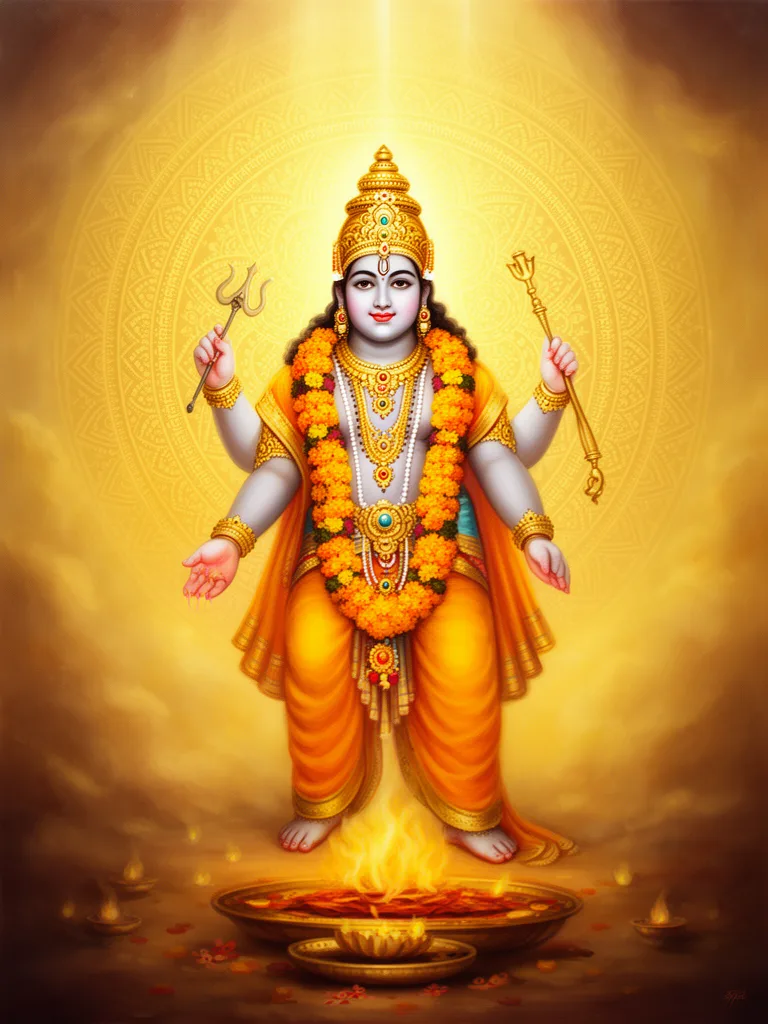
Yajna is a Vedic ritual of offering, typically involving fire, symbolizing sacrifice, communion with the divine, and the maintenance of cosmic order. It's a foundational practice in Hinduism, connecting the earthly and celestial realms through sacred action and invocation.
Where the word comes from
The Sanskrit term "Yajna" (यज्ञ) derives from the root "yaj," meaning "to sacrifice," "to worship," or "to offer." It signifies a ritualistic act of devotion and communion, central to Vedic traditions and appearing in ancient texts like the Rigveda.
In depth
"Sacrifice", whose symbol or representation is now the constellation ^Irij^a-sliiras (deer-head), and also a form of Vishnu. "The Yajna", say the Brahnians. "exists from eternity, for it proceeded from the Supreme, in whom it lay dormant from no hcffinning". It is the key to the Trai-VUJya, the thrice sacred .science contained in the RiqVeda verses in his Introduction to the Aitarerja Brdhmana — the Yajna exists as an invisible presence at all times, extending from the Ahavamya or .sacrificial fire to the heavens, forming a bridge or ladder by means of which the sacrificer can communicate with tlie world of devas, "and even ascend when alive to their abodes". It is one of the forms of Akasa. within which the mystic Word (or its underlying "Sound") calls it into existence. Pronounced by the Priest-Initiate or Yogi, this Word receives creative powers, and is communicated as an impulse on the t(^rre.strial plane through a trained WUl-powfr. Yakin and Boaz (Hrh.). A Kabbalistic and ^lasonic symbol. Tlic two pillars of bronze (Yakin, male and white; Boaz, female and red), ca.st by Hiram Abif of Tyre, called "the Widow's Son", for Solomon's supposed (^lasonic) Temj^le. Yakin was the syml)ol of Wisdom (Chokmah), the second Sepliii-a ; and Boaz, that of Intelligence (Binah) ; the temple between the two being regarded as Krthfr, the crown. Pather^lother.
How different paths see it
What it means today
The term Yajna, as understood in the Vedic tradition, offers a profound lens through which to view the nature of action and its spiritual resonance. Blavatsky's reference to it as a "sacrifice" is accurate, yet it barely scratches the surface of its intricate meaning. Yajna is not simply an act of giving something up, but a dynamic process of transformation and connection. Mircea Eliade, in his seminal work "The Myth of the Eternal Return," discusses how rituals like Yajna serve to re-enact primordial cosmic events, thereby renewing the world and grounding the participants in sacred time.
The sacrificial fire, the Agni, is not merely a physical element but a divine messenger, a transformer of offerings into spiritual sustenance. The act of Yajna is a form of sacred labor, a participation in the ongoing creation and maintenance of the cosmos. It is, as the Brahmins state, something that "exists from eternity," implying it is an inherent principle of existence, not merely an invention of human practice. This resonates with Carl Jung's concept of the archetype, the universal patterns of the psyche that manifest in ritual and myth. The sacrificer, through the precise performance of Yajna, becomes an agent of cosmic will, aligning their actions with the divine order.
The idea of Yajna as a "bridge or ladder" to the world of devas is particularly evocative. It suggests that human intention, when properly channeled through ritual, possesses the power to transcend the ordinary limitations of space and time. This is not dissimilar to the contemplative practices found in other traditions, where focused meditation or prayer is seen as a means of ascending to higher states of consciousness. The "mystic Word" or "Sound" that Blavatsky mentions, which calls Yajna into existence, points towards the power of mantra and sacred utterance, a concept deeply explored in Eastern spiritualities and even echoed in the Gnostic emphasis on the Logos. The trained "Will-power" further underscores the active, participatory nature of Yajna; it requires discipline, focus, and a deep understanding of the spiritual mechanics involved.
Ultimately, Yajna invites us to consider our actions not as isolated events, but as potential points of sacred engagement, capable of forging connections and contributing to the grander cosmic dance.
Related esoteric terms
Books on this concept








No reflections yet. Be the first.
Share your interpretation, experience, or question.
