Varna
Varna, meaning "color" in Sanskrit, refers to the traditional fourfold social division in Hinduism, historically linked to occupation and spiritual duty. These varnas are the Brahmins (priests and scholars), Kshatriyas (warriors and rulers), Vaishyas (merchants and farmers), and Shudras (laborers and servants). It's distinct from the more rigid, hereditary *jati* system.
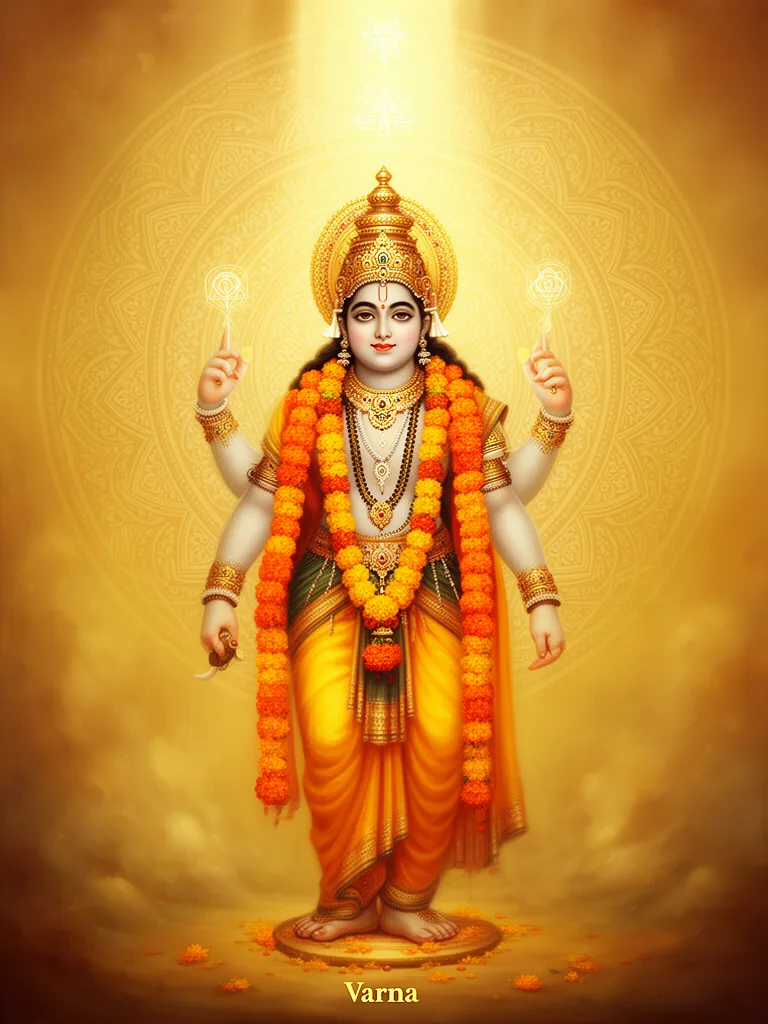
Where the word comes from
The Sanskrit word varna (वर्ण) literally translates to "color," "hue," or "class." Its earliest occurrences in Vedic literature suggest a distinction, possibly social or racial, that evolved into the concept of four principal social orders. The term’s roots are ancient, appearing in texts like the Rigveda, and its interpretation has been a subject of continuous scholarly debate.
In depth
Caste; lit., "colour"'. The four chief ca.stes named t»y Manu — the lirnlnniu Kshatri\a. Vaisya ami Sudra — are called (liatiir-rarna.
How different paths see it
What it means today
The term Varna, translating to "color," carries a resonance that echoes through centuries of Indian thought, hinting at distinctions that were perhaps once more fluid than the rigid caste system that later solidified. While Blavatsky’s definition points to the four chief castes—Brahmin, Kshatriya, Vaishya, and Shudra—it’s crucial to apprehend the conceptual distance between the ancient Varna ideal and the hereditary jati system that often became its brutal manifestation. The Varna system, as envisioned in early Vedic texts and elaborated in scriptures like the Bhagavad Gita, was intended as a framework of social organization based on guna (quality) and karma (action), rather than solely on lineage. Krishna, in the Gita, famously states, "I have created the four Varnas according to the division of guna and karma," suggesting a dynamic, meritocratic ideal where individuals were placed according to their inherent nature and their chosen path. This was not merely about occupation but about a spiritual calling, a specific role in the grand cosmic play. The Brahmin, attuned to wisdom and ritual; the Kshatriya, embodying courage and governance; the Vaishya, fostering prosperity and trade; and the Shudra, serving with diligence and skill—each was seen as a vital limb of the social body, contributing to the well-being of the whole. Mircea Eliade, in his explorations of archaic societies, often highlighted the significance of functional divisions that maintained cosmic order. The Varna system, in its theoretical form, sought to mirror this cosmic order on the human plane. However, the historical accretion of privilege and the ossification of these divisions into hereditary, impermeable castes, often enforced by social and religious sanctions, tragically distorted this original intent. The "color" in Varna, therefore, becomes a potent metaphor, not just for superficial distinctions, but for the differing energetic and spiritual qualities that were believed to characterize each social stratum, a concept that resonates, albeit distantly, with Jung's ideas of archetypal roles and the collective unconscious. Understanding Varna requires acknowledging both its aspirational philosophical underpinnings and its problematic historical evolution, a tension that continues to shape discourse on identity and social justice in India today. It invites us to consider how systems of social organization, even those with spiritual intentions, can become instruments of division when divorced from their foundational principles of inherent worth and equitable contribution.
Related esoteric terms
Books on this concept








No reflections yet. Be the first.
Share your interpretation, experience, or question.
