Tibet
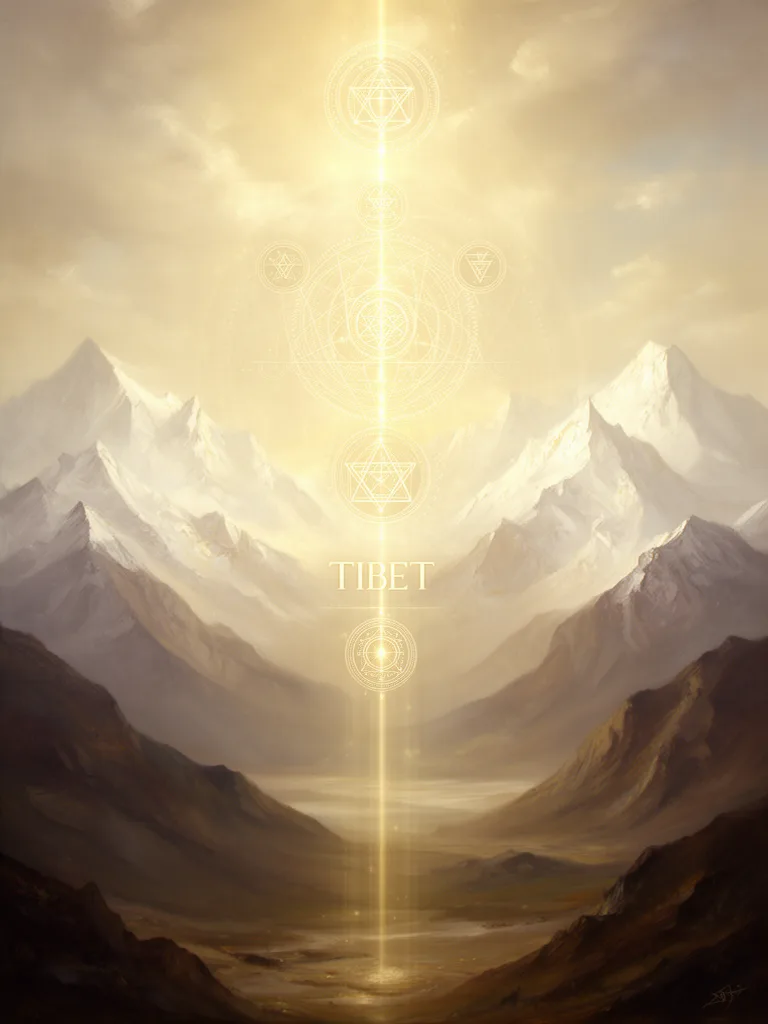
Tibet, often referred to as the "Roof of the World," is a high-altitude plateau in Central Asia, historically a region of profound spiritual and philosophical significance, particularly for Vajrayana Buddhism. Its unique geography and isolation fostered a rich tradition of contemplative practices, esoteric knowledge, and monastic institutions that have captivated the Western imagination.
Where the word comes from
The name "Tibet" likely derives from the Tibetan word "Thö-pa," meaning "hidden," or from the Turkic "T'u-bo," referring to the region. Its ancient Sanskrit name was "Bhotanta," meaning "end of India." The region's self-designation is "Bod," and its people are "Bodpa." The term gained wider Western currency through early explorers and scholars.
In depth
Nebo (Chald.). The same as the Hindu Budha, son of Soma the :\Iooii, and Mercury the planet. (See "Nabu".)
How different paths see it
What it means today
The very mention of Tibet conjures images of soaring peaks, ancient monasteries clinging to precipitous cliffs, and the resonant hum of mantras. For centuries, this remote plateau, often called the "Land of Snows," has served as a sanctuary for a unique and profound spiritual tradition. Mircea Eliade, in his seminal work on shamanism, recognized the deep roots of ecstatic practices that found fertile ground in such isolated, spiritually charged environments. Tibet's isolation, a geographical imperative, became a crucible for the evolution of Vajrayana Buddhism, a path that distinguishes itself through its intricate philosophical systems and potent yogic techniques.
H.P. Blavatsky, in her own expansive work, frequently referenced Tibetan wisdom, often linking it to more ancient, esoteric streams of knowledge. She saw in its practices a living connection to primal spiritual truths, a notion echoed by scholars like Giuseppe Tucci, who dedicated his life to understanding Tibetan art, history, and religion. The Tibetan approach to spirituality is not one of passive contemplation alone; it is deeply active, involving rigorous mental training, visualization, and the cultivation of inner energies. The figure of the yogi, the adept who can master their own mind and body, is central. This is not about escaping the world, but about transforming one's perception of it, a concept that resonates with modern psychological insights, as explored by Carl Jung in his studies of archetypes and the collective unconscious.
The philosophical underpinnings, particularly the concept of emptiness (shunyata), as elaborated by Nagarjuna and later masters, offer a radical re-framing of reality, challenging our ingrained notions of self and substance. This philosophical depth, married to practical methods like the tantric practices described by Lama Anagarika Govinda, provides a comprehensive system for spiritual realization. The emphasis on compassion (karuna) as the active principle of wisdom is particularly striking, suggesting that true enlightenment is inseparable from a profound engagement with the suffering of all beings. In a world increasingly fractured and individualized, Tibet's legacy offers a potent reminder of the interconnectedness of all things and the transformative power of dedicated spiritual pursuit. The enduring question it poses is whether such a deeply integrated spiritual life can find resonance beyond its geographical cradle.
Related esoteric terms
Books on this concept







No reflections yet. Be the first.
Share your interpretation, experience, or question.
