Soul
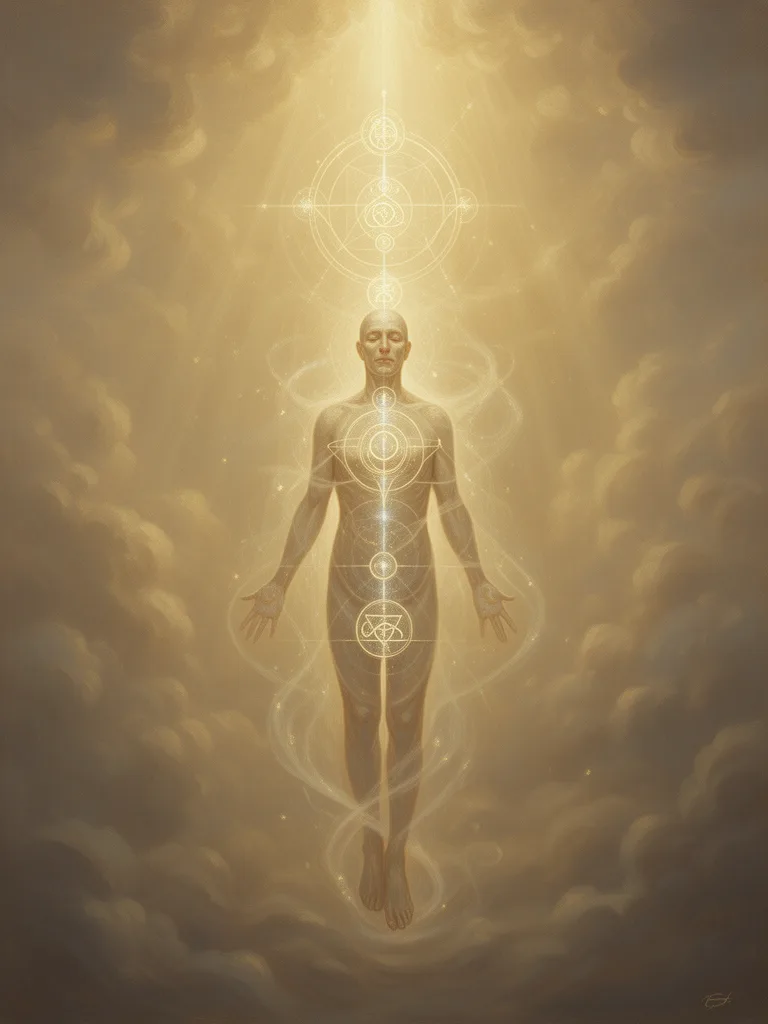
The animating principle of life, encompassing consciousness, vitality, and individuality, often considered distinct from the physical body and capable of survival after death. It is the seat of emotions, intellect, and the will.
Where the word comes from
The English word "soul" derives from Old English "sáwol," tracing back to Proto-Germanic "*saiwalō." Its ultimate Indo-European root is debated but may relate to concepts of "to bind" or "to tear," suggesting an essence that is both connected and distinct.
In depth
The ^'^'X''^' or ncphcsh of the Bible; the vital principle, or the breath of life, which every animal, down to the infusoria, shares w'ith man. lu the translated Bible it stands indifferently for life, blood and soul, "Let us not kill his nephesh^\ says the original text: "let us not kill him'\ translate the Christians (Genesis xxxvii, 21), and so on.
How different paths see it
What it means today
The concept of the soul, as Blavatsky’s definition hints with its reference to the Hebrew "nephesh," is a protean entity woven through the fabric of human thought, a persistent echo of our quest for meaning beyond the visible. It is not merely an abstract theological notion but a deeply personal locus of experience, the perceived seat of our inner lives. Mircea Eliade, in his studies of the sacred, noted how the soul's perceived journey, whether to the underworld or to celestial realms, reflects humanity's fundamental orientation towards the cosmos and its own place within it. Carl Jung, in his exploration of the psyche, saw the soul as the totality of psychic processes, both conscious and unconscious, a dynamic interplay that shapes our individual destiny and collective unconscious.
The "vital principle" Blavatsky mentions resonates with the ancient understanding of anima, the breath of life that animates all beings. This is not just biological function but a qualitative essence, a spark of awareness. In Sufism, the struggle with the nafs, the lower self, is a testament to the soul's capacity for both degradation and elevation, a battlefield where the divine and the mundane contend. D.T. Suzuki, in illuminating Buddhist thought, would point out that while a permanent soul is rejected, the continuity of consciousness, the karmic stream, offers a different perspective on what endures. For the Hindu, the Atman is the ultimate reality, a profound identification with the Absolute, a realization that the individual spark is the cosmic fire.
The soul, in its myriad interpretations, serves as a potent symbol for the ineffable aspects of human existence: consciousness, identity, and the yearning for transcendence. It is the canvas upon which our deepest fears and most soaring hopes are painted, a concept that continues to beckon us toward introspection and a deeper understanding of our own mysterious being. The exploration of the soul, therefore, is not merely an academic pursuit but a vital engagement with the very essence of what it means to be alive.
Related esoteric terms
Books on this concept






No reflections yet. Be the first.
Share your interpretation, experience, or question.
