Sod
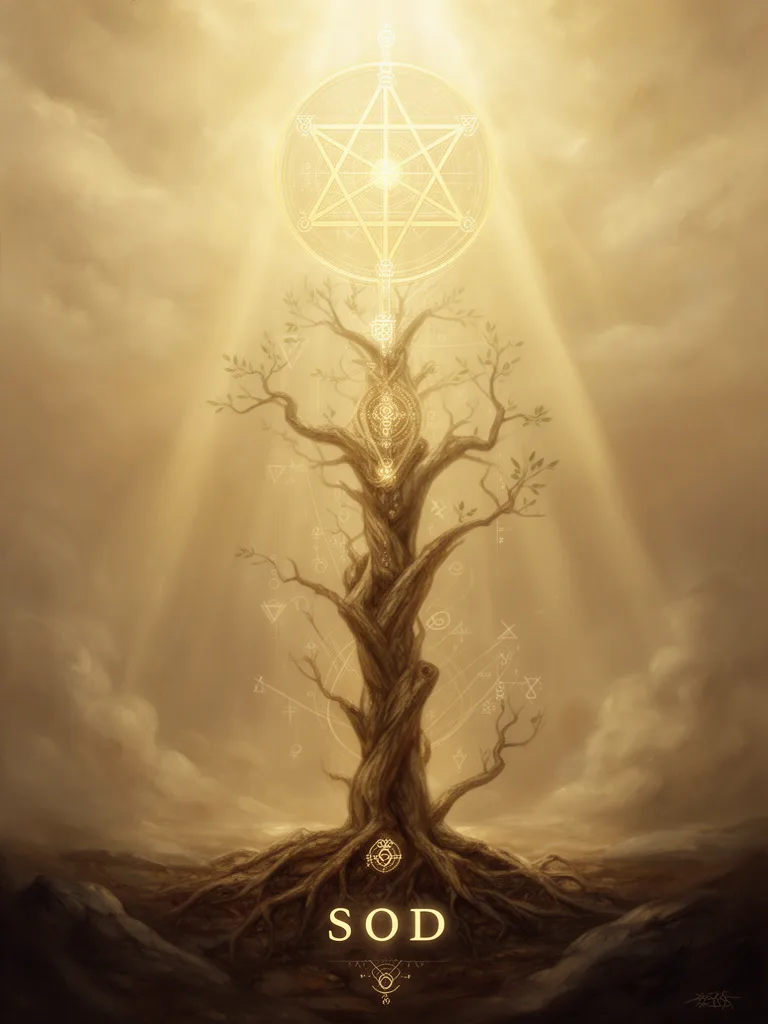
Sod refers to a hidden or secret knowledge, often of a mystical or religious nature. It signifies an inner circle of understanding, a mystery guarded from the uninitiated, particularly within ancient Jewish traditions.
Where the word comes from
The term "Sod" originates from the Hebrew word "sod" (סוֹד), meaning "secret," "council," or "confidant." It implies a hidden counsel or a deeply guarded mystery, suggesting a level of esoteric knowledge shared among an select group.
In depth
An "Arcanum", or religious mystery. The Mysteries of Baal, Adonis and Bacclius, all snn-gods having serpents as syml)ols. or, as in tlie ease of Mithra, a "solar serpent". The ancient Jews had their Sod also, symbols not excluded, since they had the "brazen .serpent" lifted in the Wilderness, which particular serpent was the Persian Mithra, tlie symbol of Moses as an Initiate, but was certainly never meant to represent the historical Christ. "The secret (Sod) of the Lord is with them tliat fear him", says David, in Psalm xxv., 14. But this reads in tiie original Hebrew, "Sod Ihoh (or the Mysteries) of Jehovah are for those who fear him". So terribly is the Old Testament mistranslated, that verse 7 in Psahti Ixxxix.. which stands in the orifrinal "Al (El) is terrible in the great Sod of the Kcdcshim" (the Galli, the priests of the inner Jewish mysteries), reads now in the mutilated translation "God is greatly to be feared in the asscmhhj of the saints". Simeon and Levi held their Sod, and it is repeatedly mentioned in the Bible. "Oh my soul," exclaims the dying Jacob, "come not thou into their secret {Sod, in the orig.), unto their assembly", i.e.. into the Sodality of Simeon and Levi {Gen. xlix., 6). (See Dunlap, Sod, ih' M II st erics of Adani.)
How different paths see it
What it means today
The term "Sod," as presented by Blavatsky, invites us into the ancient practice of guarding sacred knowledge, a tradition deeply embedded in the human impulse to seek what lies beyond the ordinary. It speaks to the existence of an inner circle of understanding, a sanctuary of wisdom accessible not through casual inquiry, but through a specific orientation of the soul. The Hebrew root, "sod," meaning council or secret, immediately conjures images of hushed discussions in dimly lit chambers, of whispered revelations passed from initiate to initiate.
This concept is not unique to the ancient Near East. Mircea Eliade, in his seminal works on the history of religions, often pointed to the universal human need for initiatory rites and the transmission of sacred lore. The "Sod" aligns with this, suggesting that certain truths about the cosmos and the divine are not meant for public broadcast but are reserved for those who have undergone a transformation, a spiritual "fear" or reverence that prepares them to receive such profound insights. The allusion to the "brazen serpent" in the wilderness, a symbol Blavatsky connects to Mithra and Moses, highlights how even seemingly simple biblical narratives can hold layers of esoteric meaning, a "secret of the Lord" hidden within plain sight.
The danger, as Jacob's warning to his soul suggests, lies in mistaking the outer form for the inner essence, or in allowing the "Sod" to become a tool of exclusion rather than a gateway to deeper communion. The corruption of these mysteries, as Blavatsky implies with the mistranslation of Psalm lxxxix., is a recurring theme in spiritual history, where the profound becomes the mundane, and the sacred council devolves into a mere assembly. The modern seeker, encountering the concept of "Sod," might find resonance in the contemplative practices that aim to access a direct apprehension of reality, a knowing that bypasses the intellect and speaks directly to the spirit, much like the "Sod" of the ancient mystics. It reminds us that the deepest wisdom is often found not in accumulation of facts, but in the quiet cultivation of a receptive heart.
RELATED_TERMS: Gnosis, Esotericism, Mysticism, Initiation, Kabbalah, Torah, Inner Meaning, Sacred Knowledge
Related esoteric terms
Books on this concept








No reflections yet. Be the first.
Share your interpretation, experience, or question.
